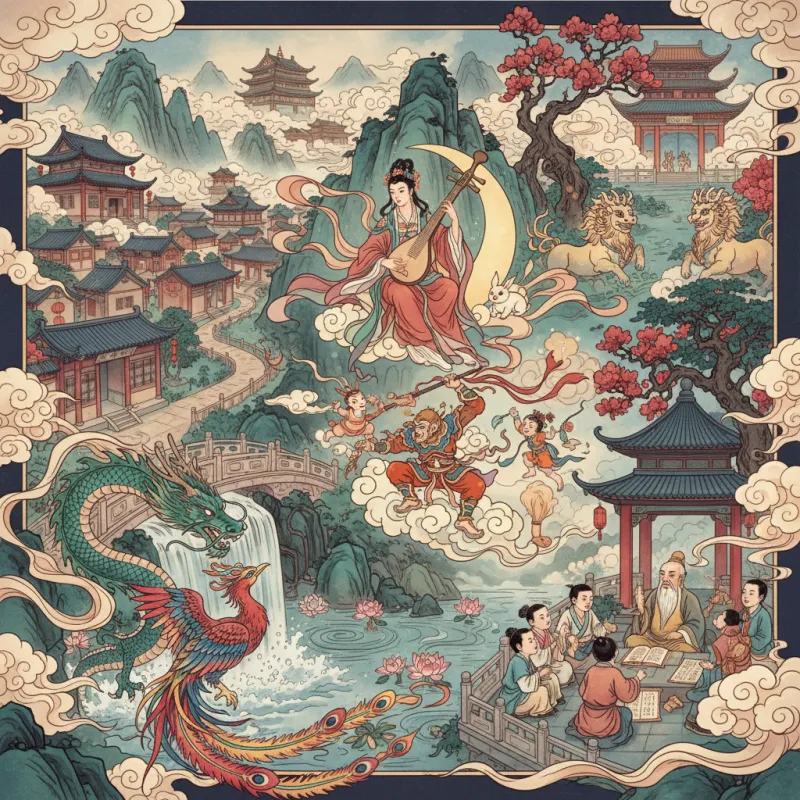
Picture this: A farmer in rural Sichuan pours tea for a guest, carefully filling the cup only seven-tenths full. A businessman in Shanghai consults the Yijing (易经, Book of Changes) before signing a contract. A grandmother in Beijing arranges her furniture according to fengshui (风水) principles she learned from her mother, who learned from hers. These aren't quaint traditions or superstitions — they're living expressions of philosophical systems that have shaped human civilization for over three millennia.
Chinese culture isn't a museum piece. It's a breathing, evolving organism that has survived dynasties, revolutions, and modernization precisely because its core ideas are flexible enough to adapt while remaining fundamentally unchanged. Understanding it requires abandoning the Western impulse to categorize everything into neat boxes. In Chinese thought, philosophy bleeds into religion, which flows into art, which circles back to daily life. Everything connects.
The Three Teachings: Philosophy as a Way of Life
When people talk about Chinese philosophy, they usually mean the "Three Teachings" (sanjiao, 三教): Confucianism, Daoism, and Buddhism. But here's what textbooks miss — most Chinese people don't pick one. They blend all three depending on context, like switching between apps on a phone.
Confucianism (Rujia, 儒家) handles your social life. It's the operating system for family relationships, government, and education. Confucius (551-479 BCE) wasn't trying to create a religion; he was solving a practical problem: how do you create social harmony in a chaotic world? His answer: through ren (仁, benevolence), li (礼, ritual propriety), and xiao (孝, filial piety). When that Sichuan farmer pours tea with both hands, he's performing li. When the Shanghai businessman honors his parents' wishes even when he disagrees, that's xiao.
Daoism (Daojia, 道家) takes over when Confucianism gets too rigid. Founded by the possibly-mythical Laozi around the 6th century BCE, Daoism says: stop trying so hard. The Dao (道, the Way) is the natural flow of the universe, and wisdom means aligning with it rather than fighting it. The Daodejing (道德经) is only 5,000 characters, but it's influenced everything from Chinese medicine to martial arts to landscape painting. That seven-tenths-full teacup? It leaves room for the guest to add more — a Daoist principle of incompleteness that allows for growth.
Buddhism arrived from India around the 1st century CE and got thoroughly Sinicized. Chinese Buddhism absorbed Daoist concepts and Confucian ethics, creating unique schools like Chan (禅, Zen in Japanese). The result is a Buddhism that emphasizes sudden enlightenment and finding Buddha-nature in everyday activities — sweeping floors, chopping vegetables, drinking tea. This is why Chinese culture can simultaneously embrace ancestor worship (very un-Buddhist) and Buddhist temples (very un-Confucian) without seeing any contradiction.
Family: The Unbreakable Unit
If you want to understand why Chinese culture has survived so long, look at the family structure. In the West, the individual is the basic social unit. In China, it's the family — and not just your immediate family, but your entire lineage stretching back generations and forward to descendants not yet born.
This isn't sentimentality; it's a sophisticated social technology. The jiazu (家族, extended family clan) system created networks of mutual obligation that functioned as social safety nets, business partnerships, and political alliances. Even today, when a Chinese person introduces themselves, they often mention their hometown and family background before their personal achievements.
The concept of mianzi (面子, face) makes no sense outside this family context. "Face" isn't just personal reputation — it's the honor of your entire lineage. This is why Chinese parents push their children so hard academically: your success or failure reflects on everyone who shares your surname. It's also why gift-giving is so elaborate and why refusing a favor can be insulting. You're not just interacting with an individual; you're negotiating between two family networks.
Language: Writing That Transcends Sound
Chinese characters (hanzi, 汉字) are the only writing system from the ancient world still in daily use. They're not an alphabet — they're logograms, where each character represents a meaning rather than a sound. This has profound implications.
First, it means Chinese culture could spread across regions with completely different spoken languages. A Cantonese speaker and a Mandarin speaker might not understand each other's speech, but they can read the same newspaper. This written unity helped hold together an empire larger than Europe.
Second, characters carry layers of meaning that alphabetic writing can't match. The character for "good" (好) combines "woman" (女) and "child" (子) — a mother with her child. "Peace" (安) shows a woman under a roof. These aren't just etymological curiosities; they're embedded cultural values that native speakers absorb unconsciously.
The four-character idiom (chengyu, 成语) is where this really shines. Phrases like huà shé tiān zú (画蛇添足, "drawing legs on a snake") pack entire stories and moral lessons into four syllables. There are over 5,000 common chengyu, and educated Chinese people deploy them constantly in speech and writing. They're cultural DNA, transmitting wisdom across centuries.
Food: Philosophy on a Plate
Chinese food culture is inseparable from Chinese medicine, which is inseparable from Daoist philosophy. The concept of yinyang (阴阳) — complementary opposites in dynamic balance — governs everything from ingredient pairing to cooking methods.
Hot foods (re, 热) like ginger and lamb must balance cold foods (leng, 冷) like cucumber and watermelon. Cooking methods matter: stir-frying is yang (active, hot), while steaming is yin (passive, cool). A proper meal isn't just nutritious; it's therapeutically balanced. This is why Chinese people drink hot water even in summer — it balances the body's internal temperature.
Regional cuisines reflect geography and philosophy. Sichuan food's famous spiciness comes from málà (麻辣, numbing-spicy) peppercorns that create a tingling sensation — a Daoist embrace of paradox and complexity. Cantonese cuisine emphasizes freshness and natural flavors, letting ingredients speak for themselves. Northern wheat-based foods versus southern rice-based foods created distinct cultural identities that persist today.
The communal dining style — shared dishes in the center, everyone taking from the same plates — reinforces Confucian values of family unity and hierarchy. The host serves guests first, elders before youth, guests before family. Even the lazy Susan (cānzhuō zhuànpán, 餐桌转盘) is a technological solution to Confucian etiquette.
Festivals: The Rhythm of the Year
The Chinese calendar is lunisolar, tracking both moon phases and solar seasons. This creates a festival cycle that connects human activity to cosmic rhythms — very Daoist, very Chinese.
Chūnjié (春节, Spring Festival, commonly called Chinese New Year) isn't just a holiday; it's a complete system reset. Debts are paid, houses are cleaned, families reunite. The tradition of giving red envelopes (hóngbāo, 红包) with money transfers luck and prosperity between generations. Firecrackers scare away evil spirits — specifically Nián (年), a mythical beast that terrorized villages until people discovered it feared loud noises and the color red.
Qīngmíng Jié (清明节, Tomb Sweeping Day) in early April is when families visit ancestral graves, clean the tombstones, and make offerings. This isn't morbid — it's maintaining the connection between living and dead that Confucianism considers essential. Your ancestors aren't gone; they're part of your ongoing family story.
The Mid-Autumn Festival (Zhōngqiū Jié, 中秋节) celebrates the harvest moon with mooncakes (yuèbǐng, 月饼) — dense pastries filled with lotus seed paste or red bean. The round shape symbolizes family completeness. During the Yuan Dynasty (1271-1368), rebels hid messages inside mooncakes to coordinate an uprising against Mongol rule. Even pastries have revolutionary history.
Arts: Capturing the Dao
Chinese arts aren't about realistic representation — they're about capturing qìyùn (气韵, spirit resonance), the vital energy that animates all things. This is why traditional Chinese painting looks "unfinished" to Western eyes. The empty space (liúbái, 留白) isn't absence; it's where the qi (气, vital energy) flows.
Calligraphy (shūfǎ, 书法) is considered the highest art form because it combines visual beauty, literary meaning, and the calligrapher's qi in the moment of creation. The same character written by different people expresses different energies. Emperor Huizong of Song (1082-1135) created a distinctive "Slender Gold" style that's still recognizable today — his personality frozen in brushstrokes.
Chinese opera (xìqǔ, 戏曲) uses highly stylized movements where every gesture has specific meaning. A general stroking his beard shows contemplation. A woman covering her face with a sleeve indicates shyness. The painted faces (liǎnpǔ, 脸谱) in Beijing Opera are color-coded: red for loyalty, white for treachery, black for integrity. You can read a character's personality before they speak.
The guqin (古琴, seven-string zither) is the instrument of scholars and sages. It's not for entertainment — it's for self-cultivation. The Yōulán (幽兰, Solitary Orchid) melody dates to the 6th century and sounds like meditation made audible. Playing guqin badly is considered worse than not playing at all; it pollutes the qi.
Martial Arts: Moving Meditation
Chinese martial arts (wǔshù, 武术) are applied philosophy. The "internal" styles like tàijíquán (太极拳, Tai Chi) and bāguàzhǎng (八卦掌, Eight Trigram Palm) are moving Daoism — they teach you to redirect force rather than meet it head-on, to be like water that flows around obstacles.
The concept of nèigōng (内功, internal power) distinguishes Chinese martial arts from purely physical fighting systems. You're not just training muscles; you're cultivating qi through breathing, meditation, and specific movements. This is why elderly taiji practitioners can generate surprising power — they're using whole-body integration and energy flow, not muscular strength.
The Shaolin Temple connection to Chan Buddhism created martial arts as spiritual practice. The monks weren't training to fight; they were using physical discipline to achieve mental clarity. The famous "72 Shaolin Arts" include techniques like Iron Head and Iron Palm, but also meditation practices and herbal medicine. Fighting ability was a side effect of spiritual cultivation.
Modern Transformations: Continuity and Change
The 20th century tried to destroy traditional Chinese culture. The May Fourth Movement (1919) blamed Confucianism for China's weakness. The Cultural Revolution (1966-1976) systematically attacked the "Four Olds" — old customs, old culture, old habits, old ideas. Red Guards burned books, destroyed temples, and persecuted anyone associated with traditional culture.
But here's the thing about culture that's 5,000 years old — it's resilient. The philosophical foundations survived because they're embedded in language, family structures, and daily practices that no political movement could fully eradicate. Today, there's a massive revival of interest in traditional culture among young Chinese people. Hanfu (汉服, traditional Han clothing) is trendy. Classical poetry is popular on social media. People are rediscovering what was nearly lost.
The challenge now is integration. How do you maintain cultural identity while embracing modernity? How do you honor ancestors while thinking independently? How do you balance Confucian hierarchy with democratic values? These aren't abstract questions — they're playing out in millions of individual lives.
Chinese culture isn't a fixed thing you can learn and check off a list. It's a living conversation spanning millennia, and you're invited to join. Start anywhere — with a cup of tea, a martial arts class, a classic novel like Journey to the West. Follow your curiosity deeper. The more you learn, the more connections you'll see, until you realize that understanding Chinese culture isn't about memorizing facts. It's about recognizing patterns that have shaped how a quarter of humanity sees the world.
And maybe, just maybe, those patterns will change how you see it too.
Related Reading
- Yin and Yang Explained: Beyond the Black and White Symbol
- Zhuangzi's Butterfly Dream: What Is Reality?
- Mencius on Human Nature: Are We Born Good?
- Laozi and the Tao Te Ching: A Practical Guide
- Chinese Philosophy for Beginners: Confucius, Laozi, and Zhuangzi Walk Into a Bar
- The Century of Humiliation: How China Remembers
- Qi: The Concept That Runs Chinese Culture
- Jade in Chinese Culture: The Stone of Heaven
Explore Chinese Culture
- Explore feng shui in daily life
- Explore supernatural folklore
- Explore classical Chinese literature