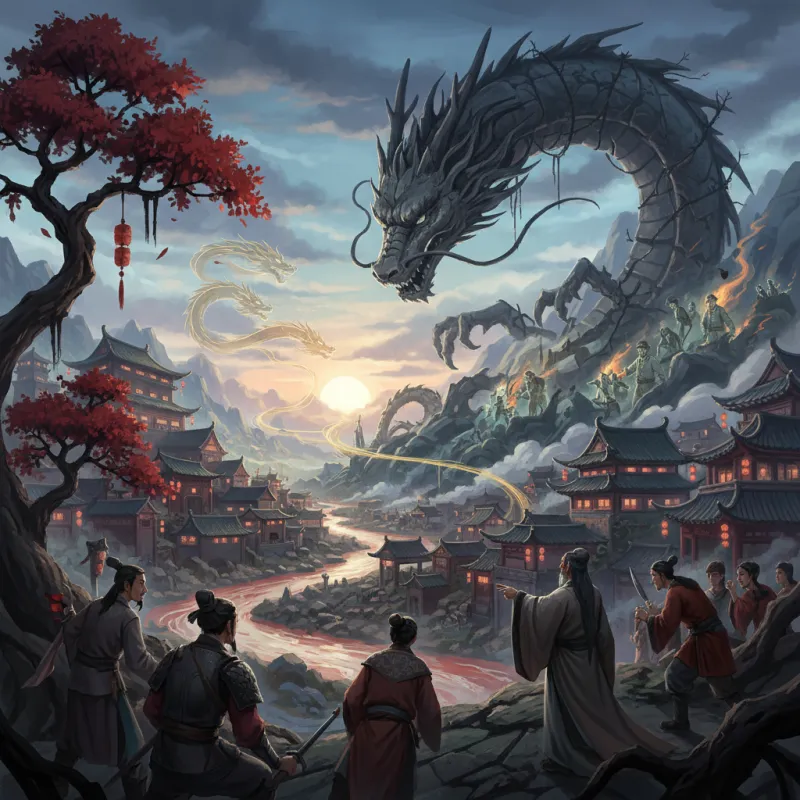
The opium smoke drifted through Canton's harbor in 1839 as Commissioner Lin Zexu watched 20,000 chests of British opium dissolve into trenches of lime and salt water. He thought he was defending China's sovereignty. The British thought he was destroying their property. Three years later, China had lost its first war in centuries, ceded Hong Kong, and opened five ports to foreign trade under gunpoint. Lin Zexu died in exile, his anti-drug campaign remembered not as heroism but as the spark that ignited China's darkest century.
This is where the Century of Humiliation (百年国耻, bǎinián guóchǐ) begins — not with a bang, but with a bonfire of narcotics that backfired spectacularly. For the next 110 years, from 1839 to 1949, China would experience what its modern government calls the defining trauma of the nation: repeated military defeats, territorial losses, unequal treaties, and the systematic dismantling of Chinese sovereignty by foreign powers. It's the historical wound that never quite healed, the collective memory that shapes everything from China's foreign policy to its domestic nationalism today.
The Opium Wars: When Trade Became Warfare
The First Opium War (1839-1842) wasn't really about opium — it was about who controlled trade, and by extension, who controlled China's relationship with the outside world. For centuries, the Qing Dynasty had maintained a tribute system where foreign nations acknowledged Chinese superiority in exchange for trading privileges. The British East India Company found this arrangement insufferable, especially since China only wanted silver in exchange for tea, silk, and porcelain.
The solution? Flood China with opium from British-controlled India. By the 1830s, millions of Chinese were addicted, silver was flowing out of China instead of in, and the Qing government was desperate. Lin Zexu's destruction of British opium in Canton gave Britain the pretext it needed. The Royal Navy's steam-powered warships demolished Chinese coastal defenses. The Treaty of Nanking (1842) forced China to pay reparations, open treaty ports, and grant Britain "most favored nation" status — meaning any concession China gave to another power automatically applied to Britain too.
The Second Opium War (1856-1860) was even worse. British and French forces burned the Old Summer Palace (圆明园, Yuánmíngyuán) — a sprawling complex of palaces, gardens, and libraries that represented the pinnacle of Qing cultural achievement. The destruction was deliberate, punitive, and traumatic. Today, the ruins remain unrestored in Beijing, a permanent reminder of foreign aggression. China was forced to legalize opium, open more ports, allow foreign diplomats in Beijing, and cede more territory. The Qing Dynasty's claim to be the "Middle Kingdom" (中国, Zhōngguó) — the center of civilization — was shattered.
The Carving of the Melon: Foreign Concessions and Spheres of Influence
After the Opium Wars, the floodgates opened. Foreign powers descended on China like diners at a buffet, each claiming their slice. This period is often called "the carving of the Chinese melon" (瓜分中国, guāfēn Zhōngguó), and the metaphor is apt — China was treated as an object to be divided, not a sovereign nation to be respected.
Germany seized Qingdao in 1897. Russia took Port Arthur. France claimed Guangzhou Bay. Britain expanded its holdings in Hong Kong and claimed the Yangtze River valley as its sphere of influence. Japan, newly modernized and eager to prove itself, defeated China in the First Sino-Japanese War (1894-1895) and took Taiwan, the Pescadores Islands, and effective control of Korea. The Treaty of Shimonoseki was particularly humiliating because China lost to an Asian neighbor it had historically considered inferior — a student surpassing and then beating its teacher.
Within China's own borders, foreign concessions operated as mini-colonies. Shanghai's International Settlement and French Concession had their own police forces, courts, and laws. Chinese citizens could be arrested in their own country by foreign police and tried under foreign law. The famous "No Dogs or Chinese Allowed" sign — whether it literally existed or not — captures the spirit of extraterritoriality (治外法权, zhìwài fǎquán), where foreigners in China were above Chinese law. The psychological impact of being a second-class citizen in your own land cannot be overstated.
The Boxer Rebellion: Resistance and Retaliation
By 1900, anti-foreign sentiment had reached a boiling point. The Boxers (义和团, Yìhétuán, literally "Righteous and Harmonious Fists") were a peasant movement that practiced martial arts and believed they were invulnerable to bullets through spiritual rituals. They attacked foreign missionaries, Chinese Christians, and railway lines — symbols of foreign intrusion. "Support the Qing, destroy the foreign" (扶清灭洋, fú Qīng miè yáng) was their slogan.
The Qing court, desperate and delusional, threw its support behind the Boxers and declared war on eight foreign powers simultaneously. It went as badly as you'd expect. An eight-nation alliance (Britain, France, Germany, Russia, Japan, the United States, Italy, and Austria-Hungary) marched on Beijing, defeated the Boxers, and occupied the capital. The Empress Dowager Cixi fled in disguise. Foreign troops looted the Forbidden City. The Boxer Protocol of 1901 imposed crushing reparations — 450 million taels of silver, to be paid over 39 years with interest, totaling nearly one billion taels. China's customs revenue was placed under foreign supervision to ensure payment.
The Boxer Rebellion is remembered in China not as a xenophobic uprising but as a patriotic resistance movement crushed by foreign aggression. The fact that the Boxers were superstitious, violent, and strategically incompetent is less emphasized than their anti-imperialist spirit. This selective memory is characteristic of how the Century of Humiliation is taught — foreign aggression is highlighted, domestic failures are downplayed or reframed as resistance.
The Fall of the Qing and the Warlord Era
The Qing Dynasty limped through its final decade, attempting reforms that were too little, too late. The 1911 Revolution, led by Sun Yat-sen, overthrew the last emperor and established the Republic of China. But the revolution didn't end the humiliation — it arguably made things worse. Without a strong central government, China fragmented into territories controlled by warlords, each with their own armies and agendas.
The Treaty of Versailles in 1919 was supposed to mark China's entry into the community of nations as a victor of World War I. Instead, the treaty transferred Germany's concessions in Shandong Province to Japan rather than returning them to China. The May Fourth Movement erupted in response — students in Beijing protested, intellectuals called for modernization, and a new generation rejected both traditional Confucian culture and foreign imperialism. The movement's slogan, "Mr. Science and Mr. Democracy" (赛先生和德先生, Sài xiānsheng hé Dé xiānsheng), captured the desire to strengthen China through Western ideas while rejecting Western domination.
The irony wasn't lost on anyone: China had sent laborers to support the Allied war effort, and this was the thanks it received. The sense of betrayal deepened the national wound and radicalized a generation of intellectuals, including a young library assistant named Mao Zedong.
The Japanese Invasion: The Deepest Cut
If the Opium Wars began the Century of Humiliation, the Japanese invasion from 1931 to 1945 was its nadir. Japan's seizure of Manchuria in 1931, the Marco Polo Bridge Incident in 1937, and the subsequent full-scale invasion brought unprecedented brutality. The Nanjing Massacre (南京大屠杀, Nánjīng Dàtúshā) in December 1937 saw Japanese troops murder an estimated 200,000 to 300,000 Chinese civilians and prisoners of war over six weeks. Rape, torture, and looting were systematic.
The Japanese occupation was different from earlier foreign incursions. The British, French, and Germans wanted trade and concessions; Japan wanted to colonize and subjugate. The puppet state of Manchukuo, the collaborationist government in Nanjing under Wang Jingwei, and the brutal "Three Alls Policy" (三光政策, sānguāng zhèngcè — "kill all, burn all, loot all") in rural areas demonstrated Japan's intent to erase Chinese sovereignty entirely.
China's resistance during World War II is a source of immense pride, but it came at a staggering cost: an estimated 15 to 20 million Chinese deaths. The war united the Nationalist government under Chiang Kai-shek and the Communist forces under Mao Zedong in an uneasy alliance, though both sides were already positioning for the civil war that would follow Japan's defeat. The Japanese surrender in 1945 didn't immediately end China's suffering — the civil war would rage for another four years.
1949: The Narrative's Endpoint
When Mao Zedong stood atop Tiananmen Gate on October 1, 1949, and declared that "the Chinese people have stood up" (中国人民站起来了, Zhōngguó rénmín zhàn qǐlái le), he was explicitly marking the end of the Century of Humiliation. The Communist victory over the Nationalists, the establishment of the People's Republic of China, and the expulsion of foreign influence were framed as China's redemption — the moment when national humiliation transformed into national rejuvenation (民族复兴, mínzú fùxīng).
This narrative is politically convenient but historically selective. The Century of Humiliation framework emphasizes foreign aggression while minimizing domestic failures: the Qing Dynasty's technological stagnation, its refusal to modernize until too late, the corruption and incompetence of its officials, and the internal rebellions (like the Taiping Rebellion, which killed more people than World War I) that weakened China as much as foreign invasions did. It also glosses over the fact that the Communist Party's early years involved significant Soviet influence and support — foreign involvement that doesn't fit the narrative of complete independence.
But narratives don't have to be perfectly accurate to be powerful. The Century of Humiliation is taught in every Chinese school, referenced in political speeches, and invoked whenever China's sovereignty is questioned. It's why territorial disputes over Taiwan, the South China Sea, and the Diaoyu/Senkaku Islands are non-negotiable. It's why China's military modernization is framed as defensive, not aggressive. It's why "hurting the feelings of the Chinese people" (伤害中国人民的感情, shāng hài Zhōngguó rénmín de gǎnqíng) is a phrase that appears in diplomatic protests with remarkable frequency.
Memory as Policy: The Century's Modern Legacy
Understanding the Century of Humiliation isn't just an academic exercise — it's essential for understanding contemporary China. When Xi Jinping speaks of the "Chinese Dream" (中国梦, Zhōngguó mèng), he's explicitly connecting it to overcoming the humiliation of the past. When China refuses to accept international arbitration on maritime disputes, it's because accepting foreign judgment feels like returning to the era of unequal treaties. When Chinese nationalism flares up over a Hollywood movie or a foreign politician's statement, it's because the historical wound is still raw.
The Century of Humiliation narrative has its critics, both inside and outside China. Some historians argue it oversimplifies a complex period, ignores China's agency in its own decline, and fosters a victim mentality that justifies aggressive foreign policy. Others point out that every nation has historical traumas, but not every nation makes them the centerpiece of national identity. Japan's post-war pacifism, for example, represents a very different response to historical defeat.
But for China, the memory of humiliation isn't just about the past — it's about ensuring the past never repeats. The rapid economic development, military modernization, and assertive foreign policy of the past few decades are all framed as preventing another century of weakness. Whether this approach leads to genuine security or creates new conflicts is the question that will define China's role in the 21st century.
The ruins of the Old Summer Palace still stand in Beijing, unrestored by deliberate choice. They're a memorial, a warning, and a promise: never again. For better or worse, the Century of Humiliation remains China's most powerful historical narrative, shaping how the nation sees itself and how it engages with the world. Understanding this period isn't just about understanding Chinese history — it's about understanding Chinese present and future.
Related Reading
- Why Chinese History Matters: Lessons for the Modern World
- Chinese History in 30 Minutes: From the Yellow Emperor to the Last Dynasty
- Chinese Dynasties: A Quick Guide to 5,000 Years
- The Silk Road: How Trade Routes Shaped Chinese Culture
- Chinese Food Culture: What the World Gets Wrong About Chinese Cuisine
- Chinese Cinema's Global Moment: From Wuxia to Art House to Marvel
- Unraveling China's Trickster Tales: Lore, Legends, and Cultural Impact
Explore Chinese Culture
- Explore feng shui in daily life
- Explore supernatural folklore
- Explore classical Chinese literature