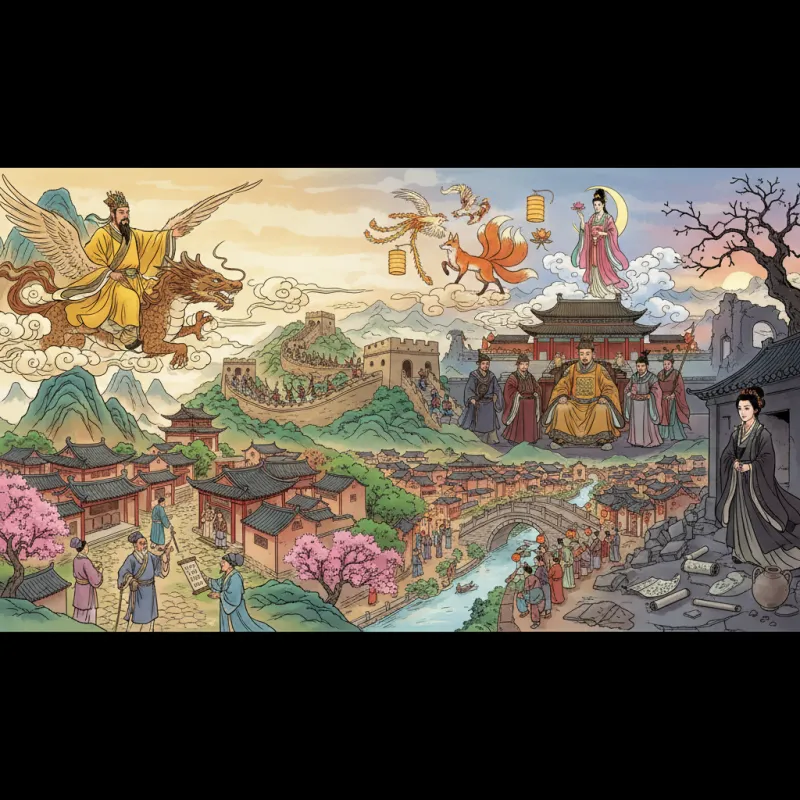
Five thousand years of history in half an hour? That's roughly one dynasty every three minutes. Impossible, you say — and you'd be right if we tried to cover everything. But Chinese history, for all its complexity, follows patterns that repeat like the hexagrams of the Yijing (易经, Book of Changes). Dynasties rise through military prowess, consolidate through cultural achievement, decay through corruption, and collapse into chaos before the cycle begins again. Once you see the pattern, five millennia becomes surprisingly digestible.
The Mythical Foundation: More Than Just Legends
Every civilization needs an origin story. The Chinese chose the Three Sovereigns and Five Emperors (三皇五帝, Sān Huáng Wǔ Dì) — semi-divine culture heroes who supposedly invented everything from agriculture to writing to the calendar. The Yellow Emperor (黄帝, Huángdì), the most important of these figures, allegedly ruled around 2700 BCE and is considered the ancestor of all Han Chinese.
Did these figures actually exist? Probably not as described. But here's what matters: by claiming an unbroken lineage back to these mythical rulers, Chinese civilization established something unprecedented — a sense of continuous cultural identity spanning five thousand years. No other major civilization can make this claim. Egypt fell to foreign conquerors. Rome collapsed. Mesopotamia vanished. China endured, and this mythical beginning explains why Chinese people still call themselves "descendants of the Yellow Emperor" (炎黄子孙, Yán Huáng zǐsūn).
The Shang Dynasty: When Myth Becomes History
Around 1600 BCE, we transition from legend to archaeology with the Shang Dynasty (商朝, Shāng Cháo). The Shang weren't just the first historically verified Chinese dynasty — they were Bronze Age masters whose casting techniques wouldn't be matched in Europe for another thousand years.
But their most important legacy was writing. Oracle bone inscriptions (甲骨文, jiǎgǔwén) — questions carved onto turtle shells and ox bones, then heated until they cracked — represent the earliest form of Chinese characters. These weren't primitive pictographs but a sophisticated writing system already containing thousands of characters. Modern Chinese can still read many of these 3,500-year-old inscriptions, which is like an English speaker reading ancient Sumerian cuneiform.
The Shang also established ancestor worship as the foundation of Chinese religion and social structure. This wasn't just about honoring the dead — it was a cosmic bureaucracy where deceased ancestors could intercede with higher powers on behalf of their living descendants. This system, refined over millennia, would shape everything from Chinese funeral customs to the imperial examination system.
The Zhou Dynasty: Philosophy's Golden Age
The Zhou Dynasty (周朝, Zhōu Cháo, 1046-256 BCE) lasted longer than any other Chinese dynasty — nearly eight centuries. But don't let the dates fool you. After 771 BCE, the Zhou kings became ceremonial figureheads while hundreds of small states fought for supremacy during the Spring and Autumn Period (春秋, Chūnqiū) and the Warring States Period (战国, Zhànguó).
This chaos produced China's greatest intellectual flowering. When political order collapses, philosophers flourish — and the late Zhou period gave us Confucius (孔子, Kǒngzǐ), Laozi (老子, Lǎozǐ), Mozi (墨子, Mòzǐ), and dozens of other thinkers whose ideas still shape Chinese culture today. Confucianism emphasized social harmony through proper relationships. Daoism sought alignment with the natural way of the universe. Legalism advocated strict laws and harsh punishments. These weren't abstract philosophies but competing blueprints for rebuilding civilization.
The state that ultimately won this centuries-long competition was Qin — and it won by embracing Legalism's ruthless efficiency.
The Qin Dynasty: Brutal Unification
In 221 BCE, King Zheng of Qin conquered the last rival state and declared himself Qin Shi Huang (秦始皇, Qín Shǐ Huáng) — the First Emperor of Qin. His fifteen-year reign transformed China from a collection of warring states into a unified empire with standardized writing, currency, weights, measures, and even axle widths for carts.
He also burned books, buried scholars alive, and built the Great Wall by working hundreds of thousands of laborers to death. The First Emperor was a monster — but an effective monster. He created the template for Chinese imperial government that would last two thousand years.
The Qin Dynasty collapsed almost immediately after his death in 210 BCE, torn apart by rebellions. But the empire he created survived. This is the pattern: a brutal unifier creates the system, then a more moderate dynasty inherits and refines it.
The Han Dynasty: China's Classical Age
The Han Dynasty (汉朝, Hàn Cháo, 206 BCE-220 CE) is to China what Rome is to the West — the classical civilization that defined everything that came after. The Han adopted Confucianism as state ideology, established the civil service examination system, expanded Chinese territory to its greatest extent yet, and opened the Silk Road to the West.
This is why Chinese people call themselves Han (汉人, Hàn rén) — the Han Dynasty created Chinese cultural identity as we know it. The Han also produced China's greatest historian, Sima Qian (司马迁, Sīmǎ Qiān), whose Records of the Grand Historian established the format for all subsequent Chinese historical writing.
But even the mighty Han followed the dynastic cycle. By the second century CE, court eunuchs controlled the government, peasant rebellions erupted, and regional warlords carved out independent kingdoms. The Han collapsed in 220 CE, beginning four centuries of division.
The Tang Dynasty: China's Golden Age
After centuries of disunity, the Sui Dynasty (隋朝, Suí Cháo, 581-618 CE) reunified China through massive infrastructure projects — particularly the Grand Canal connecting north and south. Like the Qin, the Sui accomplished great things through brutal methods and collapsed quickly.
The Tang Dynasty (唐朝, Táng Cháo, 618-907 CE) inherited this reunified empire and created what many consider Chinese civilization's golden age. Tang China was cosmopolitan, confident, and culturally dominant throughout East Asia. The capital Chang'an (modern Xi'an) was the world's largest city, home to over a million people including merchants, monks, and diplomats from across Asia.
Tang poetry reached heights never surpassed — Li Bai (李白, Lǐ Bái) and Du Fu (杜甫, Dù Fǔ) remain China's most celebrated poets. Tang Dynasty festivals and customs established traditions still practiced today. Buddhism, which had entered China centuries earlier, reached its peak influence during the Tang.
But the pattern held. The An Lushan Rebellion (755-763 CE) devastated the empire, and though the Tang survived another century and a half, it never recovered its former glory.
The Song Dynasty: Economic Revolution
The Song Dynasty (宋朝, Sòng Cháo, 960-1279 CE) never matched the Tang's military power or territorial extent — in fact, the Song lost control of northern China to nomadic invaders. But economically and technologically, the Song was revolutionary.
This is when China invented paper money, gunpowder weapons, the compass, and movable type printing. Song China was the world's first industrial economy, with iron production that wouldn't be matched in Europe until the 18th century. The Song capital Kaifeng had over a million inhabitants and a vibrant urban culture of restaurants, theaters, and entertainment districts.
Neo-Confucianism, developed by Song philosophers like Zhu Xi (朱熹, Zhū Xī), became the orthodox ideology that would dominate Chinese thought for the next eight centuries. The civil service examination system reached its mature form, creating a meritocratic bureaucracy that was the envy of the world.
The Yuan Dynasty: Mongol Conquest
In 1279, Kublai Khan completed the Mongol conquest of China, establishing the Yuan Dynasty (元朝, Yuán Cháo, 1271-1368 CE). For the first time, all of China was ruled by foreign conquerors.
The Mongols were brutal warriors but pragmatic administrators. They employed Chinese bureaucrats, patronized Chinese arts, and adopted many Chinese customs — while maintaining their distinct identity and privileging Mongols in government positions. Marco Polo's famous account describes the splendor of Kublai Khan's court, though modern historians debate how much of his book is accurate.
The Yuan Dynasty proved that Chinese civilization could absorb even its conquerors. The Mongols ruled China, but Chinese culture ultimately absorbed Mongol rulers. This pattern would repeat with the Qing Dynasty centuries later.
The Ming Dynasty: Chinese Restoration
The Ming Dynasty (明朝, Míng Cháo, 1368-1644 CE) began with the overthrow of Mongol rule and a restoration of native Chinese government. The early Ming was expansionist and confident — Admiral Zheng He (郑和, Zhèng Hé) led massive treasure fleets to Southeast Asia, India, Arabia, and East Africa decades before European explorers rounded Africa's southern tip.
But then China turned inward. The treasure voyages stopped. The Ming built the Great Wall's most impressive sections not as a symbol of strength but as a defensive barrier against northern nomads. Chinese culture flourished — the Ming produced masterpieces of porcelain, literature, and architecture — but the empire became increasingly conservative and isolated.
The Ming's final century was marked by peasant rebellions, government corruption, and invasions by Japanese pirates and Manchu warriors. In 1644, a rebel army captured Beijing, the last Ming emperor hanged himself, and the Manchu armies swept south to establish China's final dynasty.
The Qing Dynasty: The Last Empire
The Qing Dynasty (清朝, Qīng Cháo, 1644-1912 CE) was China's second conquest dynasty, ruled by Manchus from the northeast. Like the Mongols, the Manchus maintained their distinct identity while adopting Chinese governmental systems and cultural practices.
The early Qing emperors — particularly Kangxi, Yongzheng, and Qianlong — were capable rulers who expanded Chinese territory to its greatest extent, incorporating Tibet, Xinjiang, Mongolia, and Taiwan. The 18th century Qing Empire was wealthy, powerful, and culturally sophisticated.
But the 19th century brought disaster. The Opium Wars with Britain exposed China's military weakness. The Taiping Rebellion (1850-1864) killed tens of millions. Foreign powers carved out spheres of influence. The Qing attempted reforms but couldn't overcome entrenched conservatism and foreign pressure.
In 1912, the last emperor abdicated, ending not just the Qing Dynasty but two thousand years of imperial rule. The dynastic cycle had finally broken — or perhaps it had simply transformed into something new.
The Pattern Persists
Thirty minutes later, here we are: from mythical Yellow Emperor to the last Qing emperor, five thousand years compressed into a readable narrative. What's remarkable isn't just the length of Chinese history but its continuity. Dynasties rose and fell, foreign conquerors came and went, but Chinese civilization persisted, absorbing invaders and adapting to challenges while maintaining a core cultural identity.
The dynastic cycle — rise, consolidation, decay, collapse — repeated with remarkable consistency. Each dynasty followed similar patterns: military unification, cultural flowering, bureaucratic ossification, corruption, rebellion, and collapse. Understanding this pattern is the key to understanding Chinese history.
And perhaps the pattern hasn't ended. Modern China, despite its communist government and industrial economy, still exhibits characteristics of the dynastic cycle: centralized authority, meritocratic bureaucracy, emphasis on social harmony, and the belief in China's unique civilizational mission. Five thousand years of history doesn't disappear in a century — it transforms, adapts, and continues in new forms.
Related Reading
- Why Chinese History Matters: Lessons for the Modern World
- The Silk Road: How Trade Routes Shaped Chinese Culture
- Chinese Dynasties: A Quick Guide to 5,000 Years
- The Century of Humiliation: How China Remembers
- Chinese Cinema: How Kung Fu Films Conquered the World
- Zhuangzi's Butterfly Dream: What Is Reality?
- Tea and Zen: The Spiritual Connection
Explore Chinese Culture
- Explore feng shui in daily life
- Explore supernatural folklore
- Explore classical Chinese literature