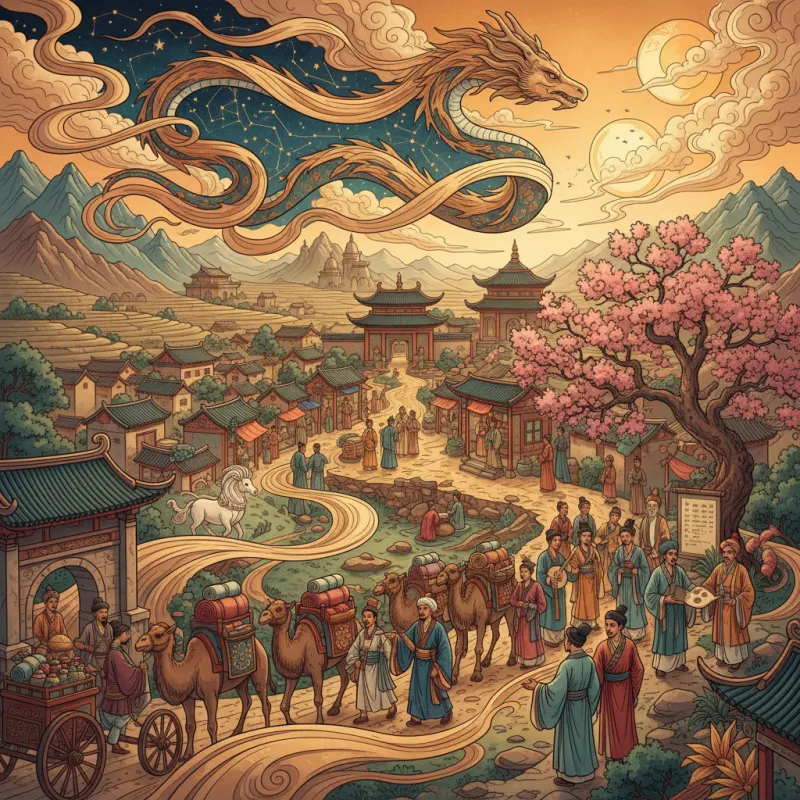
A single bolt of silk could buy a horse. In the markets of Chang'an during the Tang Dynasty, merchants from Persia, India, and the Byzantine Empire haggled over fabric so fine it could pass through a ring, so coveted that Roman senators passed laws limiting its wear. But if you think the 丝绸之路 (Sīchóu Zhī Lù, Silk Road) was just about luxury textiles, you've missed the real story. The routes that snaked from China's ancient capitals through the Taklamakan Desert and over the Pamir Mountains carried something far more transformative than silk: they carried the building blocks of civilizations.
The Network That Wasn't a Road
Here's what most people get wrong: the Silk Road was never a single road, and for much of its history, no one called it that. The term was invented in 1877 by German geographer Ferdinand von Richthofen, who romanticized these trade routes in his atlas of China. The Chinese knew them as the 西域 (Xīyù, Western Regions) routes, a pragmatic name for a pragmatic network. Multiple paths branched and converged across Central Asia, some skirting the northern edge of the Taklamakan Desert through oasis cities like Dunhuang and Turpan, others following the southern rim through Khotan and Kashgar. Maritime routes connected Chinese ports to Southeast Asia, India, and beyond.
The network operated from roughly the 2nd century BCE through the 15th century CE, though its golden age was the Tang Dynasty (618-907 CE), when Chang'an became the world's most cosmopolitan city. At its peak, the capital hosted over one million residents, including communities of Persian, Arab, Jewish, and Indian merchants who built their own temples and lived in designated quarters. The city's Western Market was so international that Chinese shoppers needed interpreters.
What Actually Traveled the Routes
Yes, silk was the marquee product. Chinese sericulture was a state secret, and legend claims that anyone caught smuggling silkworm eggs faced execution. The monopoly held until around 550 CE, when two Nestorian monks allegedly smuggled eggs to Byzantium in hollow bamboo staffs. But silk was just the beginning of the inventory.
From China westward went porcelain, tea, paper, gunpowder, and printing technology. The Chinese imported horses from Ferghana (modern Uzbekistan) — the famous "heavenly horses" that sweat blood, actually suffering from parasites but prized by emperors nonetheless. They imported grapes, walnuts, pomegranates, and alfalfa, crops that transformed Chinese agriculture. Glass came from Rome, lapis lazuli from Afghanistan, ivory from India. The Tang Dynasty poet Li Bai drank wine from a Persian glass cup while composing verses — that's the Silk Road in a single image.
But the most consequential cargo was intangible. Buddhism traveled the Silk Road from India to China, arriving during the Han Dynasty and fundamentally reshaping Chinese philosophy, art, and daily life. The religion adapted as it moved, absorbing local beliefs and practices until Chinese Buddhism became distinct from its Indian parent. For more on how foreign influences transformed Chinese spiritual life, see Chinese Buddhism: How Indian Philosophy Became Chinese.
The Oasis Cities: Where Cultures Collided
The Silk Road's true character reveals itself in the oasis cities that dotted the routes. Dunhuang, at the edge of the Gobi Desert, became a repository of Buddhist art and manuscripts. The Mogao Caves, carved between the 4th and 14th centuries, contain over 45,000 square meters of murals showing not just Buddhist iconography but the faces of merchants, musicians, and pilgrims from dozens of ethnic groups. When a monk sealed Cave 17 around 1000 CE, he preserved over 50,000 documents in Chinese, Tibetan, Sanskrit, and other languages — a time capsule of Silk Road multiculturalism discovered in 1900.
Samarkand, in modern Uzbekistan, was where Persian, Turkic, and Chinese influences blended into something new. The city's artisans developed techniques for making paper learned from Chinese prisoners of war after the Battle of Talas in 751 CE, then improved the process and spread it westward to the Islamic world and eventually Europe. Without that transfer of technology, the Renaissance might have looked very different.
These cities weren't just waypoints; they were laboratories of cultural synthesis. A merchant from Guangzhou might hear Greek philosophy discussed in a Zoroastrian temple, then share a meal of Central Asian naan bread with Indian spices while listening to Persian music played on Chinese instruments.
How Trade Routes Shaped Chinese Identity
The Silk Road forced China to define itself against the outside world. During the Han Dynasty, Emperor Wu sent Zhang Qian westward in 138 BCE to forge alliances against the Xiongnu nomads. Zhang Qian failed his diplomatic mission but returned with detailed reports of the Western Regions, sparking Chinese interest in trade and expansion. This outward orientation was new. Earlier Chinese dynasties had been relatively insular, viewing themselves as the 中国 (Zhōngguó, Middle Kingdom) with little to learn from barbarians.
The Tang Dynasty took this cosmopolitanism to its peak. The imperial court employed foreign generals, married princesses to foreign rulers, and adopted foreign fashions. Tang women wore Persian-style clothing, played polo (imported from Persia), and danced to music from Central Asia. The dynasty's openness to foreign influence is visible in Tang tomb figurines: camels, foreign merchants with prominent noses and beards, and musicians playing exotic instruments.
But this openness had limits and cycles. The An Lushan Rebellion (755-763 CE), led by a general of Sogdian and Turkic descent, devastated the Tang Dynasty and triggered a xenophobic backlash. Foreign merchants faced restrictions, and Buddhism suffered persecution in 845 CE. The pattern repeated throughout Chinese history: periods of openness followed by retrenchment, the Silk Road's influence waxing and waning with political winds.
The Technologies That Changed Everything
Paper, gunpowder, printing, and the compass — the "Four Great Inventions" that Francis Bacon credited with transforming the world — all traveled the Silk Road westward from China. But the exchange wasn't one-directional, and it wasn't always peaceful.
Papermaking reached the Islamic world after the Battle of Talas in 751 CE, when Arab forces defeated a Chinese army and captured skilled papermakers. Within decades, Samarkand became a major paper production center, and the technology spread to Baghdad, Cairo, and eventually Europe. The Islamic Golden Age's explosion of scholarship depended on cheap paper replacing expensive parchment.
Gunpowder followed a similar path. Invented by Chinese alchemists seeking immortality elixirs (ironic, given its eventual use), gunpowder reached the Islamic world by the 13th century and Europe by the 14th. The technology that helped Chinese emperors consolidate power eventually undermined the feudal order in Europe and enabled European colonial expansion — including back into China during the Century of Humiliation. For more on this historical reversal, see The Century of Humiliation: How China Remembers.
The compass, originally used for feng shui and fortune-telling, became a navigation tool that enabled the Age of Exploration. Chinese magnetic compasses reached Europe by the 12th century, making possible the voyages that would connect the world — and ultimately make the overland Silk Road obsolete.
The Decline and What Replaced It
The Silk Road's decline was gradual and multicausal. The Mongol Empire's collapse in the 14th century fragmented the routes and made them more dangerous. The Black Death, which traveled from China to Europe along trade routes in the 1340s, disrupted commerce and killed perhaps a third of Europe's population. The rise of the Ottoman Empire created new barriers and middlemen between East and West.
But the real killer was maritime technology. Portuguese navigators found a sea route to India around Africa in 1498, and suddenly merchants could bypass the Silk Road entirely. Sea routes were faster, cheaper, and safer than overland caravans. The Ming Dynasty, despite its early 15th-century maritime expeditions under Admiral Zheng He, turned inward and eventually banned private maritime trade. This decision, driven by Confucian suspicion of merchants and fear of coastal piracy, may have cost China its chance to dominate global trade.
By the 16th century, the overland Silk Road was a shadow of its former self. The oasis cities declined, and the cosmopolitan culture they fostered faded. China's next major engagement with the outside world would come not through trade but through colonialism and war.
The Modern Silk Road: History Repeating?
In 2013, Chinese President Xi Jinping announced the Belt and Road Initiative, explicitly invoking Silk Road imagery to describe a massive infrastructure project connecting China to Europe, Africa, and beyond. The modern version involves ports, railways, highways, and fiber-optic cables rather than camel caravans, but the ambition is similar: to position China at the center of global trade networks.
Whether this new Silk Road will foster the same cultural exchange as the old one remains to be seen. The original Silk Road succeeded because it was decentralized and multicultural, a network of independent merchants and cities rather than a state project. It thrived on the free exchange of goods and ideas, not on any single empire's control.
The historical Silk Road's greatest legacy isn't the trade routes themselves but the proof that isolation impoverishes while exchange enriches. Every civilization touched by the Silk Road — Chinese, Persian, Indian, Arab, European — was transformed by the encounter. Chinese cuisine gained new ingredients, Chinese Buddhism absorbed foreign influences, Chinese technology spread worldwide and returned in new forms. The Middle Kingdom discovered it wasn't alone in the middle, and that discovery, uncomfortable as it sometimes was, made Chinese culture richer and more resilient.
The next time you drink tea (originally a Chinese monopoly), eat noodles (possibly inspired by Central Asian or Italian pasta), or use paper (a Chinese invention perfected by Islamic scholars), remember: you're experiencing the Silk Road's legacy. The routes may be gone, but the exchange continues.
Related Reading
- Why Chinese History Matters: Lessons for the Modern World
- Chinese History in 30 Minutes: From the Yellow Emperor to the Last Dynasty
- The Century of Humiliation: How China Remembers
- Chinese Dynasties: A Quick Guide to 5,000 Years
- Tai Chi for Beginners: Your First Steps into Moving Meditation
- Discovering the Rich Tapestry of Chinese Folklore: Myths, Legends, and Traditions
- Learning Chinese: An Honest Guide for Complete Beginners
Explore Chinese Culture
- Explore feng shui in daily life
- Explore supernatural folklore
- Explore classical Chinese literature