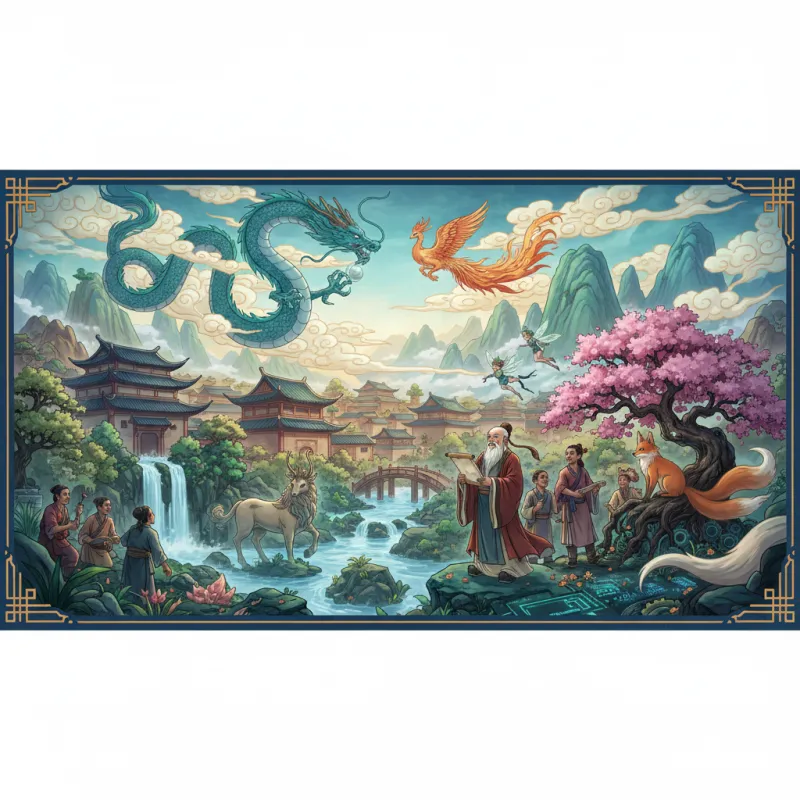
When the Mongols conquered China in 1279, they did something unexpected: they became Chinese. Kublai Khan didn't just rule China — he adopted Chinese administrative systems, patronized Chinese arts, and established a dynasty that followed Confucian principles. This pattern repeated with the Manchus in 1644. Conquerors arrived as outsiders and left as inheritors of a civilization so compelling, so deeply rooted, that it absorbed them. This isn't just historical trivia. It's a masterclass in cultural resilience that speaks directly to our fragmented modern world.
The Continuity Paradox
Chinese civilization has survived longer than any other continuous culture on Earth — over 3,000 years of documented history, and archaeological evidence pushing that back another two millennia. But here's what makes it remarkable: it's not survival through isolation. China has been invaded, conquered, fragmented, and reunified dozens of times. The Zhou Dynasty collapsed into the Warring States period. The Han fell to warlords. The Tang crumbled. The Song retreated south. Yet through every catastrophe, the civilization reconstituted itself around the same core texts, the same written language, the same philosophical frameworks.
The 汉字 (Hànzì, Chinese characters) are the thread that never broke. A scholar from the Han Dynasty (206 BCE - 220 CE) could read inscriptions from the Shang Dynasty (1600-1046 BCE) with effort. A modern Chinese reader can parse classical texts from the Tang Dynasty (618-907 CE) with some training. Try that with English and Old English — Beowulf might as well be a foreign language. This linguistic continuity created an unbroken chain of institutional memory. Every dynasty studied the successes and failures of previous dynasties. The 史记 (Shǐjì, Records of the Grand Historian) by Sima Qian became a template for historical writing that lasted two thousand years.
Governance at Scale
China solved problems of scale that modern nations still struggle with. How do you govern a territory the size of Europe with pre-industrial technology? How do you maintain order across diverse regions, languages, and ethnic groups? The answer was the 科举 (kējǔ, imperial examination system), implemented during the Sui Dynasty (581-618 CE) and perfected under the Tang and Song.
This wasn't just a test — it was social engineering. Any man, regardless of birth, could theoretically rise to the highest levels of government by mastering Confucian classics. The reality was more complicated (wealthy families had advantages), but the principle mattered. It created a meritocratic ideal that unified the empire. Officials from Guangdong to Manchuria shared the same educational foundation, the same texts, the same values. They could communicate in 文言文 (wényánwén, classical Chinese) even if their spoken dialects were mutually unintelligible.
The modern world inherited this obsession with standardized testing from China, often without understanding its original purpose. The SAT, the GRE, China's own 高考 (gāokǎo, college entrance examination) — they're all descendants of the keju system. But we've lost the philosophical framework that made it work: the idea that education should cultivate moral character, not just technical skills. The Confucian classics weren't just literature — they were training manuals for ethical leadership.
The Mandate of Heaven and Political Legitimacy
Western political philosophy often traces legitimacy to divine right, social contract, or democratic consent. Chinese political thought developed something different: 天命 (tiānmìng, the Mandate of Heaven). Introduced by the Zhou Dynasty to justify their overthrow of the Shang, it established a revolutionary principle: rulers govern by virtue, not by birth. If a dynasty becomes corrupt, oppressive, or incompetent, Heaven withdraws its mandate. Rebellion becomes not just justified but cosmically necessary.
This created a strange paradox. Chinese emperors claimed absolute authority, yet that authority was conditional. Natural disasters — floods, droughts, earthquakes — were interpreted as signs that Heaven was displeased. The emperor had to perform rituals, issue self-criticizing edicts, sometimes even abdicate. It was a feedback mechanism built into autocracy, a way for the governed to signal that the system was failing.
Modern China officially rejects imperial ideology, but the Mandate of Heaven's logic persists. The Communist Party's legitimacy rests on performance — economic growth, social stability, national strength. When these falter, the anxiety is palpable. The party studies dynastic collapses obsessively, looking for warning signs. Xi Jinping's anti-corruption campaigns echo the self-correcting impulses of emperors who sensed Heaven's mandate slipping away.
Cycles and Patterns
Chinese historians identified a pattern: the 朝代循环 (cháodài xúnhuán, dynastic cycle). A new dynasty rises through military prowess and moral authority. It establishes order, reduces taxes, repairs infrastructure. Population grows. The economy flourishes. Then, gradually, corruption spreads. The imperial family becomes decadent. Eunuchs or generals seize power. Taxes increase. Peasants rebel. The dynasty falls. A new one rises from the chaos.
This cyclical view of history contrasts sharply with the Western progressive narrative — the idea that history moves linearly toward greater freedom, prosperity, and enlightenment. Chinese history suggests something more sobering: civilizations rise and fall, but human nature remains constant. The same problems recur. The same solutions work temporarily. Then entropy sets in.
The Tang Dynasty's collapse offers a case study. At its height in the 8th century, Chang'an was the world's largest city, a cosmopolitan hub where Persian merchants, Indian monks, and Central Asian musicians mingled. Then came the An Lushan Rebellion (755-763 CE), a civil war that killed millions and shattered the dynasty's authority. The Tang limped on for another century and a half, but never recovered its glory. Regional warlords carved out autonomous territories. The central government lost control. By 907 CE, the dynasty was finished.
What's striking is how predictable it was. Historians at the time recognized the pattern. They'd seen it before in the Han Dynasty's fall. They'd see it again in the Ming Dynasty's collapse. Understanding these cycles doesn't prevent them — human ambition, institutional decay, and random shocks are too powerful — but it does provide perspective. Our current crises aren't unprecedented. Civilizations have weathered worse.
Pragmatism Over Ideology
Chinese philosophy is remarkably non-dogmatic. Confucianism, Daoism, and Buddhism coexisted for centuries, not through tolerance exactly, but through pragmatic syncretism. A scholar might be Confucian in public life, Daoist in private contemplation, and Buddhist when facing death. The same person could hold seemingly contradictory beliefs without cognitive dissonance.
This philosophical flexibility shaped Chinese statecraft. Dynasties adopted whatever worked. The Tang borrowed heavily from Buddhism. The Song emphasized Confucian rationalism. The Qing maintained Manchu military traditions while governing through Chinese bureaucratic systems. Ideology mattered less than results.
Contrast this with the West's religious wars, ideological purges, and philosophical absolutism. Europe tore itself apart over whether bread and wine literally became Christ's body and blood. China debated whether human nature was inherently good (Mencius) or required strict laws (Legalism), but these debates rarely led to mass violence. The Chinese approach was: try both, see what works, adjust accordingly.
This pragmatism is China's greatest strength in the modern world. The Communist Party abandoned orthodox Marxism when it stopped producing results. Deng Xiaoping's famous line — "It doesn't matter whether a cat is black or white, as long as it catches mice" — is pure Chinese pragmatism. The West often struggles with this flexibility, mistaking it for cynicism or lack of principles. But it's a different kind of principle: the principle that human welfare matters more than ideological purity.
What the West Gets Wrong
Western interpretations of Chinese history often fall into two traps. The first is orientalism — treating China as exotic, inscrutable, fundamentally different. The second is projection — assuming Chinese history follows the same patterns as European history, just with different names and dates.
Both miss the point. Chinese civilization developed different solutions to universal human problems. How do you create social order without a transcendent God? Confucianism's answer: through ritual, education, and family loyalty. How do you maintain cultural unity across vast distances? The answer: a shared written language and bureaucratic class. How do you legitimize political authority? The Mandate of Heaven.
These aren't exotic curiosities. They're alternative models that worked for millennia. As the West grapples with polarization, institutional decay, and loss of shared values, Chinese history offers lessons. Not blueprints — China's solutions emerged from specific historical circumstances — but possibilities. Proof that there are multiple paths to civilization.
The Long View
The most valuable lesson from Chinese history is temporal perspective. Chinese historians think in centuries. The 资治通鉴 (Zīzhì Tōngjiàn, Comprehensive Mirror in Aid of Governance), compiled in the 11th century, covers 1,362 years of history. It was written to help rulers learn from the past. The assumption was that patterns repeat, that human nature is constant, that today's crisis has precedents.
This long view is increasingly rare in the modern world. We're trapped in the present, obsessed with quarterly earnings, election cycles, viral news. We've lost the ability to think generationally. Chinese history reminds us that civilizations operate on different timescales than individuals. The decisions we make today will echo for centuries.
The Chinese philosophical traditions that emerged from this historical consciousness remain relevant. The emphasis on education, family, social harmony — these aren't outdated values. They're responses to permanent human challenges. Similarly, understanding traditional Chinese festivals reveals how a civilization maintains continuity through ritual and shared cultural memory.
Chinese history matters because it's the longest experiment in civilization we have. It shows what's possible, what's durable, what fails. It demonstrates that cultures can survive catastrophic collapses and reconstitute themselves. It proves that different civilizational models can succeed. And it reminds us that the problems we face — corruption, inequality, political legitimacy, social cohesion — are ancient. We're not the first to confront them. We won't be the last. But we can learn from those who came before.
Related Reading
- The Silk Road: How Trade Routes Shaped Chinese Culture
- Chinese History in 30 Minutes: From the Yellow Emperor to the Last Dynasty
- The Century of Humiliation: How China Remembers
- Chinese Dynasties: A Quick Guide to 5,000 Years
- Chinese New Year: The Complete Guide to Spring Festival
- How to Start Learning Chinese Calligraphy
- Chinese Pop Culture: A Guide for the Curious Outsider
Explore Chinese Culture
- Explore feng shui in daily life
- Explore supernatural folklore
- Explore classical Chinese literature