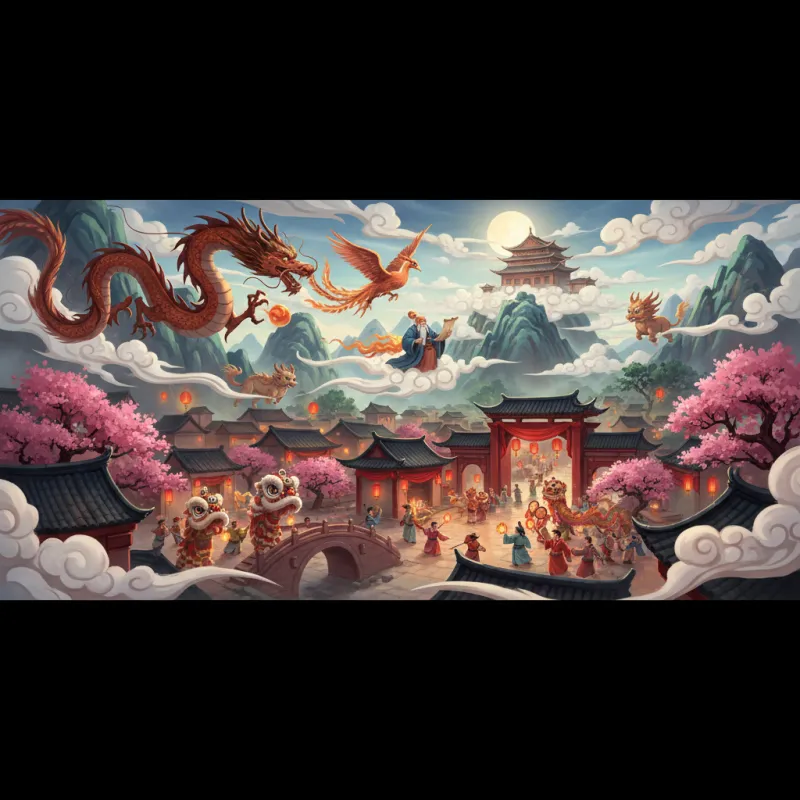
The explosion of firecrackers at midnight on New Year's Eve isn't just noise — it's a sonic exorcism. For thousands of years, Chinese families have greeted the new year by creating the loudest, most chaotic racket possible, all to scare away 年 (Nián), a mythical beast that once terrorized villages every spring. The monster is long gone, but the tradition remains, and with it, the understanding that 春节 (Chūnjié, Spring Festival) — what the West calls Chinese New Year — is less a celebration than a cosmic reset button. Everything old must be driven out. Everything new must be welcomed with open arms and deafening noise.
The Beast That Started It All
The legend of Nián explains why Chinese New Year looks the way it does. According to folklore, this creature emerged from the mountains or sea (sources vary) once a year to devour crops, livestock, and occasionally villagers. People lived in terror until they discovered Nián's three weaknesses: loud noises, bright lights, and the color red. The monster couldn't stand them. So communities began hanging red lanterns, pasting red paper on doors, and setting off bamboo stalks in fire — the original firecrackers, which exploded with a sharp crack when heated. The beast never returned, but the defenses became tradition. Today's 红包 (Hóngbāo, red envelopes) filled with money, the crimson couplets flanking doorways, the thunderous fireworks displays — all of it traces back to a monster that probably never existed but shaped a festival celebrated by over a billion people.
When Exactly Is Chinese New Year?
Here's where it gets complicated. Spring Festival follows the 农历 (Nónglì, lunar calendar), specifically falling on the second new moon after the winter solstice. This means the date shifts every year on the Gregorian calendar, landing somewhere between January 21 and February 20. The festival officially lasts fifteen days, beginning on New Year's Eve and concluding with the 元宵节 (Yuánxiāo Jié, Lantern Festival), though most people only get seven days off work. Each year is associated with one of twelve zodiac animals in a repeating cycle: Rat, Ox, Tiger, Rabbit, Dragon, Snake, Horse, Goat, Monkey, Rooster, Dog, and Pig. These animals combine with five elements (Wood, Fire, Earth, Metal, Water) to create a sixty-year cycle. 2024 was the Year of the Wood Dragon. 2025 brings the Wood Snake. Your birth year's animal is your 本命年 (Běnmìngnián), and tradition holds that these years bring bad luck unless you wear red underwear. I'm not making this up.
The Great Migration Home
春运 (Chūnyùn, Spring Festival travel rush) is the largest annual human migration on the planet. For forty days surrounding the festival, roughly three billion trips are made as hundreds of millions of migrant workers leave China's coastal factory cities and return to inland villages. Train tickets sell out within minutes of release. Highways transform into parking lots stretching for miles. Airports operate at 120% capacity. The logistics are staggering — China Railway runs thousands of extra trains, and still people stand in aisles for thirty-hour journeys. Why? Because 团圆 (Tuányuán, family reunion) is non-negotiable. Missing Spring Festival at home is like missing Christmas, Thanksgiving, and your birthday combined. It's the one time each year when the entire family gathers under one roof, and no amount of inconvenience, expense, or exhaustion will stop people from making the trip. The government has tried to discourage travel during pandemic years. They failed. The pull of home is stronger than policy.
New Year's Eve: The Main Event
除夕 (Chúxī, New Year's Eve) is when everything happens. Families gather for 年夜饭 (Niányèfàn, reunion dinner), the most important meal of the year. The table groans under the weight of dishes, each carrying symbolic meaning. Fish (鱼, yú) is mandatory because it sounds like "surplus" — you must have fish to have abundance. Dumplings (饺子, jiǎozi) resemble ancient gold ingots and promise wealth. Noodles represent longevity; cutting them is bad luck. Spring rolls look like gold bars. Glutinous rice cakes (年糕, niángāo) sound like "getting higher year after year," implying career advancement or growing children. Nothing is random. Every dish is a prayer disguised as food.
After dinner, families watch the 春节联欢晚会 (Chūnjié Liánhuān Wǎnhuì, Spring Festival Gala), a four-hour variety show broadcast by CCTV that draws 700 million viewers. It's simultaneously beloved and mocked — the performances are wholesome to the point of blandness, the comedy sketches avoid anything controversial, and the whole production feels like propaganda wrapped in sequins. Yet everyone watches. It's tradition. At midnight, the firecrackers begin. In cities where fireworks are banned, people drive to the suburbs. The sky lights up. The noise is apocalyptic. The new year has arrived, and Nián, wherever he is, knows to stay away.
The Fifteen Days of Celebration
The festival doesn't end on New Year's Day. Each day of the first lunar month carries specific customs. Day one is for honoring elders — children bow to parents and grandparents, receiving 红包 (hóngbāo, red envelopes) filled with cash in return. The amount matters: even numbers are lucky, but avoid four (sounds like "death") and give amounts ending in eight (sounds like "prosperity"). Day two is when married daughters visit their birth families. Day three and four are considered unlucky for visiting, so people stay home. Day five is 破五 (Pòwǔ, "Breaking Five"), when businesses reopen and people can finally sweep their floors — cleaning during the first days would sweep away good luck. Day seven is everyone's birthday; traditionally, all Chinese people add a year to their age on this day, regardless of actual birth date. Day fifteen brings the Lantern Festival, marking the first full moon and the official end of celebrations. Families eat 汤圆 (tāngyuán, sweet rice balls) symbolizing completeness and reunion, and children parade through streets carrying lanterns shaped like animals, flowers, or cartoon characters.
What You Absolutely Cannot Do
Spring Festival is governed by an elaborate system of taboos. Break them at your peril — or at least expect disapproving looks from your grandmother. Don't sweep or take out garbage during the first five days; you'll sweep away wealth and luck. Don't wash your hair on New Year's Day; you'll wash away good fortune. Don't say unlucky words like "death," "sickness," "poverty," or "ghost." If you break something, immediately say 岁岁平安 (Suìsuì píng'ān, "peace year after year") because 碎 (suì, broken) sounds like 岁 (suì, year). Don't cry, especially children — tears on New Year's Day mean a year of tears. Don't lend money or pay debts; you'll be lending or paying all year. Don't use knives or scissors; you'll cut off good fortune. Don't wear black or white; these are mourning colors. The list goes on. Modern young people roll their eyes at these superstitions, then follow them anyway. Why risk it?
The Festival's Evolution
Spring Festival has changed dramatically over the past century. During the Cultural Revolution (1966-1976), the government tried to eliminate it as feudal superstition. They failed spectacularly. The festival went underground, families celebrating quietly behind closed doors. After economic reforms in the 1980s, Spring Festival roared back bigger than ever. Today it's a curious hybrid of ancient tradition and modern commerce. People still paste 春联 (chūnlián, Spring Festival couplets) on their doors, but they order them on Taobao instead of writing them by hand. They still give red envelopes, but increasingly as digital transfers through WeChat rather than physical cash. They still set off firecrackers, though many cities have banned them due to pollution and safety concerns. The core remains unchanged — family, food, and the hope that this year will be better than the last — but the packaging evolves with each generation.
The festival's global reach has expanded too. Chinatowns worldwide host parades and celebrations. Major cities light up with red lanterns. Non-Chinese people attend festival events, eat dumplings, and wish each other 新年快乐 (Xīnnián kuàilè, Happy New Year). UNESCO recognized Spring Festival as an Intangible Cultural Heritage of Humanity in 2024. What began as a village defense against a mythical monster has become a global phenomenon, proof that some traditions are too powerful to be confined by borders or calendars.
Why It Still Matters
In an increasingly modern, urbanized China where young people work far from home and traditional culture competes with smartphones and social media, Spring Festival remains sacred. It's the one time when the relentless pace of Chinese life actually stops. Factories close. Offices empty. The pressure to achieve, earn, and advance pauses for a week. People return to the villages they left, eat the foods they grew up with, and reconnect with the people who knew them before they became whoever they are now. It's a reminder that beneath the skyscrapers and high-speed trains, China is still a culture that values family above all else, that believes in cycles of renewal, and that understands some things — like going home for New Year — are worth any amount of trouble.
The firecrackers will explode again next year. The dumplings will be made. The red envelopes will be distributed. And somewhere, in the collective memory of a civilization, Nián will stay in his mountain, deterred by the noise and light and color of a billion people celebrating together. That's the real magic of Spring Festival — not that it scares away monsters, but that it brings people home.
Related Reading
- Chinese Festivals: The Calendar That Runs on Stories
- Dragon Boat Festival: Racing, Remembrance and Rice Dumplings
- Dragon Boat Festival: Racing for Qu Yuan
- Mid-Autumn Festival: Mooncakes and Moon Gazing
- Chinese Festivals the World Should Know About
- The Chinese Zodiac: Complete Guide to the 12 Animals
- Food Symbolism in Chinese Culture: Every Dish Tells a Story
- Wuxia vs. Xianxia vs. Xuanhuan: Chinese Fantasy Genres Explained
Explore Chinese Culture
- Explore feng shui in daily life
- Explore supernatural folklore
- Explore classical Chinese literature