Every Chinese New Year, millions of people worldwide ask the same question: "What's my zodiac animal?" But here's what most don't realize — the answer might determine whether your grandmother approves of your marriage, whether your business partner thinks you're trustworthy, and why your mother scheduled your birth by C-section for a Dragon year instead of waiting for nature to take its course.
The Great Race That Never Happened (But Everyone Believes)
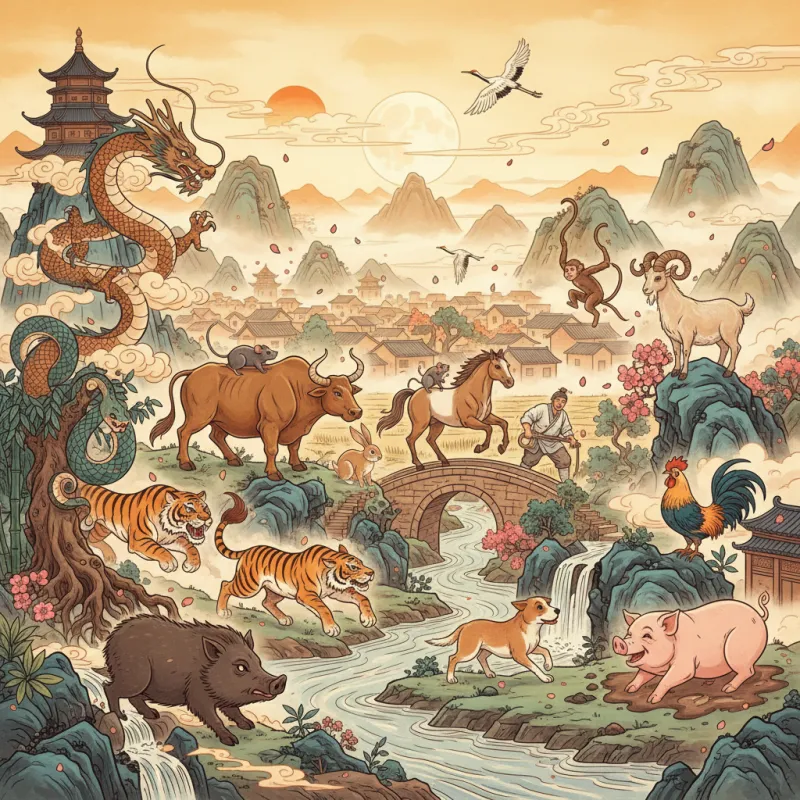
The story goes like this: the 玉皇大帝 (Yù Huáng Dàdì, Jade Emperor) announced a race to determine which animals would represent the years. The first twelve to cross the river and reach his celestial palace would earn their place in the zodiac. What happened next reads like a fable about human nature disguised as animal behavior.
The Rat, too small to swim the river alone, convinced the kind-hearted Ox to give him a ride. Just as they reached the shore, the Rat leaped from the Ox's head and scurried across the finish line first. The Ox, despite being faster and stronger, came second — a lesson about cunning versus diligence that Chinese parents have been teaching their children for centuries.
The Tiger arrived third, exhausted from fighting the river's current. The Rabbit hopped across on stepping stones (or, in some versions, hitched a ride on a log). The Dragon, who could fly, came fifth because he stopped to make rain for farmers and help a rabbit cross the river — the only explanation for why a creature with wings didn't win. The Snake hid in the Horse's hoof and frightened it at the last moment, claiming sixth place while the Horse took seventh.
The Goat, Monkey, and Rooster worked together on a raft, arriving eighth, ninth, and tenth. The Dog, despite being an excellent swimmer, got distracted playing in the water and came eleventh. The Pig stopped for a feast and a nap, waddling in last.
Here's the thing: this story probably originated during the Han Dynasty (206 BCE – 220 CE), but the zodiac system itself is older. The earliest confirmed reference appears on bamboo slips from the Qin Dynasty (221-206 BCE), discovered in Hubei province in 1975. The animals were already established — the race story came later to explain them, the way myths always arrive after the facts to make sense of what people already believe.
The Cat's Revenge and Regional Variations
Ask a Vietnamese person about the zodiac, and they'll tell you the fourth animal isn't a Rabbit — it's a Cat. This isn't a translation error. Vietnam genuinely replaced the Rabbit with the Cat in their version of the zodiac, and the reason remains debated by scholars.
The Chinese version includes a subplot about why cats aren't in the zodiac at all. The Rat, tasked with waking the Cat for the race, deliberately let the Cat oversleep. When the Cat finally woke up and realized what happened, it began the eternal enmity between cats and rats. It's a convenient explanation for predator-prey relationships, though zoologists might disagree with the mythology.
Other variations exist across Asia. The Mongolian zodiac replaces the Tiger with a Leopard. The Thai zodiac swaps the Rabbit for a Naga (serpent deity). These aren't corruptions of a "pure" Chinese original — they're evidence that the zodiac system spread along trade routes and adapted to local cultures, like Chinese festivals that evolved differently in different regions.
How the System Actually Works (It's Not Just Your Birth Year)
Most people think the Chinese zodiac is simple: you're born in a Dragon year, so you're a Dragon. Wrong. Or at least, incomplete.
The full system uses four animals — one for your year, month, day, and hour of birth. These are called your 四柱 (Sì Zhù, Four Pillars) or 八字 (Bā Zì, Eight Characters, because each pillar has two characters in the traditional system). Professional fortune-tellers and matchmakers analyze all four, not just the year animal that appears on placemats at Chinese restaurants.
Your year animal represents how others perceive you. Your month animal (determined by the lunar month of birth) represents your inner self and relationships with parents. Your day animal represents your marriage and relationship with your spouse. Your hour animal represents your children and later life.
The zodiac also cycles through five elements — Wood, Fire, Earth, Metal, and Water — creating a sixty-year cycle before the same combination repeats. A Wood Rat (last seen in 1984, next in 2044) has different characteristics than a Fire Rat (1936, 1996) or a Water Rat (1972, 2032). This is why your grandmother might say, "Not just any Dragon year — we need a Water Dragon year for the baby."
Personality Traits: Stereotype or Self-Fulfilling Prophecy?
The zodiac assigns specific personality traits to each animal, and here's where it gets psychologically interesting. Are Rats actually clever and resourceful, or do people born in Rat years become clever and resourceful because everyone tells them they are?
Rats (1948, 1960, 1972, 1984, 1996, 2008, 2020) are supposedly intelligent, adaptable, and charming but also opportunistic. Oxen (1949, 1961, 1973, 1985, 1997, 2009, 2021) are hardworking, reliable, and stubborn. Tigers (1950, 1962, 1974, 1986, 1998, 2010, 2022) are brave, competitive, and unpredictable. Rabbits (1951, 1963, 1975, 1987, 1999, 2011, 2023) are gentle, elegant, and cautious.
Dragons (1952, 1964, 1976, 1988, 2000, 2012, 2024) get the best reputation — confident, ambitious, charismatic. This isn't subtle. Dragon years see measurable spikes in birth rates across Chinese communities worldwide. In 2012, Hong Kong hospitals were overwhelmed with Dragon year babies. Maternity wards in Singapore, Taiwan, and Chinese-American communities reported similar surges. The preference is so strong that some couples use IVF timing or scheduled C-sections to ensure a Dragon baby.
Snakes (1953, 1965, 1977, 1989, 2001, 2013) are wise and enigmatic but possessive. Horses (1954, 1966, 1978, 1990, 2002, 2014) are energetic and independent but impatient. Goats (1955, 1967, 1979, 1991, 2003, 2015) are creative and gentle but pessimistic. Monkeys (1956, 1968, 1980, 1992, 2004, 2016) are clever and curious but mischievous.
Roosters (1957, 1969, 1981, 1993, 2005, 2017) are observant and hardworking but critical. Dogs (1958, 1970, 1982, 1994, 2006, 2018) are loyal and honest but anxious. Pigs (1959, 1971, 1983, 1995, 2007, 2019) are generous and optimistic but naive.
Studies have shown that people born in "lucky" zodiac years (Dragon, Tiger) report higher life satisfaction and achieve more career success in Chinese societies — not because the zodiac is real, but because cultural expectations create real advantages. Teachers expect more from Dragon students. Employers prefer Dragon job candidates. It's astrology as social engineering.
Marriage Compatibility and the Matchmaker's Math
Traditional Chinese matchmakers don't just check if you and your partner get along — they calculate whether your zodiac animals are compatible. This practice, called 合八字 (Hé Bā Zì, matching the eight characters), can make or break engagements.
The system divides the twelve animals into four groups of three "allies" who form natural partnerships. Rat-Dragon-Monkey form one group. Ox-Snake-Rooster form another. Tiger-Horse-Dog are the third. Rabbit-Goat-Pig complete the set. Marriages within these groups are considered harmonious.
Direct opposites in the zodiac — six years apart — are considered incompatible. Rat and Horse clash. Ox and Goat conflict. Tiger and Monkey fight. Rabbit and Rooster argue. Dragon and Dog oppose. Snake and Pig contradict. These pairings supposedly lead to divorce, financial problems, and unhappy children.
My own aunt postponed her wedding by eight months because a fortune-teller said her Rooster year clashed with her fiancé's Rabbit year. They eventually married anyway (love conquers superstition, sometimes) and have been together for thirty years. But I've also met couples who broke up specifically because of zodiac incompatibility, despite being happy together. The belief itself has power, regardless of truth.
Modern dating apps in China, Taiwan, and Singapore often include zodiac filters. You can search for partners born in compatible years, the same way Western apps filter by height or education. It's ancient astrology meeting digital algorithms.
The Zodiac in Literature and Popular Culture
The zodiac animals appear throughout Chinese literature, often as metaphors for human behavior. In 《西游记》(Xī Yóu Jì, Journey to the West), Sun Wukong the Monkey King embodies the Monkey's cleverness and mischief. The novel was written during the Ming Dynasty (1368-1644), when zodiac symbolism was already deeply embedded in Chinese consciousness.
The 《水浒传》(Shuǐ Hǔ Zhuàn, Water Margin) features 108 heroes, and scholars have noted that their personalities often align with zodiac traits. Wu Song, who famously kills a tiger with his bare hands, was likely born in a Tiger year — brave, strong, and reckless.
Contemporary Chinese cinema uses zodiac symbolism constantly. Jackie Chan's "Chinese Zodiac" (2012) built an entire action plot around stealing bronze animal heads. The film grossed over $145 million in China, proof that zodiac themes still resonate with modern audiences.
Anime and manga have adopted the zodiac too. "Fruits Basket" by Natsuki Takaya centers on characters cursed to transform into zodiac animals. The series has sold over 30 million copies worldwide, introducing the Chinese zodiac to audiences who might never have encountered it otherwise.
Why the Zodiac Endures in the Modern World
Here's what fascinates me: the Chinese zodiac survives in an age of science, psychology, and personality tests backed by research. The Myers-Briggs Type Indicator has sixteen categories. The Big Five personality traits have statistical validity. Yet millions of educated, modern Chinese people still consult the zodiac for major life decisions.
Part of the answer is cultural continuity. The zodiac connects contemporary Chinese people to their ancestors, to traditional festivals, to a worldview that existed before Western influence. Rejecting the zodiac feels like rejecting Chinese identity itself.
But there's also something psychologically satisfying about the system. It's simple enough to remember (twelve animals, not sixteen personality types). It's specific enough to feel personal (your exact birth year matters). It's flexible enough to explain anything (five elements, four pillars, compatibility charts). And it's unfalsifiable — if a prediction fails, you can always blame other factors in your eight characters.
The zodiac also provides what psychologists call "narrative identity" — a story about who you are and why you behave the way you do. "I'm a Tiger, so of course I'm competitive" is easier than examining complex psychological factors. It's astrology as shorthand for self-understanding.
The Year You Were Born Matters (Because We Decide It Does)
The Chinese zodiac isn't real in any scientific sense. Your birth year doesn't determine your personality, your marriage prospects, or your career success. The animals didn't race across a river to the Jade Emperor's palace. The Cat wasn't betrayed by the Rat.
But here's the paradox: the zodiac is real because millions of people believe it's real and act accordingly. Parents time pregnancies for Dragon years. Employers favor certain zodiac signs. Couples break up over incompatibility charts. These beliefs create measurable effects in the world — birth rate spikes, hiring discrimination, relationship decisions.
The zodiac is a collective fiction that shapes reality, like money or national borders or Chinese mythology itself. It's a story we tell about time, personality, and fate. And like all powerful stories, it's true not because it describes the world accurately, but because it changes how we live in the world.
So what's your zodiac animal? And more importantly — do you believe it matters?
Related Reading
- The Four Great Folktales of China: Love, Loyalty and Legend
- Journey to the West: Why Sun Wukong Is China's Favorite Character
- Chinese Creation Myths: How the World Began
- Journey to the West: A First-Timer's Guide to China's Greatest Novel
- Legendary Flavors: Exploring Chinese Food Folklore and Timeless Culinary Traditions
- Exploring the Rich Tapestry of Chinese Folklore, Legends, and Fairy Tales
- Decoding Chinese Internet Culture: From Baidu Tieba to Bilibili
Explore Chinese Culture
- Explore feng shui in daily life
- Explore supernatural folklore
- Explore classical Chinese literature