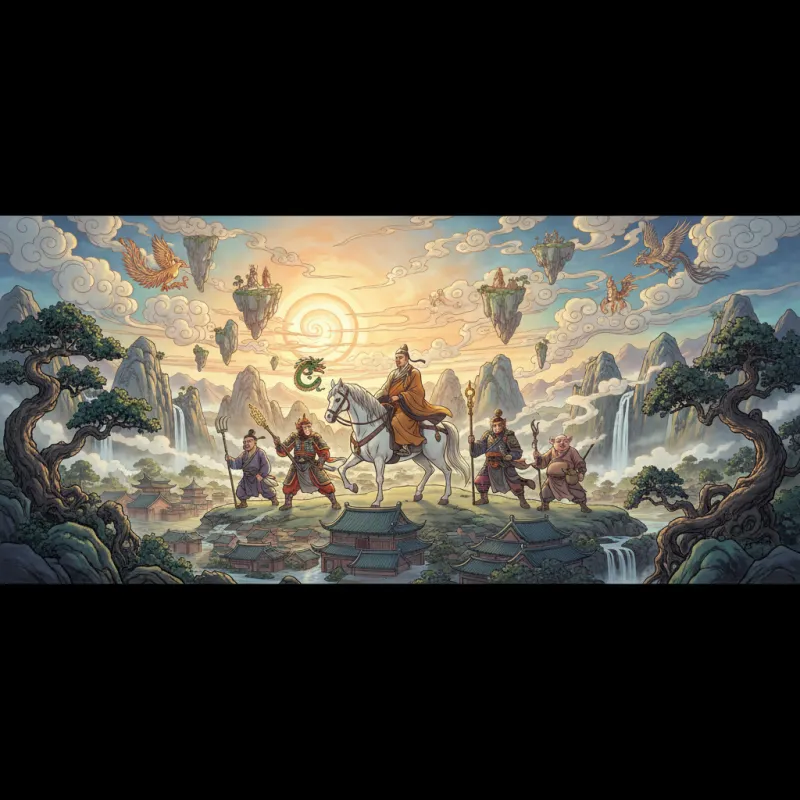
A monkey born from a stone rebels against heaven, gets imprisoned under a mountain for five centuries, then becomes a Buddhist pilgrim's bodyguard. If that sounds like the fever dream of someone who mixed too many genres in a blender, congratulations—you've just grasped the beautiful chaos that is Journey to the West. This 16th-century novel isn't just China's most beloved epic; it's a work so wildly ambitious that it somehow manages to be a kung-fu adventure, a religious parable, a bureaucratic satire, and a slapstick comedy all at once. And it actually works.
Why This 500-Year-Old Book Still Matters
Written by Wu Cheng'en (吴承恩, Wú Chéng'ēn) during the Ming Dynasty, Journey to the West (西游记, Xīyóu Jì) has spawned more adaptations than you can count—TV series, films, video games, anime, you name it. The Monkey King alone appears in everything from Dragon Ball to modern Chinese blockbusters. But here's the thing: most adaptations cherry-pick the action scenes and ignore the novel's deeper layers. The original text is simultaneously a thrilling adventure and a sophisticated commentary on Ming-era politics, Buddhist philosophy, and human nature itself.
The basic plot sounds straightforward: the monk Tang Sanzang (唐三藏, Táng Sānzàng), known in English as Tripitaka, travels from China to India to retrieve Buddhist scriptures. He's accompanied by three disciples—a monkey, a pig, and a river demon—who are all doing penance for past crimes. They face 81 trials over 14 years. But that summary is like describing The Odyssey as "a guy trying to get home from work."
The Monkey King: Chaos Incarnate
Let's be honest—Sun Wukong (孙悟空, Sūn Wùkōng) steals the show. The first seven chapters don't even mention the pilgrimage; they're entirely devoted to the Monkey King's origin story, and they're the most entertaining chapters in classical Chinese literature.
Born from a magic stone on the Mountain of Flowers and Fruit, Sun Wukong becomes king of the monkeys, learns supernatural martial arts from a Taoist sage, and then proceeds to make himself the most powerful being in existence through a combination of training, theft, and sheer audacity. He crashes a celestial banquet, eats the Jade Emperor's immortality peaches, steals Laozi's elixir pills, drinks the imperial wine, and basically treats heaven like his personal buffet. When the celestial armies try to stop him, he defeats them all—including 100,000 heavenly soldiers.
The Buddha finally traps him under a mountain for 500 years, which is where Tripitaka finds him. The monk frees him, but there's a catch: Sun Wukong must wear a golden headband that tightens painfully whenever Tripitaka recites a certain sutra. This becomes the novel's central tension—the wild, powerful, impatient Monkey King forced to serve a weak, naive, but morally pure monk.
Sun Wukong's powers are absurd even by fantasy standards. He can transform into 72 different forms, fly on clouds at incredible speeds, see through any disguise, pluck hairs from his body and blow them into clones of himself, and wield a staff that can shrink to needle-size or grow to prop up the sky. He's essentially invincible, which means the novel has to get creative about creating actual challenges for him.
The Rest of the Crew (Yes, They Matter Too)
Tripitaka himself is the novel's most divisive character. He's pious, compassionate, and committed to his mission—but he's also gullible, physically weak, and frequently gets kidnapped by demons who want to eat him (his flesh supposedly grants immortality). Modern readers often find him frustrating, but that's the point. He represents pure faith and moral authority, which the novel suggests is more important than raw power. Still, you'll want to shake him at least once per chapter.
Zhu Bajie (猪八戒, Zhū Bājiè), whose name literally means "Pig of Eight Prohibitions," is the comic relief—a former celestial marshal banished to earth for drunkenly hitting on the moon goddess. He's lazy, gluttonous, lustful, and constantly trying to quit the pilgrimage. But he's also surprisingly human in his flaws, which makes him oddly endearing. He represents earthly desires that Buddhism teaches us to overcome, though he's not particularly interested in overcoming anything except his next meal.
Sha Wujing (沙悟净, Shā Wùjìng), the river demon, is the steady, reliable one—basically the group's straight man. He was a celestial general who broke a crystal goblet and got banished. He carries the luggage, mediates disputes, and rarely gets spotlight moments, but every team needs someone who actually does their job without drama.
What's Really Happening Here
On the surface, Journey to the West is about a pilgrimage. Dig deeper, and it's about the journey toward enlightenment—each demon they fight represents an internal obstacle (desire, anger, ignorance, attachment). The novel draws from Buddhist, Taoist, and Confucian traditions, creating a uniquely Chinese spiritual synthesis.
But it's also a satire. The Heavenly Bureaucracy mirrors the Ming Dynasty's imperial administration, complete with incompetent officials, political backstabbing, and absurd regulations. Many demons turn out to be escaped pets or vehicles of powerful deities, who show up at the last minute to reclaim them—a pointed commentary on how the powerful protect their own. The novel suggests that heaven is just as corrupt and petty as any earthly government.
The structure is episodic: the pilgrims arrive somewhere, encounter a demon (often disguised), Sun Wukong sees through the disguise, Tripitaka doesn't believe him, chaos ensues, they eventually defeat the demon, and move on. This formula repeats for roughly 80 chapters. It sounds repetitive, but Wu Cheng'en varies it brilliantly—some demons are genuinely threatening, others are pathetic, some are sympathetic, and a few are actually innocent beings that Sun Wukong misjudges.
How to Actually Read This Thing
The complete novel runs about 100 chapters and can feel overwhelming. Here's my advice: read the first seven chapters (the Monkey King's rebellion) to understand why this character became iconic. Then skip to chapter 13 where the pilgrimage actually begins. Read chapters 13-30 to get the rhythm of the journey. If you're hooked, continue. If not, skip to the final chapters (98-100) for the conclusion.
The best English translation is Anthony C. Yu's four-volume complete version, which includes extensive notes explaining the Buddhist and Taoist references. W.J.F. Jenner's translation is more accessible but abridged. For a middle ground, try Julia Lovell's recent translation, which captures the novel's humor while remaining faithful to the original.
Fair warning: the novel's treatment of women hasn't aged well. Female characters are mostly demons in disguise or damsels in distress. The few virtuous women are praised primarily for their chastity. This reflects Ming Dynasty attitudes, but it's still jarring for modern readers.
Why It Endures
Journey to the West works because it operates on multiple levels simultaneously. Kids love the monkey who fights demons. Teenagers appreciate the rebellion against authority. Adults recognize the spiritual allegory. Scholars analyze the political satire. Everyone enjoys the humor—and yes, there are fart jokes alongside the Buddhist philosophy.
The novel also captures something universal about the struggle between our wild, impulsive nature (Sun Wukong) and our higher aspirations (Tripitaka). We're all monkeys wearing headbands, trying to control our worst impulses while pursuing something greater than ourselves. The fact that the monkey never fully submits, that he remains irreverent and questioning even as he protects his master, suggests that enlightenment doesn't require crushing your spirit—just directing it toward better purposes.
For more on Chinese mythological figures, check out The Eight Immortals and Nezha: The Child God Warrior. These characters share Journey to the West's blend of religious significance and popular entertainment, showing how Chinese mythology has always been more playful and subversive than Western audiences might expect.
The pilgrimage takes 14 years and covers thousands of miles, but the real journey is internal. That's the novel's ultimate trick—it disguises a profound spiritual text as a rollicking adventure story, ensuring that even readers who don't care about enlightenment will stick around for the monkey's next fight. Five hundred years later, we're still following him.
Related Reading
- The Four Great Folktales of China: Love, Loyalty and Legend
- The Chinese Zodiac: Complete Guide to the 12 Animals
- Journey to the West: Why Sun Wukong Is China's Favorite Character
- Chinese Creation Myths: How the World Began
- Chinese History in 30 Minutes: From the Yellow Emperor to the Last Dynasty
- Dim Sum Culture: More Than Just Dumplings
- Unveiling the Rich Tapestry of Chinese Folklore and Legends
Explore Chinese Culture
- Explore feng shui in daily life
- Explore supernatural folklore
- Explore classical Chinese literature