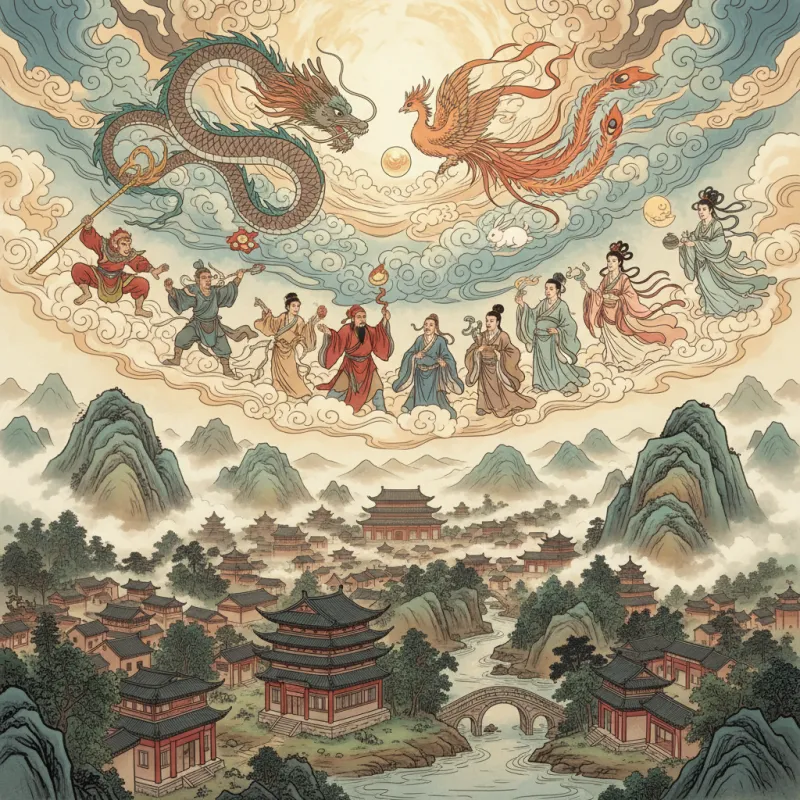
The Jade Emperor's celestial court was in chaos. A monkey, born from stone and drunk on immortality peaches, had just declared himself equal to heaven itself. This wasn't some minor bureaucratic dispute—this was Journey to the West (西游记, Xīyóu Jì), and it perfectly captures what makes Chinese folklore so endlessly compelling: the audacity to imagine mortals, demons, and gods locked in struggles that reshape the cosmos itself.
Chinese folklore isn't a neat collection of bedtime stories. It's a sprawling, contradictory, magnificent mess spanning 5,000 years, where Buddhist monks travel with pig demons, fox spirits seduce scholars, and kitchen gods report your family's behavior to heaven's administrators. These aren't just tales—they're the operating system of Chinese cultural consciousness, encoding everything from agricultural calendars to political philosophy in narratives so vivid they've survived dynasties, revolutions, and the internet age.
The Four Pillars: China's Greatest Folk Narratives
When scholars talk about Chinese folklore's foundation, four novels dominate the conversation, and for good reason. Journey to the West (16th century) gave us Sun Wukong (孙悟空, Sūn Wùkōng), the Monkey King whose rebellion against heaven remains the ultimate anti-authority fantasy. Water Margin (水浒传, Shuǐhǔ Zhuàn) romanticized 108 outlaws who became folk heroes—think Robin Hood multiplied by a hundred, each with their own backstory and fighting style.
Then there's Romance of the Three Kingdoms (三国演义, Sānguó Yǎnyì), which transformed the historical chaos of 220-280 CE into an epic of loyalty, betrayal, and strategic genius. Liu Bei, Guan Yu, and Zhang Fei's peach garden oath became the template for brotherhood in Chinese culture. And Dream of the Red Chamber (红楼梦, Hónglóu Mèng), though more literary novel than folklore, captured the aristocratic world with such detail that readers still debate whether it's really about the Qing dynasty's decline or Buddhist enlightenment.
These four novels didn't just entertain—they created archetypes. Every clever trickster owes something to Sun Wukong. Every loyal warrior channels Guan Yu. They're the DNA of Chinese storytelling.
Gods, Ghosts, and the Bureaucracy of Heaven
Here's what makes Chinese cosmology delightfully weird: heaven operates like an imperial government. The Jade Emperor (玉皇大帝, Yùhuáng Dàdì) sits at the top, but below him are departments, ministers, and even a Kitchen God (灶神, Zàoshén) who files annual reports on each household. It's divine governance meets Confucian administration.
This bureaucratic heaven reflects earthly power structures, but folklore constantly subverts it. The Eight Immortals (八仙, Bāxiān)—a ragtag group including a cripple, a drunk, and a woman—achieve immortality through Taoist cultivation, not official appointment. They represent the folk tradition's democratic impulse: transcendence is available to anyone, not just the elite.
Ghost stories reveal even more cultural anxiety. The Liaozhai Zhiyi (聊斋志异, Liáozhāi Zhìyì), Pu Songling's 17th-century collection, features hundreds of tales where fox spirits (狐狸精, húlijīng) seduce scholars, ghosts seek justice, and the boundary between human and supernatural constantly blurs. These aren't horror stories—they're social commentary. When a ghost returns to expose a corrupt official, that's folklore doing the work that censorship prevented in real life.
Regional Variations: Folklore's Local Flavors
Travel from Beijing to Guangzhou, and you'll encounter completely different folk traditions. Northern folklore, influenced by proximity to the steppes and harsh winters, features more martial heroes and survival tales. The legend of Mulan (花木兰, Huā Mùlán), the woman warrior who disguised herself as a man, originated in northern ballads around the 5th century.
Southern folklore, particularly in regions like Fujian and Guangdong, swarms with maritime spirits and dragon boat traditions. The story of Mazu (妈祖, Māzǔ), the deified fisherman's daughter who became the goddess of the sea, dominates coastal communities. She's not in the classical texts—she's pure regional folk religion, yet millions worship her today.
Yunnan's ethnic minorities contribute their own narratives entirely. The Bai people's creation myths, the Naxi's Dongba pictographic scriptures, the Miao's embroidered story cloths—these represent parallel folklore traditions that complicate any notion of a single "Chinese" folklore. The Han majority's stories dominate the written record, but oral traditions preserve incredible diversity.
For more on how regional differences shape cultural practices, explore Chinese festival traditions and their local variations.
The Moral Universe: Karma, Filial Piety, and Cosmic Justice
Chinese folklore operates on a moral physics where actions have consequences, if not immediately then across lifetimes. The concept of bao (报, bào)—reciprocity or retribution—runs through countless tales. Help a beggar, and he might be an immortal in disguise. Mistreat your parents, and you'll be reborn as an animal.
The Twenty-Four Filial Exemplars (二十四孝, Èrshísì Xiào) codified extreme examples of filial piety, some bordering on absurd. One story features a son lying naked on ice to melt it and catch fish for his stepmother. Another has a man burying his child alive to save money for his mother. Modern readers find these disturbing, but they reveal how folklore served as moral instruction, even when the lessons were taken to uncomfortable extremes.
Yet folklore also contains subversive elements. The Butterfly Lovers (梁山伯与祝英台, Liáng Shānbó yǔ Zhù Yīngtái)—China's Romeo and Juliet—ends with the lovers transforming into butterflies, escaping the arranged marriage system that killed them. It's a tragedy that critiques social constraints while appearing to uphold them.
Festivals as Living Folklore
Chinese festivals aren't just celebrations—they're folklore in action. The Mid-Autumn Festival's moon cakes encode the legend of Chang'e (嫦娥, Cháng'é), who drank the elixir of immortality and floated to the moon. Every year, families retell this story while eating moon cakes, keeping the narrative alive through ritual and food.
The Dragon Boat Festival commemorates Qu Yuan (屈原, Qū Yuán), the 3rd-century BCE poet who drowned himself in protest of corruption. Racing dragon boats and eating zongzi (粽子, zòngzi) aren't just traditions—they're embodied folklore, where the story lives in physical action. This is how folklore survives: not in books, but in bodies, tastes, and annual repetition.
The Qingming Festival (清明节, Qīngmíng Jié) blends ancestor worship with spring celebration, reflecting folklore's practical function. Sweeping graves isn't morbid—it's maintaining relationships with the dead, who remain active participants in family life. The boundary between living and dead is permeable in Chinese cosmology, and festivals reinforce this.
Discover how traditional Chinese food culture connects to these festival narratives.
Fox Spirits, Dragon Kings, and Shape-Shifters
Chinese folklore's bestiary is spectacular. Dragons (龙, lóng) aren't evil—they're weather deities, river guardians, and symbols of imperial power. The Dragon King of the East Sea appears in Journey to the West as both ally and obstacle, reflecting dragons' ambiguous nature.
Fox spirits deserve special attention. Unlike Western werewolves, Chinese fox spirits (huli jing) are sophisticated, often female, and deeply ambiguous. They can be seductresses who drain men's life force, or they can be devoted lovers seeking human connection. Pu Songling's stories feature fox spirits who are more moral than the humans they encounter. This ambiguity reflects cultural anxiety about female sexuality and power—fox spirits are dangerous precisely because they're attractive and autonomous.
The Shanhaijing (山海经, Shānhǎi Jīng), or Classic of Mountains and Seas, catalogs hundreds of mythical creatures from the 4th century BCE onward. Nine-tailed foxes, one-legged birds, fish with human faces—it reads like a fever dream, but it's been a source text for Chinese fantasy for millennia. Modern video games and novels still mine this text for creature designs.
Folklore's Modern Transformations
Chinese folklore didn't freeze in the Qing dynasty. It's alive, mutating, adapting. The 2019 animated film Ne Zha reimagined the rebellious deity as a misunderstood outcast, grossing over $700 million. The Three-Body Problem trilogy by Liu Cixin weaves folklore elements into hard science fiction. Video games like Black Myth: Wukong bring Sun Wukong to global audiences with AAA production values.
Even the Chinese government engages with folklore strategically. Confucius Institutes promote cultural soft power through traditional stories. The Belt and Road Initiative invokes the Silk Road's historical narratives. Folklore becomes political tool, cultural export, and national identity marker simultaneously.
But folklore also resists official narratives. Online communities create danmei (耽美) fiction that queers classical tales. Feminist retellings reimagine passive female characters as active agents. Folklore's strength is its adaptability—it belongs to everyone who retells it, and each retelling changes it slightly.
Why These Stories Still Matter
Chinese folklore endures because it addresses permanent human questions through infinitely variable stories. How do we balance individual desire with social obligation? What happens after death? Can we transcend our circumstances? These aren't uniquely Chinese questions, but Chinese folklore offers distinctly Chinese answers—or rather, thousands of competing answers that refuse to resolve into simple lessons.
The stories also preserve historical memory in ways official histories don't. Folklore remembers famines, rebellions, and social upheavals through ghost stories and cautionary tales. It's people's history, messy and contradictory, resistant to neat categorization.
Most importantly, Chinese folklore remains a living tradition. Every grandmother telling stories, every festival celebration, every new adaptation adds another layer to this 5,000-year conversation. The Monkey King is still causing trouble. Fox spirits still seduce scholars (now in web novels). The Jade Emperor's bureaucracy still needs reform.
Understanding Chinese folklore means accepting that you'll never fully understand it—there's always another regional variant, another interpretation, another story you haven't heard. That inexhaustibility is the point. These legends aren't museum pieces. They're the living, breathing, constantly evolving imagination of the world's oldest continuous civilization, and they're not done surprising us yet.
Related Reading
- Martial Arts Films: A History of Flying Fists and Hidden Meaning
- Chinese Supernatural Fiction: From Liaozhai to Modern Web Novels
- The Chinese Zodiac: All 12 Animals Explained
Explore Chinese Culture
- Explore feng shui in daily life
- Explore supernatural folklore
- Explore classical Chinese literature