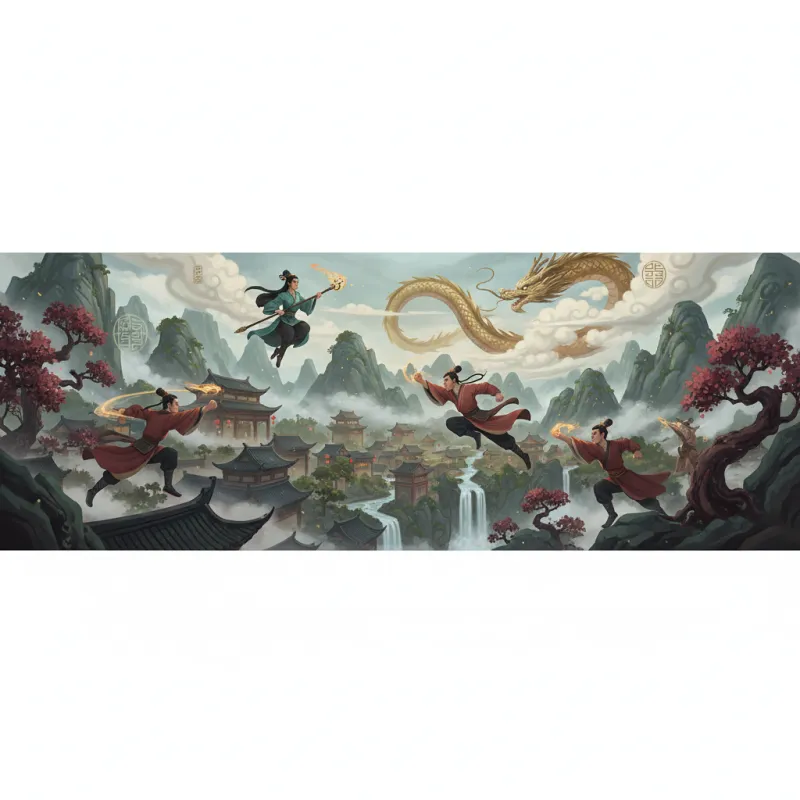
A man leaps from a rooftop, his body horizontal to the ground, suspended impossibly in mid-air for three full seconds before his sword finds its target. This isn't superhero fantasy — it's Tuesday afternoon in a Hong Kong cinema, 1967, and the audience isn't gasping in disbelief. They're nodding in recognition. Because martial arts cinema — 武术电影 (Wǔshù Diànyǐng) — never promised realism. It promised something better: a visual language for expressing the inexpressible, a way to make philosophy fly.
Shanghai Dreams and Swordplay Roots
The first martial arts films emerged in 1920s Shanghai, but they were born centuries earlier in the pages of 武侠小说 (Wǔxiá Xiǎoshuō, martial hero novels). Writers during the Ming and Qing dynasties had already solved the central problem: how do you make virtue visible? Their answer was 轻功 (Qīnggōng, lightness skill) — the ability to defy gravity, to literally rise above earthly concerns. When filmmakers adapted these stories, they inherited not just plots but an entire aesthetic philosophy that said physical impossibility could express spiritual truth.
The earliest surviving martial arts film, "The Burning of the Red Lotus Temple" (1928), ran for eighteen feature-length installments and caused such a sensation that the Nationalist government briefly banned the genre, worried it was making people believe in magic. They missed the point entirely. Audiences didn't believe people could fly — they believed that righteousness should make you feel like you could fly, and cinema had finally found a way to show that feeling.
These Shanghai films established the template: a wandering hero, usually from the 江湖 (Jiānghú, literally "rivers and lakes," meaning the martial arts underworld), who lives by a personal code of 义 (Yì, righteousness) rather than conventional law. The hero's supernatural abilities weren't superpowers in the Western sense — they were the external manifestation of internal cultivation, of 武德 (Wǔdé, martial virtue). You couldn't learn to walk on water through exercise alone; you needed moral refinement.
The Hong Kong Revolution
When the Communist revolution sent Shanghai's film industry into exile, Hong Kong became the new center of martial arts cinema. The 1960s and 70s transformed the genre from costume drama into something rawer and more immediate. Director Chang Cheh at Shaw Brothers Studio stripped away the wire-work and fantasy elements, creating what he called "yang gang" (阳刚, masculine strength) cinema — films where heroes bled, suffered, and died in balletic slow-motion.
Then came Bruce Lee, who broke every rule. His 1971 film "The Big Boss" featured no flying, no swords, no period costumes — just a man in a contemporary setting using real martial arts techniques. Lee's innovation wasn't just stylistic; it was philosophical. Traditional 武侠 heroes fought for abstract justice in a mythical past. Lee's characters fought against colonialism, economic exploitation, and racism in the present. His famous line "Don't think, feel" from "Enter the Dragon" (1973) wasn't just fight choreography advice — it was a challenge to the Western Enlightenment's privileging of reason over embodied knowledge.
Lee died at 32, but his impact made martial arts cinema a global phenomenon. Suddenly, everyone wanted to understand what Chinese martial arts traditions actually meant, even if the films themselves were often more interested in spectacle than authenticity.
Wire-Work and Wuxia's Return
The 1990s brought 武侠 back with a vengeance, but transformed by decades of technical innovation and cross-cultural pollination. Ang Lee's "Crouching Tiger, Hidden Dragon" (2000) introduced Western audiences to what Hong Kong fans had been watching for years: a cinema where emotional states became physical realities. When Zhang Ziyi's character runs up walls and across water, she's not showing off her 轻功 — she's expressing the impossibility of her love, the way desire makes you feel weightless and doomed simultaneously.
Yuen Woo-ping's wire-work choreography in these films created a new grammar of movement. Characters don't just fight; they converse through combat. The famous bamboo forest duel in "Crouching Tiger" is a negotiation, a seduction, and a philosophical debate conducted entirely through the language of bodies in motion. This is what martial arts cinema does that no other genre can: it makes abstract concepts like honor, duty, and desire into visible, kinetic forces.
Zhang Yimou's "Hero" (2002) pushed this further, using color symbolism and visual composition to create what's essentially a Rashomon-style meditation on truth and political power, all disguised as a wuxia spectacular. The film's controversial ending — where the assassin chooses not to kill the emperor because he believes in the greater good of unification — sparked genuine political debate in China. Martial arts cinema had come full circle, once again making the government nervous about its ideological implications.
The Philosophy in the Fists
What makes martial arts cinema distinctively Chinese isn't the fighting — it's the framework. These films operate on assumptions that don't translate easily to Western action cinema. The idea that decades of training can make you superhuman isn't about genetic mutation or alien technology; it's about 修炼 (Xiūliàn, cultivation), the Daoist and Buddhist concept that human potential is essentially unlimited if you're willing to do the work.
The genre's obsession with masters and students, with lineages and schools, reflects Confucian ideas about the transmission of knowledge and the importance of proper relationships. When a student betrays their master in a martial arts film, it's not just personal drama — it's a violation of cosmic order. The 师徒 (Shītú, master-student) relationship is sacred, which is why so many plots revolve around its corruption or restoration.
Even the geography matters. The 江湖 isn't just a setting; it's a parallel society with its own rules, existing alongside but separate from conventional government authority. It's where people go when the official system fails them, which is why martial arts heroes are almost always operating outside the law even when they're upholding justice. This reflects a deep Chinese cultural ambivalence about state power and the value of individual moral action.
Bodies as Texts
The best martial arts films understand that fight choreography is a form of writing. Every movement carries meaning; every exchange tells a story. When Jet Li's character in "Once Upon a Time in China" (1991) uses traditional kung fu to defeat Western boxers and firearms, it's not just nationalist wish-fulfillment — it's a complex meditation on modernity, tradition, and what gets lost in translation between cultures.
The genre's treatment of women fighters is particularly revealing. Characters like Cheng Pei-pei in "Come Drink with Me" (1966) or Michelle Yeoh in "Wing Chun" (1994) aren't just "strong female characters" in the contemporary sense. They're operating in a tradition where martial prowess has always been understood as potentially gender-neutral, where 女侠 (Nǚxiá, female martial heroes) have been literary fixtures for centuries. The films don't make a big deal about women fighting because the culture already had a framework for understanding female martial artists as normal, even admirable.
This is why Western attempts to replicate martial arts cinema often feel hollow. You can copy the wire-work and the choreography, but without the underlying cultural assumptions about cultivation, virtue, and the relationship between physical and spiritual development, you're just filming people jumping around. The Matrix (1999) succeeded precisely because it imported not just the style but the philosophy, using martial arts as a visual metaphor for enlightenment and the transcendence of perceived limitations.
The Modern Landscape
Contemporary martial arts cinema has fractured into multiple streams. Mainland China produces big-budget historical epics that often double as nationalist allegories. Hong Kong continues its tradition of inventive action choreography, though the industry has shrunk dramatically. Meanwhile, the influence has spread globally — from Indonesian action films like "The Raid" to Korean historical dramas to the fight scenes in Marvel movies.
What's been lost in this diffusion is the genre's original purpose: to make invisible things visible, to give physical form to philosophical concepts. Modern action cinema borrowed the techniques but often forgot the meaning. When John Wick performs impossible gun-fu, it's spectacular, but it's not saying anything beyond "this looks cool." When Donnie Yen's Ip Man defeats ten Japanese fighters in a single sequence, it's simultaneously a historical revenge fantasy, a meditation on Chinese national humiliation, and a demonstration of how traditional Chinese values can triumph over brute force.
The genre's future probably lies in this tension between spectacle and significance. Films like "The Grandmaster" (2013) try to preserve the philosophical depth while meeting modern audience expectations for visual innovation. Whether martial arts cinema can maintain its cultural specificity while remaining globally popular is an open question.
The Legacy in Motion
Martial arts films changed world cinema in ways that extend far beyond fight choreography. They proved that non-Western narrative structures could work for global audiences, that philosophical complexity and spectacular action weren't mutually exclusive, and that the human body in motion could be as expressive as any dialogue or close-up.
More importantly, they exported a set of ideas about human potential, moral cultivation, and the relationship between individual and society that continue to resonate. When someone watches a martial arts film and feels inspired to train, to improve themselves, to believe that dedication and discipline can transform you — that's not just entertainment. That's the genre doing exactly what it was designed to do: making virtue visible, making philosophy fly.
The flying fists were never just about fighting. They were about showing what it looks like when someone becomes more than they were, when training and moral cultivation lift you above ordinary human limitations. In a world that often feels heavy and earthbound, martial arts cinema offers something precious: the image of human beings who have learned to soar.
Related Reading
- Chinese Animation: From Ink Wash Classics to Global Hits
- Chinese Cinema: An Essential Guide for Film Lovers
- Chinese Cinema: How Kung Fu Films Conquered the World
- Chinese Cinema's Global Moment: From Wuxia to Art House to Marvel
- Famous Calligraphers Through History
- Chinese Tea Culture: A Journey Through 5,000 Years of Brewing
- Learning Chinese: An Honest Guide for Complete Beginners
Explore Chinese Culture
- Explore feng shui in daily life
- Explore supernatural folklore
- Explore classical Chinese literature