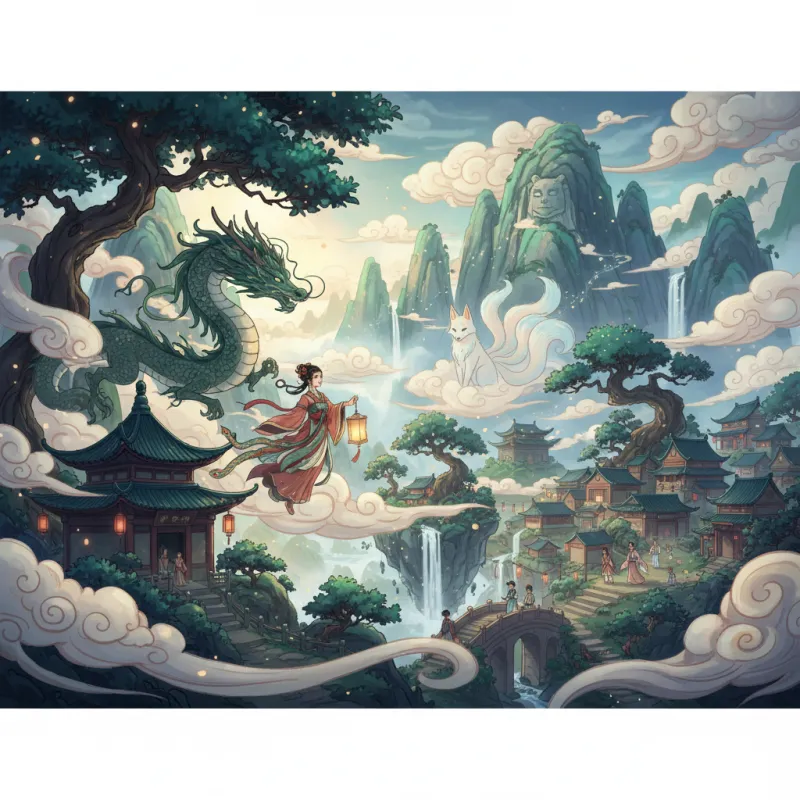
A monkey king somersaults across clouds made of brushstrokes. Each frame looks like it was painted by a Song Dynasty master, yet the character moves with fluid grace that would make Disney animators jealous. This is "Havoc in Heaven" (大闹天宫, Dà Nào Tiān Gōng), a 1961 masterpiece that represents everything unique about Chinese animation — and everything the world almost lost.
The Ink Wash Revolution Nobody Talks About
Chinese animation didn't start by copying anyone. While Disney perfected cel animation and Japan developed its distinctive anime style, China's Shanghai Animation Film Studio invented something entirely different: ink wash animation (水墨动画, Shuǐmò Dònghuà). The 1960 short "Where is Mama?" (小蝌蚪找妈妈, Xiǎo Kēdǒu Zhǎo Māma) literally animated traditional Chinese paintings. Not paintings that looked animated — actual brush-and-ink techniques transferred frame by frame onto film.
The technical achievement was staggering. Artist Te Wei (特伟) and his team figured out how to maintain the spontaneous, living quality of ink wash painting while creating consistent character movement. Western animation relied on clean lines and solid colors. Japanese anime developed its signature limited animation style. Chinese animators were trying to make paintings breathe. When "Feeling from Mountain and Water" (山水情, Shānshuǐ Qíng) premiered in 1988, international critics called it impossible — animation that captured the philosophical depth of traditional Chinese landscape painting while telling a moving story about a master and student.
This wasn't just aesthetic preference. It was cultural assertion. Chinese animation drew from Chinese opera traditions, shadow puppetry (皮影戏, Píyǐng Xì), and paper-cutting folk art. Characters moved with the stylized gestures of Beijing Opera performers. Villains wore the face paint patterns of traditional theater. The visual language came from centuries of Chinese artistic tradition, not from Western animation studios.
The Golden Age That Almost Everyone Missed
Between 1950 and 1990, Shanghai Animation Film Studio produced works that should be studied in every animation school. "Havoc in Heaven" took four years to complete and employed virtually every animator in China. The result was two hours of hand-drawn brilliance that told the Journey to the West story with more personality and visual invention than most modern CGI blockbusters manage.
The studio's output was remarkably diverse. "The Monkey King: Uproar in Heaven" (1961-1964) used bold colors and dynamic action. "The Cowboy's Flute" (牧笛, Mù Dí, 1963) employed soft ink wash techniques for a pastoral story. "Nezha Conquers the Dragon King" (哪吒闹海, Nézhā Nào Hǎi, 1979) combined traditional line art with modern character design. Each film looked distinctly Chinese while pushing animation techniques forward.
But here's the tragedy: almost nobody outside China saw them. These films played at international festivals, won awards, influenced animators who encountered them — but they never achieved the global distribution of Disney or the cult following of anime. Language barriers played a role, but so did Cold War politics and the simple fact that China's film export infrastructure was minimal. Hayao Miyazaki has cited Chinese animation as a major influence, particularly "Princess Iron Fan" and the Wan Brothers' work. Yet most Western animation fans have never heard of Te Wei or seen "Feeling from Mountain and Water."
The Lost Decades and the Donghua Renaissance
The 1990s and early 2000s were brutal for Chinese animation. State funding dried up. Shanghai Animation Film Studio struggled. The market flooded with cheaper foreign imports and domestic productions that tried to copy Japanese anime or American cartoons without understanding what made them work. Chinese animation became synonymous with low-budget children's shows and propaganda pieces.
Then something shifted around 2015. A new generation of Chinese animators, many trained abroad or influenced by global animation, started creating work that was unapologetically Chinese but technically sophisticated and narratively ambitious. They weren't trying to make Chinese anime or Chinese Disney films. They were asking: what does Chinese animation look like in the 21st century?
"Big Fish & Begonia" (大鱼海棠, Dà Yú Hǎitáng, 2016) answered with a visually stunning film that drew from "Classic of Mountains and Seas" (山海经, Shān Hǎi Jīng) mythology and Hakka tulou architecture. "White Snake" (白蛇:缘起, Bái Shé: Yuánqǐ, 2019) retold the classic Legend of the White Snake with fluid CGI animation that finally matched the technical quality of major Japanese and American studios. These weren't perfect films — both had narrative issues — but they proved Chinese studios could produce theatrical animation that looked expensive and felt culturally specific.
Ne Zha and the Billion-Dollar Proof
Then came "Ne Zha" (哪吒之魔童降世, Nézhā zhī Mótóng Jiàngshì) in 2019, and everything changed. This punk-rock reimagining of the Nezha mythology earned over $700 million at the Chinese box office, becoming the highest-grossing animated film in Chinese history. More importantly, it was genuinely good — funny, emotionally resonant, visually inventive, and willing to subvert expectations about how Chinese mythology should be portrayed.
Director Yang Yu (饺子, Jiǎozi) made Nezha an ugly, mischievous kid rejected by his community rather than a noble hero. The film kept the core mythology — the conflict with the Dragon King, the relationship with his parents, the themes of destiny and sacrifice — but told it with modern sensibilities and spectacular action sequences. It proved that Chinese animation could be commercially successful, culturally rooted, and creatively bold simultaneously.
"Jiang Ziya: Legend of Deification" (姜子牙, Jiāng Zǐyá, 2020) followed with $300+ million. "New Gods: Nezha Reborn" (新神榜:哪吒重生, Xīn Shén Bǎng: Nézhā Chóngshēng, 2021) reimagined the character in a cyberpunk setting. "New Gods: Yang Jian" (新神榜:杨戬, Xīn Shén Bǎng: Yáng Jiǎn, 2022) continued the trend. Chinese studios had found a formula: take classical mythology, apply modern animation techniques, don't be afraid to reinterpret, and trust that audiences want stories rooted in their own culture.
The Donghua Streaming Explosion
While theatrical animation grabbed headlines, Chinese streaming platforms quietly built a massive donghua (动画, the Chinese term for animation) industry. Series like "The King's Avatar" (全职高手, Quánzhí Gāoshǒu), "Mo Dao Zu Shi" (魔道祖师, Mó Dào Zǔ Shī), and "Heaven Official's Blessing" (天官赐福, Tiān Guān Cì Fú) attracted millions of viewers and demonstrated that Chinese animation could sustain long-form storytelling.
These series draw heavily from web novels and manhua (Chinese comics), creating a multimedia ecosystem similar to Japan's manga-anime-light novel pipeline. The animation quality varies — some episodes look spectacular, others clearly stretched budgets — but the ambition is undeniable. "Link Click" (时光代理人, Shíguāng Dàilǐ Rén) tells a time-travel story with genuine emotional weight and clever plotting. "Scissor Seven" (刺客伍六七, Cìkè Wǔ Liù Qī) combines slapstick comedy with surprisingly poignant character development.
What's notable is how these series handle Chinese cultural elements. They don't explain everything for international audiences, but they're not impenetrable either. Characters drink tea, practice cultivation (修炼, Xiūliàn), navigate complex social hierarchies, and reference historical periods — all presented as normal rather than exotic. It's animation made primarily for Chinese audiences that happens to have found international fans, rather than animation designed for global markets from the start.
What Makes Chinese Animation Chinese?
After decades of evolution, certain elements consistently appear in Chinese animation. There's a preference for ensemble casts and complex relationships over individual heroes. Stories often explore themes of duty, sacrifice, and the tension between personal desire and social obligation — very Confucian concerns even in fantasy settings. Visual design frequently incorporates traditional architecture, clothing, and artistic motifs, even in futuristic or fantastical contexts.
The pacing tends to be different too. Chinese animation often takes time for contemplative moments, landscape shots, and character interactions that don't advance the plot. This reflects both traditional Chinese narrative structures and the influence of ink wash animation's meditative quality. Even in action-heavy films like "Ne Zha," there are quiet scenes that let emotions breathe.
Most distinctively, Chinese animation draws from an enormous well of mythology, history, and literature that remains relatively unknown internationally. Every Chinese viewer knows Nezha, the Monkey King, Jiang Ziya, and the basic stories of "Journey to the West" and "Investiture of the Gods" (封神演义, Fēngshén Yǎnyì). This shared cultural knowledge allows animators to subvert expectations, play with conventions, and tell stories that assume audience familiarity with the source material.
The Global Future of Donghua
Chinese animation is no longer trying to catch up with Japan or America. It's establishing its own identity and export market. Netflix, Crunchyroll, and other platforms now regularly license donghua. International animation studios increasingly partner with Chinese companies. The technical gap has essentially closed — Chinese studios can produce animation that matches any global standard.
The question now is whether Chinese animation can achieve the cultural penetration that anime has managed. Will international audiences embrace donghua the way they embraced Studio Ghibli and "Demon Slayer"? The signs are promising but uncertain. "Ne Zha" barely registered outside China despite its massive domestic success. But "Link Click" found genuine international fandom, and younger viewers seem increasingly willing to engage with animation from multiple cultural traditions.
What's certain is that Chinese animation has reclaimed its place as a major force in global animation. The ink wash masters of the 1960s would recognize the cultural confidence of today's donghua, even if the techniques have evolved. Chinese animation is no longer a historical curiosity or a cheap alternative to Japanese anime. It's a distinct tradition with its own aesthetics, storytelling approaches, and creative ambitions — and it's just getting started.
Related Reading
- Chinese Cinema: An Essential Guide for Film Lovers
- Chinese Cinema: How Kung Fu Films Conquered the World
- Martial Arts Films: A History of Flying Fists and Hidden Meaning
- Chinese Cinema's Global Moment: From Wuxia to Art House to Marvel
- Legendary Flavors: Exploring Chinese Food Folklore and Timeless Culinary Traditions
- Unveiling the Rich Tapestry of Chinese Folklore and Legends
- Unveiling the Rich Tapestry of Chinese Folklore and Festival Origins
Explore Chinese Culture
- Explore feng shui in daily life
- Explore supernatural folklore
- Explore classical Chinese literature