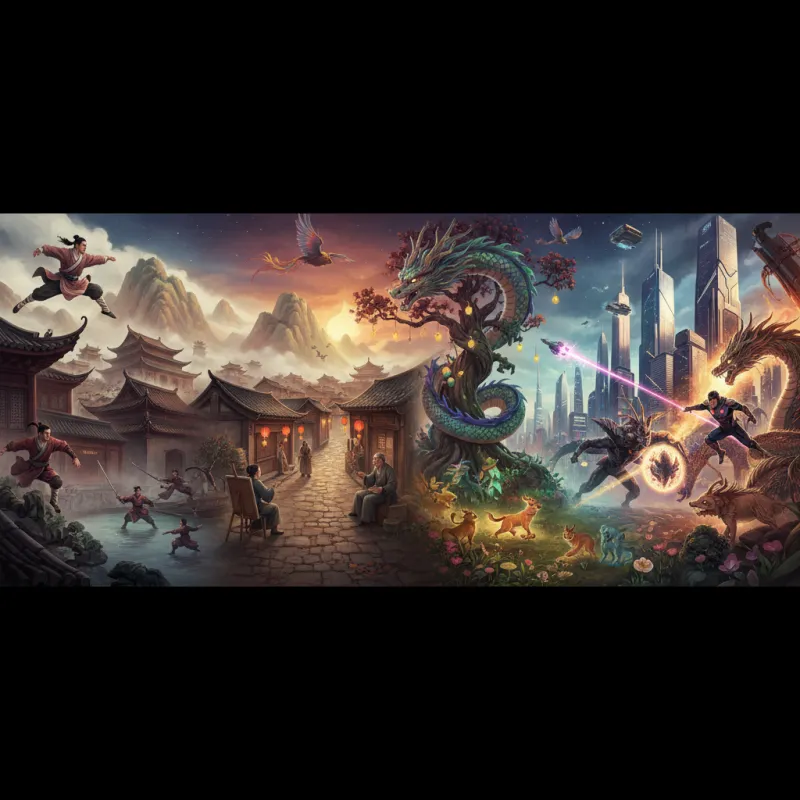
When Simu Liu's Shang-Chi landed a $432 million opening weekend in 2021, it wasn't just another Marvel origin story—it was the culmination of a fifty-year campaign to make Chinese faces, fighting styles, and storytelling rhythms feel native to global cinema. But the path from Bruce Lee's one-inch punch to a Chinese superhero in the MCU reveals something more complex than simple "breaking through": it's a story of strategic retreats, artistic compromises, and the persistent question of whether global success requires cultural dilution.
The Action Vanguard: When Fists Spoke Louder Than Subtitles
Bruce Lee didn't introduce Chinese cinema to the world—he detonated it. Enter the Dragon (1973) grossed over $200 million worldwide at a time when that was genuinely shocking money for a non-Hollywood production. But Lee's genius wasn't just physical; it was strategic. He understood that wuxia (武侠, wǔxiá)—the centuries-old tradition of martial heroes—could be stripped down to its kinetic essence and made universally legible.
Jackie Chan refined this formula further, adding slapstick comedy that transcended language barriers. By the 1990s, John Woo was exporting bullet ballet to Hollywood itself, directing Face/Off and Mission: Impossible 2. The Hong Kong action wave succeeded because it required zero cultural context. A flying kick needs no footnotes.
But this accessibility came at a cost. For decades, Western audiences conflated "Chinese cinema" with "kung fu movies," blind to the psychological dramas, historical epics, and experimental films being made on the mainland. The action wave opened a door but also built a wall—Chinese cinema was exciting, but it wasn't serious.
The Prestige Pivot: When Film Festivals Became Gatekeepers
Zhang Yimou's Raise the Red Lantern (1991) represented a radical strategic shift. Instead of chasing mass audiences, the Fifth Generation directors—so called because they were the fifth class to graduate from the Beijing Film Academy after the Cultural Revolution—courted film festival juries. Zhang, Chen Kaige, and Tian Zhuangzhuang created visually sumptuous, politically allegorical films designed to win Cannes, Venice, and Berlin.
The strategy worked brilliantly. Farewell My Concubine (1993) won the Palme d'Or. Zhang Yimou became the go-to director for "important" Chinese cinema. Wong Kar-wai's In the Mood for Love (2000) turned Hong Kong nostalgia into high art, with Maggie Cheung's cheongsams (旗袍, qípáo) becoming as iconic as anything in Hitchcock.
But the art house wave created its own trap. These films often performed better in Paris than in Beijing. Chinese critics accused directors like Zhang of creating "Orientalist" spectacles—beautiful, exotic, and ultimately designed for Western consumption. The elaborate period costumes, the emphasis on political repression, the slow-burn pacing—all of it felt calculated to satisfy Western assumptions about what "authentic" Chinese cinema should look like. As film critic Dai Jinhua acidly noted, these directors were "selling China's wounds" to foreign audiences.
The tension was real: Hero (2002), Zhang Yimou's wuxia epic, was criticized in China for its perceived endorsement of authoritarianism, while Western critics praised its visual beauty but found its politics troubling. The film grossed $177 million worldwide—proving that art house prestige could translate to commercial success—but the ideological debates it sparked revealed how fraught the "global moment" had become.
The Marvel Compromise: Representation Without Roots
Shang-Chi and the Legend of the Ten Rings represents the third wave: full integration into Hollywood's machinery. Simu Liu is a Chinese-Canadian actor playing a Chinese-American character in a film directed by Destin Daniel Cretton (who is Japanese-American). The film features Mandarin dialogue, references to Chinese mythology, and fight choreography by Brad Allan, a student of Jackie Chan.
It's also, unmistakably, a Marvel movie—complete with CGI dragon battles, a glowing MacGuffin, and the requisite post-credits scenes. The Chinese elements are present but subordinated to the Marvel formula. This is representation, but it's representation on Hollywood's terms.
The film's reception in China was lukewarm. It grossed only $56 million there, compared to $224 million in North America. Chinese audiences found the depiction of Chinese culture superficial, the Mandarin dialogue awkward, and the story too Americanized. The film succeeded globally by making Chinese culture accessible—but accessibility, once again, meant simplification.
Compare this to The Wandering Earth (2019), China's homegrown sci-fi blockbuster that grossed $700 million, mostly in China. The film's collectivist ethos, its emphasis on sacrifice for the greater good, and its vision of international cooperation led by Chinese engineers felt authentically Chinese in ways that Shang-Chi never attempted. But The Wandering Earth barely registered in Western markets, earning just $6 million in North America.
The Streaming Shuffle: TikTok Aesthetics and Micro-Dramas
The newest development in Chinese cinema's global reach isn't happening in theaters at all. Short-form dramas (短剧, duǎnjù) and streaming content are finding massive audiences on platforms like TikTok, YouTube, and specialized apps. These micro-dramas—often just 1-2 minutes per episode—are designed for mobile consumption and algorithm-driven discovery.
Shows like The Longest Promise and historical dramas featuring elaborate costumes and romantic intrigue are being discovered by global audiences who never set foot in an art house cinema. The aesthetics draw from wuxia traditions and historical epics, but the pacing is pure social media—fast cuts, emotional peaks every few seconds, cliffhangers designed to trigger the "next episode" reflex.
This represents a fourth wave that bypasses traditional gatekeepers entirely. No film festival jury, no Hollywood studio, no distribution deal required. Chinese content creators are speaking directly to global audiences, and the audiences are responding—not because the content has been translated or simplified, but because the platform itself is universal.
The irony is that these micro-dramas often contain more untranslated Chinese cultural content than prestige films ever did. Viewers are learning about Chinese festivals and traditional clothing through addictive serialized storytelling, not through carefully curated art house experiences.
The Paradox of Global Success
Each wave of Chinese cinema's global expansion has succeeded by making different compromises. The action wave sacrificed cultural specificity for kinetic universality. The art house wave courted Western tastemakers but risked Orientalism. The Marvel integration achieved representation but within a Hollywood formula. The streaming wave bypasses gatekeepers but fragments into algorithm-optimized content.
The question isn't whether Chinese cinema has achieved a "global moment"—it clearly has, multiple times. The question is whether global success requires cultural translation so thorough that what arrives on foreign screens is no longer recognizably Chinese in any meaningful sense.
Ang Lee's Crouching Tiger, Hidden Dragon (2000) remains the highest-grossing foreign-language film in American history precisely because it threaded this needle. It was a wuxia film that honored the genre's traditions while making them accessible to audiences who'd never heard of Jin Yong (金庸, Jīn Yōng), the novelist whose work defined modern wuxia. The film's Mandarin dialogue, its meditation on Daoist philosophy, and its tragic romance felt authentically Chinese—but the emotional core was universal enough that American audiences connected without needing footnotes.
Beyond the Binary: What Comes Next
The future of Chinese cinema's global presence likely isn't a single wave but a fragmented ecosystem. Prestige directors like Jia Zhangke continue making uncompromising art films for festival circuits. Blockbusters like The Battle at Lake Changjin (2021) break Chinese box office records while barely registering internationally. Streaming platforms create parallel universes of content optimized for different algorithms and audiences.
Meanwhile, Chinese-American filmmakers like Lulu Wang (The Farewell) and Domee Shi (Turning Red) are telling diasporic stories that complicate the very notion of "Chinese cinema." These films aren't trying to represent China to the world—they're exploring what it means to be Chinese in a globalized context where identity itself is hybrid and contested.
The most interesting development may be the youngest generation of Chinese filmmakers who've grown up watching Hollywood, Hong Kong action films, Japanese anime, and Korean dramas simultaneously. Their work doesn't fit neatly into "Chinese cinema" or "global cinema" categories—it's simply cinema, made by people whose cultural references are already transnational.
Perhaps the real "global moment" isn't when Chinese cinema breaks through to international audiences, but when the distinction between "Chinese" and "global" cinema becomes meaningless. When a film can feature Mandarin dialogue, wuxia choreography, and references to Chinese mythology without needing to explain itself or apologize for its specificity. When audiences everywhere are fluent enough in multiple cinematic languages that cultural translation becomes unnecessary.
We're not there yet. But the fifty-year journey from Bruce Lee to Shang-Chi suggests we're closer than we've ever been—even if the path forward remains as complex and contested as the one behind us.
Related Reading
- Chinese Animation: From Ink Wash Classics to Global Hits
- Chinese Cinema: An Essential Guide for Film Lovers
- Chinese Cinema: How Kung Fu Films Conquered the World
- Martial Arts Films: A History of Flying Fists and Hidden Meaning
- The History of Chinese Characters: From Oracle Bones to Emojis
- Chinese Herbal Medicine: A Beginner's Guide
- Must-Visit Cultural Sites in China: A Heritage Traveler's List
Explore Chinese Culture
- Explore feng shui in daily life
- Explore supernatural folklore
- Explore classical Chinese literature