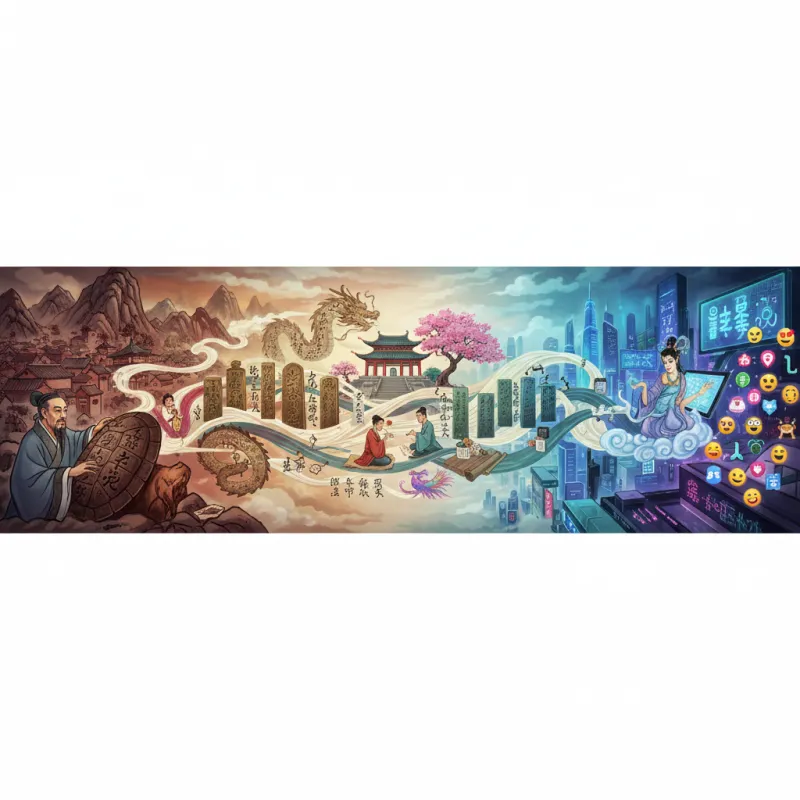
Picture a Shang Dynasty priest in 1200 BCE, hunched over a turtle shell, carving symbols with a bronze knife. He heats the shell until it cracks, reads the fracture pattern as divine prophecy, then records the answer in scratches that look more like abstract art than writing. Fast forward to today: a teenager in Shanghai types those same symbols — evolved but recognizable — into WeChat using predictive text and emoji. That's 3,200 years of continuous use, making Chinese characters the world's oldest living writing system.
Oracle Bones: When Writing Was Prophecy
The earliest confirmed Chinese writing appears on 甲骨文 (Jiǎgǔwén, oracle bone script) from the late Shang Dynasty. These weren't literary texts or administrative records — they were conversations with the dead. Royal diviners would carve questions onto turtle plastrons or ox scapulae: "Will Lady Hao's childbirth be safe?" "Should we attack the Qiang tribes in three days?" The bone was heated until it cracked, and the pattern of fractures revealed the ancestors' answer.
What's remarkable is that these weren't primitive pictograms. Oracle bone script already contained around 5,000 distinct characters, many showing sophisticated principles that still govern Chinese writing today. The character 明 (míng, bright) combined 日 (sun) and 月 (moon). The character 休 (xiū, rest) showed a person leaning against a tree. These weren't random pictures — they were a systematic encoding of meaning through visual logic.
The discovery of oracle bones in 1899 was accidental. Farmers near Anyang were selling "dragon bones" to traditional medicine shops, grinding them into powder for remedies. A scholar named Wang Yirong noticed strange markings on the bones and realized they were ancient writing. Over 150,000 oracle bone fragments have since been excavated, providing our earliest window into Chinese language, history, and thought.
Bronze, Bamboo, and the Standardization Wars
As the Shang gave way to the Zhou Dynasty (1046-256 BCE), writing moved from bones to bronze. 金文 (Jīnwén, bronze script) appeared on ritual vessels, often recording royal decrees or military victories. The characters became more elaborate, more decorative — compare the oracle bone 馬 (horse) to its bronze equivalent, which added flowing lines suggesting a mane.
But here's where things got messy. As the Zhou Dynasty fractured into warring states, regional scripts diverged wildly. The character for "horse" might have seven different forms across seven kingdoms. This wasn't just an aesthetic issue — it was a barrier to communication, trade, and governance.
Enter Qin Shi Huang, China's first emperor and history's most effective (if brutal) standardizer. In 221 BCE, after conquering the other states, he ordered the creation of 小篆 (Xiǎozhuàn, small seal script) as the official writing system. Regional variants were banned. Scholars who resisted were buried alive, along with their books. It was cultural genocide in service of unity — and it worked. Small seal script became the ancestor of all modern Chinese characters.
The Qin Dynasty also introduced another innovation that would prove equally important: 隶书 (Lìshū, clerical script). Developed by government clerks who needed to write faster, clerical script simplified the flowing curves of seal script into angular strokes. This was the moment Chinese characters became truly practical for everyday use, not just ritual or official purposes.
The Golden Age: When Characters Became Art
The Han Dynasty (206 BCE - 220 CE) saw the emergence of 楷书 (Kǎishū, regular script), the standard form still taught in schools today. But the real revolution was aesthetic. Calligraphy became one of China's highest art forms, ranked alongside poetry and painting. The way you wrote mattered as much as what you wrote.
Wang Xizhi (303-361 CE), often called the "Sage of Calligraphy," elevated character writing to spiritual practice. His 兰亭序 (Lántíng Xù, Preface to the Orchid Pavilion) is considered the greatest piece of calligraphy in Chinese history — and the original has been lost for over a thousand years. Emperor Taizong of Tang loved it so much he had it buried with him. What survives are copies of copies, each generation of calligraphers trying to capture Wang Xizhi's perfect balance of structure and spontaneity.
This period also saw the development of 草书 (Cǎoshū, cursive script) and 行书 (Xíngshū, running script). Cursive script was so abbreviated that characters became almost abstract — readable only to the educated elite. It was writing as performance, as meditation, as a window into the writer's inner state. The Tang Dynasty poet Zhang Xu would allegedly get drunk and use his hair as a brush, creating "wild cursive" that shocked and delighted viewers.
The Simplification Debate: Revolution or Vandalism?
For most of Chinese history, literacy was an elite privilege. The complexity of characters — some requiring 20+ strokes — meant years of study. In 1949, when the Communist Party took power, the literacy rate was around 20%. Something had to change.
The solution was 简化字 (Jiǎnhuàzì, simplified characters), officially introduced in 1956. The character 龍 (dragon) became 龙. The character 聽 (listen) became 听. Over 2,000 characters were simplified, some losing more than half their strokes. The goal was noble: make literacy accessible to the masses.
The results were dramatic. China's literacy rate is now over 95%. But the simplification remains controversial. Critics argue that simplified characters severed the visual logic that made characters memorable. The traditional 愛 (ài, love) contains 心 (heart) — love requires heart. The simplified 爱 removes the heart entirely. The traditional 聽 (tīng, listen) shows an ear, eyes, and heart — listening requires full attention. The simplified 听 just shows a mouth next to an axe.
Taiwan, Hong Kong, and overseas Chinese communities largely rejected simplification, continuing to use traditional characters. This created a split that persists today. Mainland Chinese often struggle to read traditional characters; Taiwanese find simplified characters aesthetically impoverished. It's not just a writing system debate — it's about cultural identity and what gets lost in the name of progress.
Digital Age: Teaching Computers to Think in Characters
The computer age should have killed Chinese characters. How do you type thousands of unique symbols on a keyboard with 26 letters? Early predictions suggested Chinese would need to romanize or face technological obsolescence.
Instead, Chinese characters thrived. The solution was input methods based on 拼音 (Pīnyīn), the romanization system developed in the 1950s. Type "zhong" and the computer offers 中 (middle), 钟 (clock), 重 (heavy), 种 (seed), and dozens more. Context-aware algorithms predict which character you want based on surrounding text. Modern input methods are so sophisticated that many Chinese users type faster than English speakers.
But there's a dark side. A generation of Chinese people can type characters they can't write by hand. This phenomenon — 提笔忘字 (tíbǐ wàngzì, "pick up the pen, forget the character") — has sparked concern about cultural loss. TV shows like 中国汉字听写大会 (Chinese Character Dictation Competition) became surprise hits, tapping into anxiety about digital amnesia.
The rise of emojis has created another fascinating twist. Chinese users often combine characters with emojis in ways that create new meanings. The character 囧 (jiǒng), originally meaning "bright," looks like a sad face and has been repurposed as an emoji-like expression of embarrassment. Ancient oracle bone logic — using visual form to convey meaning — has returned in digital form.
Unicode and the Future: 100,000 Characters and Counting
Unicode, the universal character encoding system, currently includes over 97,000 Chinese characters. Most people use fewer than 3,000 in daily life. So why encode obscure characters that appear in only one ancient text or regional dialect?
Because Chinese characters aren't just a writing system — they're a historical archive. Each character preserves linguistic, cultural, and philosophical information. The character 孝 (xiào, filial piety) shows an old person supported by a child, encoding a core Confucian value in visual form. The character 家 (jiā, home) shows a pig under a roof, reflecting ancient agricultural life when pigs were kept indoors.
New characters are still being created. In 2020, the character 𰻝 (biáng), used in the Shaanxi dish 𰻝𰻝面 (biángbiáng noodles), was finally added to Unicode. With 58 strokes, it's one of the most complex characters in existence — and it was invented relatively recently, possibly in the Qing Dynasty. The character is so complicated that restaurants often just draw it on their signs.
Why Characters Survived When Other Ancient Scripts Died
Egyptian hieroglyphs died because they were tied to a specific religion and political system. When that system collapsed, the script became meaningless. Sumerian cuneiform died because it was replaced by more efficient alphabetic systems. Chinese characters survived because they evolved.
The genius of Chinese characters is their flexibility. They can represent ancient classical Chinese, modern Mandarin, Cantonese, Japanese, Korean (historically), and even English loanwords. The character 的 (de) has no fixed pronunciation — it adapts to whatever language uses it. This adaptability, combined with China's cultural continuity, meant characters could survive dynasty changes, foreign invasions, and technological revolutions.
Today, Chinese characters are experiencing a renaissance. Calligraphy is trendy again among young people. Character-based design dominates Chinese branding and advertising. Even non-Chinese speakers get character tattoos (often hilariously mistranslated). The characters that began as cracks in turtle shells have become a global aesthetic, a bridge between ancient wisdom and digital modernity. Oracle bone priests couldn't have imagined their scratches would survive three millennia. What will Chinese characters look like in another three thousand years? If history is any guide, they'll still be recognizable — evolved, adapted, but fundamentally the same system that has carried Chinese civilization from the Bronze Age to the space age.
Related Reading
- Chinese Idioms in Daily Life: Stories Behind Common Sayings
- Learning Chinese: An Honest Guide for Complete Beginners
- The Chinese Language: Why It Is Both Impossible and Beautiful
- The Chinese Language: Why It Is Both Harder and Easier Than You Think
- Exploring Transformation in Chinese Folklore: Legends, Fairy Tales, and Cultural Traditions
- The Chinese Zodiac: All 12 Animals Explained
- Why Chinese Food Tastes Different in China: A Culinary Reality Check
Explore Chinese Culture
- Explore feng shui in daily life
- Explore supernatural folklore
- Explore classical Chinese literature