That orange chicken you love? It doesn't exist in China. Neither does General Tso's chicken, fortune cookies, or those puffy egg rolls. Walk into any restaurant in Beijing, Chengdu, or Guangzhou and ask for them—you'll get blank stares. The "Chinese food" most Westerners know is a parallel universe cuisine, invented by immigrants who had to work with what they had and what their customers would actually eat.
The Adaptation Game
When Chinese immigrants arrived in America during the Gold Rush era of the 1850s, they faced a brutal reality: no Sichuan peppercorns, no proper soy sauce, no bok choy. They had to improvise with cabbage, bell peppers, and whatever meat was cheap. The result was a new cuisine entirely—Chinese-American food.
This wasn't culinary fraud. It was survival and entrepreneurship. Chop suey (杂碎, zá suì, literally "odds and ends") became wildly popular in early 1900s America, though no one in China had heard of it. Sweet and sour pork evolved from Cantonese cooking but became something entirely different—thick, neon-red sauce instead of the lighter, tangier Cantonese version. General Tso's chicken was invented in Taiwan in the 1950s, then transformed again when it hit New York in the 1970s, becoming sweeter and crispier to match American tastes.
The same pattern repeated everywhere Chinese immigrants settled. In Britain, they created dishes swimming in thick, gloopy sauces. In Australia, they developed honey chicken. Each adaptation reflected local ingredients, local tastes, and what would sell.
The Eight Culinary Universes
China doesn't have one cuisine—it has eight major regional traditions (八大菜系, bā dà cài xì), each as distinct as French food is from Turkish food. These aren't minor variations; they're fundamentally different approaches to cooking.
Sichuan cuisine (川菜, chuān cài) is famous for málà (麻辣)—the numbing-spicy combination of Sichuan peppercorns and chili peppers. Real Sichuan food makes your lips tingle and your forehead sweat. Dishes like mapo tofu and twice-cooked pork are complex, layered with flavors that build and change as you eat. The "Szechuan" dishes in Western Chinese restaurants are usually just spicy, missing the numbing sensation entirely.
Cantonese cuisine (粤菜, yuè cài) from Guangdong province emphasizes freshness and natural flavors. Steaming and stir-frying preserve the ingredients' essence. Dim sum—those small plates served with tea—is Cantonese. So is char siu (叉烧, chā shāo), the red-glazed barbecue pork. Most Chinese restaurants abroad are Cantonese-influenced because the majority of early Chinese immigrants came from Guangdong, but even these dishes got heavily modified.
Shandong cuisine (鲁菜, lǔ cài) is the oldest, dating back over 2,500 years, and heavily influenced imperial court cooking. It's known for seafood, clear broths, and precise knife work. You'll rarely find it outside China.
Jiangsu cuisine (苏菜, sū cài) is refined and slightly sweet, famous for "red cooking" (红烧, hóng shāo)—braising in soy sauce, sugar, and Shaoxing wine. The city of Yangzhou is legendary for its fried rice, which bears no resemblance to the greasy takeout version.
Zhejiang cuisine (浙菜, zhè cài) focuses on fresh, seasonal ingredients, especially seafood and bamboo shoots. It's delicate, never heavy.
Fujian cuisine (闽菜, mǐn cài) is known for soups and the use of red wine lees in cooking. It's umami-rich and complex.
Hunan cuisine (湘菜, xiāng cài) is spicy like Sichuan but without the numbing peppercorns—just pure, aggressive heat. Chairman Mao was from Hunan and loved his home province's food.
Anhui cuisine (徽菜, huī cài) specializes in wild herbs and game, with heavy use of ham and rock sugar.
Each region has dozens of sub-styles. Saying you like "Chinese food" is meaningless—which China? Which province? Which city?
The Texture Obsession
One of the biggest disconnects between Chinese and Western food culture is texture. In China, texture (口感, kǒu gǎn) is as important as flavor—sometimes more important.
Chinese diners prize slippery, gelatinous, crunchy, and chewy textures that many Westerners find off-putting. Sea cucumber is prized not for its bland taste but for its unique springy texture. Chicken feet are popular because of the collagen-rich, slightly sticky mouthfeel. Wood ear mushrooms appear in countless dishes purely for their crisp, snappy texture.
This is why Chinese restaurants abroad often avoid authentic textures. Serving jellyfish salad or pig ear in cold sauce would alienate most Western customers. Instead, everything gets breaded and fried to a uniform crunch, or stir-fried to a familiar tender-crisp. The textural diversity of real Chinese cooking gets flattened into what Western palates expect.
The Spice Spectrum
"Chinese food is spicy" is a myth born from limited exposure. Most Chinese regional cuisines aren't spicy at all. Cantonese food is mild. Jiangsu food is slightly sweet. Shandong food focuses on savory, salty flavors.
Only Sichuan and Hunan cuisines are genuinely spicy, and even then, the heat serves a purpose beyond pain. Sichuan's málà creates a complex sensation—the peppercorns numb your mouth while the chilies burn it, creating a strange, addictive tingle. It's not about proving your toughness; it's about experiencing a unique flavor profile.
The "spicy" dishes in Western Chinese restaurants are usually just doused in chili oil without the sophistication. Real Sichuan cooking balances seven flavors: sour, sweet, bitter, spicy, numbing, fragrant, and salty. Western versions typically hit two: sweet and spicy.
The Rice and Noodle Divide
Here's something that surprises many Westerners: northern Chinese people don't eat much rice. The north-south divide in China is fundamental. Northern China grows wheat; southern China grows rice. This creates entirely different food cultures.
In Beijing, Xi'an, and other northern cities, people eat noodles, dumplings, steamed buns (馒头, mán tou), and flatbreads. Rice is occasional, not daily. The famous hand-pulled noodles (拉面, lā miàn) are northern. So are jiaozi dumplings and baozi buns.
Southern Chinese eat rice with nearly every meal, but it's not fried rice—that's a way to use leftovers. Fresh steamed rice is the standard, served plain to accompany flavorful dishes. The rice is meant to be a neutral base, not a main attraction.
This regional divide barely exists in Western Chinese restaurants, where fried rice appears on every menu regardless of the restaurant's supposed regional focus. It's a tell that you're eating adapted food, not authentic regional cuisine.
The Banquet Philosophy
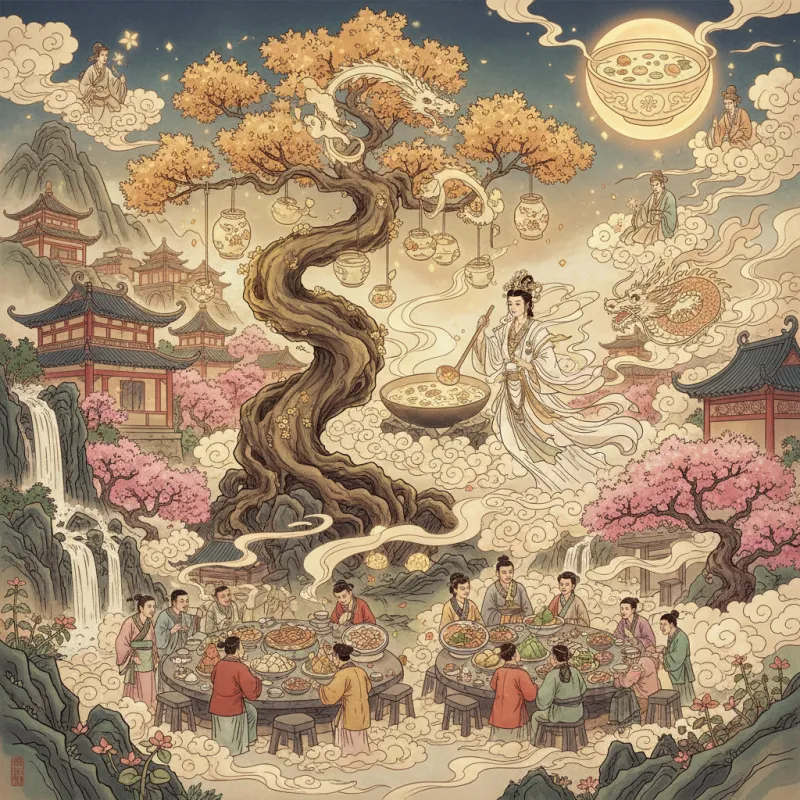
Chinese dining culture revolves around sharing. Ordering individual plates is a Western concept. In China, you order multiple dishes for the table—usually one dish per person plus one extra—and everyone shares. This isn't just etiquette; it's philosophy.
The variety matters. A proper meal balances flavors, textures, colors, and cooking methods. You might have a braised dish, a stir-fried dish, a steamed dish, and a soup. Something spicy, something mild. Something with meat, something vegetable-based. The goal is harmony (和, hé), a concept that extends from Chinese philosophy into the dining experience.
Western Chinese restaurants adapted to individual ordering because that's what customers expected. But this fundamentally changes the experience. Chinese food is designed to be eaten in variety, not as a single plate of orange chicken with fried rice.
The Ingredient Gap
Even when Western Chinese restaurants try to be authentic, they face an ingredient problem. Many essential Chinese ingredients simply aren't available abroad, or the available versions are inferior.
Sichuan peppercorns were actually banned in the United States from 1968 to 2005 due to citrus canker concerns. For nearly four decades, authentic Sichuan food was impossible to make in America. Even now, the quality varies wildly.
Chinese black vinegar (陈醋, chén cù), Shaoxing wine, proper soy sauce (not the thin, salty stuff in packets), fresh bamboo shoots, Chinese celery, winter melon, lotus root—these ingredients are hard to find outside Chinese grocery stores. Restaurants make substitutions, and the dishes change.
The vegetables are different too. Chinese restaurants abroad use broccoli heavily, but in China, you're more likely to see gai lan (Chinese broccoli), bok choy, pea shoots, water spinach, and amaranth. The flavor profiles shift entirely.
The Street Food Reality
Some of the best food in China never makes it to restaurants, let alone abroad. Street food culture is massive—vendors selling jianbing (煎饼, savory crepes), roujiamo (肉夹馍, "Chinese hamburgers"), stinky tofu, grilled skewers, and countless regional specialties.
This food is cheap, fast, and intensely local. A breakfast jianbing in Beijing tastes different from one in Tianjin, just 30 miles away. These regional variations and street specialties are impossible to replicate abroad because they're tied to specific places, specific vendors, and specific local tastes.
The sanitized, sit-down restaurant experience that most Westerners associate with Chinese food misses this entire dimension of Chinese culinary culture. It's like judging American food solely by Applebee's and never experiencing food trucks, diners, or regional barbecue joints.
The Authenticity Trap
Here's the uncomfortable truth: most people don't actually want authentic Chinese food. They want what they're used to, what tastes good to them, what doesn't challenge their palates too much.
Chinese restaurants abroad figured this out quickly. Serve sea cucumber and chicken feet, and you'll have an empty restaurant. Serve sweet, saucy, fried dishes with familiar textures, and you'll have lines out the door. It's not deception—it's business.
The Chinese-American, Chinese-British, and Chinese-Australian cuisines that developed are legitimate in their own right. They have their own histories, their own innovations, their own devoted fans. Dismissing them as "fake" misses the point. They're different, not inferior.
But if you want to understand Chinese food culture—the real, vast, impossibly diverse culinary landscape of China—you need to recognize that what you've been eating is an adaptation, a translation, a parallel cuisine. The original is waiting, if you're willing to seek it out, whether in China itself or in the growing number of regional Chinese restaurants in major cities that cater to Chinese immigrants rather than Western customers.
Start with one region. Try real Sichuan food, or authentic Cantonese dim sum, or northern-style hand-pulled noodles. Embrace unfamiliar textures. Order family-style and share. Ask Chinese friends for recommendations. Read the Chinese-language menu, not the English one.
The journey from takeout to real Chinese food is like discovering that what you thought was a pond is actually an ocean. The depth is staggering, the variety endless, and the flavors unlike anything you've experienced before.
Related Reading
- The Chinese Tea Ceremony: History and Practice
- Dim Sum Culture: More Than Just Dumplings
- Food Symbolism in Chinese Culture: Every Dish Tells a Story
- Chinese Food Culture: What the World Gets Wrong About Chinese Cuisine
- Chinese Tea Culture: A Journey Through 5,000 Years of Brewing
- Exploring the Rich Tapestry of Chinese Folklore, Legends, and Fairy Tales
- Unveiling the Rich Tapestry of Chinese Folklore and Festival Origins
Explore Chinese Culture
- Explore feng shui in daily life
- Explore supernatural folklore
- Explore classical Chinese literature