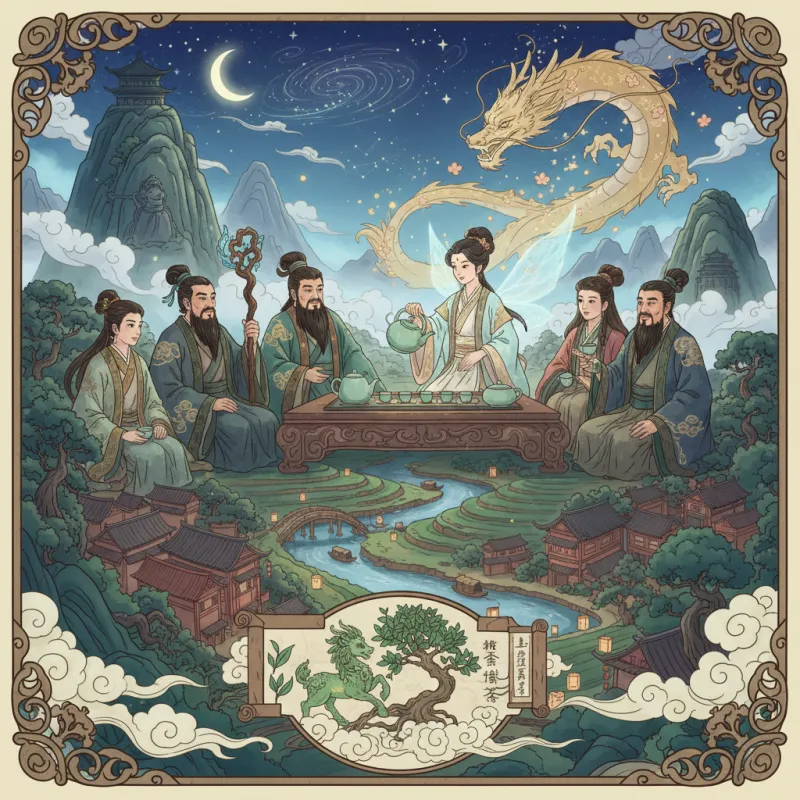
The steam rises from the gaiwan in delicate spirals, each curl a meditation, each breath a conversation between leaf and water that has been perfected over millennia. This isn't just brewing tea—it's participating in one of humanity's oldest continuous cultural practices, a ritual so refined that every gesture carries meaning, every pause speaks volumes.
The Accidental Discovery That Changed Everything
Legend credits Emperor Shen Nong (神农, Shén Nóng), the "Divine Farmer," with tea's discovery around 2737 BCE, though the story reads more like divine intervention than historical fact. According to the tale, leaves from a wild tea tree drifted into the emperor's boiling water as he rested beneath its branches. Being a herbalist and adventurous spirit, he tasted the infusion and found it refreshing, clarifying, and mildly stimulating. Whether this actually happened is less important than what it reveals: the Chinese have always understood tea as a gift from nature that requires human wisdom to unlock.
The earliest physical evidence of tea consumption dates to the Han Dynasty (206 BCE - 220 CE), when tea was primarily used as a medicinal herb. It wasn't until the Tang Dynasty (618-907 CE) that tea drinking transformed from medicine to art, from necessity to philosophy. This shift parallels the broader cultural flowering of the Tang period, when poetry, painting, and Buddhist philosophy reached unprecedented heights.
Lu Yu and the Gospel of Tea
If tea had a prophet, it would be Lu Yu (陆羽, Lù Yǔ, 733-804 CE), the Tang Dynasty scholar who wrote "The Classic of Tea" (茶经, Chájīng), the world's first comprehensive treatise on tea cultivation, preparation, and appreciation. Raised by Buddhist monks after being abandoned as a child, Lu Yu brought a monk's discipline and a poet's sensibility to his subject. His text reads like a love letter written in technical specifications.
Lu Yu didn't just describe how to make tea—he prescribed it. He specified the ideal water sources (mountain springs first, river water second, well water last), the proper vessels (specific ceramics from specific kilns), and even the acceptable sounds of boiling water (first boil sounds like fish eyes, second like a string of pearls, third like raging waves). This obsessive attention to detail wasn't pedantry; it was reverence. Lu Yu understood that the tea ceremony was a form of meditation, and like all meditations, it required complete presence.
The Tang Dynasty tea preparation method, called "cake tea" or "brick tea," involved steaming, pounding, and compressing tea leaves into solid forms. To prepare it, you'd roast the cake over fire, grind it to powder, and whisk it with hot water. This labor-intensive process made tea drinking a deliberate act, impossible to rush, forcing participants into mindfulness.
The Song Dynasty's Aesthetic Revolution
The Song Dynasty (960-1279 CE) took Tang Dynasty tea culture and elevated it to performance art. Emperor Huizong (徽宗, Huī Zōng, 1082-1135), himself an accomplished artist and tea connoisseur, wrote "Treatise on Tea" (大观茶论, Dàguān Chálùn), which refined Lu Yu's principles into an aesthetic philosophy. The Song elite held tea competitions where participants were judged on the color, aroma, and foam of their brews—imagine wine tasting meets performance art meets spiritual practice.
The Song method, called "whisked tea" (点茶, diǎnchá), involved grinding tea leaves into an extremely fine powder, placing it in a bowl, and whisking it with hot water using a bamboo whisk until it formed a thick, jade-green foam. The Japanese tea ceremony, which developed during this period through Zen Buddhist monks studying in China, directly descends from Song Dynasty practices. What we now think of as quintessentially Japanese tea culture is actually preserved Song Dynasty Chinese culture, frozen in time like a cultural time capsule.
The Ming Dynasty's Return to Simplicity
The Ming Dynasty (1368-1644 CE) revolutionized tea culture by rejecting the elaborate preparations of previous eras. Emperor Hongwu (洪武, Hóngwǔ), the dynasty's founder, abolished the tribute system that required compressed tea cakes, declaring that loose-leaf tea should be the standard. This wasn't just an administrative change—it was a philosophical statement about authenticity and naturalness.
Ming Dynasty tea culture emphasized the tea leaf's inherent qualities rather than the preparer's technical skill. The method we recognize today—steeping whole leaves in hot water—became standard during this period. This approach aligned with the Ming Dynasty's broader cultural values: a return to simplicity, an appreciation for natural beauty, and a rejection of excessive ornamentation. The famous Yixing teapots (宜兴茶壶, Yíxīng cháhú), made from purple clay and prized for their ability to enhance tea flavor, emerged during this era and remain the gold standard for serious tea drinkers.
The Gongfu Tea Ceremony: Precision as Poetry
The gongfu tea ceremony (工夫茶, gōngfu chá, literally "making tea with skill") developed in the Qing Dynasty (1644-1912 CE) in Fujian and Guangdong provinces, particularly around the production areas of oolong tea. Unlike the grand ceremonies of imperial courts, gongfu tea was an intimate practice, designed for small gatherings where the focus was on the tea itself rather than social hierarchy.
The ceremony uses small vessels—a gaiwan (盖碗, gàiwǎn, lidded bowl) or small Yixing teapot, tiny cups, a tea boat to catch overflow, and a tea tray with drainage. The tea master performs multiple short infusions of the same leaves, each steeping revealing different flavor notes as the leaves gradually unfurl. The first infusion is often discarded to "wake" the leaves and rinse away dust. Subsequent infusions might last anywhere from 10 seconds to a minute, depending on the tea type and the desired strength.
What makes gongfu tea a ceremony rather than just a brewing method is the intentionality. Every movement is deliberate: warming the vessels, appreciating the dry leaves' appearance and aroma, listening to the water boil, observing the leaves dance in the water, inhaling the fragrance from the empty cup before tasting. It's a moving meditation, a way of being fully present that happens to produce excellent tea as a byproduct.
The Philosophy Steeped in Every Cup
Chinese tea ceremony isn't religious, but it's deeply philosophical, drawing from Confucianism, Taoism, and Buddhism in equal measure. From Confucianism comes the emphasis on proper conduct, respect for hierarchy (the host serves guests in order of seniority), and the ceremony's role in maintaining social harmony. The tea ceremony is where business deals are negotiated, friendships are deepened, and family bonds are strengthened—all through the shared experience of appreciating tea together.
Taoism contributes the understanding of tea as a bridge between humanity and nature. The tea ceremony celebrates water, fire, earth (in the clay vessels), and the plant itself, creating a microcosm of natural harmony. The Taoist concept of wu wei (无为, wúwéi, "effortless action") manifests in the tea master's movements—practiced until they become natural, skillful without appearing to try.
Buddhism, particularly Chan (Zen) Buddhism, brought the meditative aspect. Monks used tea to stay alert during long meditation sessions, and the tea ceremony became a form of meditation itself. The famous saying "tea and Chan are one taste" (茶禅一味, chá chán yī wèi) captures this unity. Both practices aim for the same goal: presence, clarity, and the dissolution of the boundary between self and experience.
Modern Practice: Ancient Ritual in Contemporary Life
Today's Chinese tea ceremony exists in multiple forms, from traditional gongfu tea practiced by enthusiasts and in specialized tea houses to simplified versions in homes and offices. The rise of tea culture in urban China has created a renaissance of interest in traditional practices, with young professionals seeking the mindfulness and connection that tea ceremony provides as an antidote to modern life's frenetic pace.
Contemporary tea masters often blend traditional techniques with modern sensibilities. Some incorporate elements from Japanese tea ceremony or create fusion styles that honor tradition while acknowledging contemporary aesthetics. Tea houses in cities like Chengdu, Hangzhou, and Beijing serve as cultural centers where people gather not just to drink tea but to practice calligraphy, discuss philosophy, or simply escape the noise of urban life.
The ceremony's core principles remain unchanged: respect for the tea, attention to the process, and the creation of a shared moment of tranquility. Whether performed with antique Yixing pots and rare aged pu-erh or with modern gaiwans and fresh green tea, the ceremony's purpose endures—to transform the simple act of drinking tea into an opportunity for connection, reflection, and presence. Much like the careful preparation of traditional Chinese dumplings or the symbolic foods of the Mid-Autumn Festival, tea ceremony reminds us that how we do something matters as much as what we do.
In a world that increasingly values speed over savoring, efficiency over experience, the Chinese tea ceremony offers a radical alternative: slow down, pay attention, and find meaning in the smallest gestures. The steam still rises from the gaiwan, and in its spirals, we can still read the same lessons our ancestors discovered thousands of years ago.
Related Reading
- Why Chinese Food Tastes Different in China: A Culinary Reality Check
- Chinese Tea Culture: A Journey Through 5,000 Years of Brewing
- Chinese Food Culture: What the World Gets Wrong About Chinese Cuisine
- Food Symbolism in Chinese Culture: Every Dish Tells a Story
- The Eight Great Cuisines of China: A Flavorful Tour
- Bruce Lee's Legacy: How One Man Changed Global Culture
- Unveiling the Rich Tapestry of Chinese Folklore and Festival Origins
- Unraveling the Rich Tapestry of Chinese Animal Tales in Folklore
Explore Chinese Culture
- Explore feng shui in daily life
- Explore supernatural folklore
- Explore classical Chinese literature