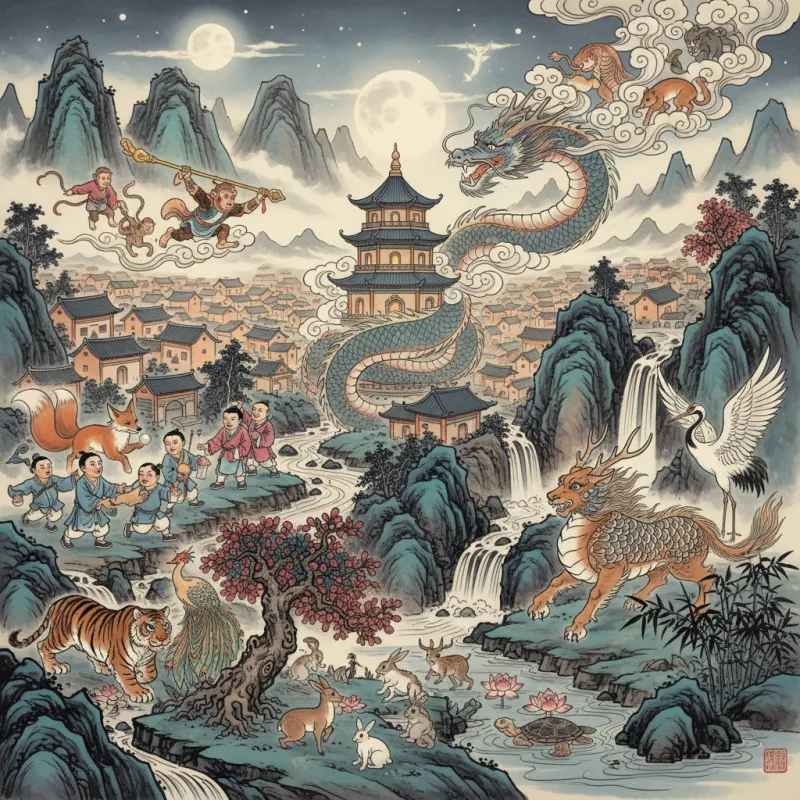
A white fox spirit materializes in the moonlight, her nine tails swaying as she transforms into a beautiful woman who will either save a scholar's life or destroy his family—depending on which dynasty's storyteller you ask. This is the paradox at the heart of Chinese animal folklore: the same creatures shift between villain and hero, trickster and sage, depending on who's telling the tale and what lesson needs teaching.
The Ancient Roots of Speaking Beasts
Chinese animal tales didn't emerge from a single source—they're a collision of shamanic traditions, Buddhist parables, Daoist philosophy, and Confucian morality plays that have been mixing for over three millennia. The earliest written examples appear in the Shanhaijing (山海经, Shānhǎijīng, "Classic of Mountains and Seas"), compiled around the 4th century BCE, which catalogs hundreds of mythical creatures alongside real animals imbued with supernatural powers. But these stories were already ancient when they were first written down, passed through generations of oral storytellers who adapted them to their audiences.
What makes Chinese animal folklore distinct from Western fables is the concept of xing (性, xìng)—the inherent nature that can be cultivated or corrupted. Unlike Aesop's animals, which represent fixed moral types, Chinese folklore creatures exist on a spectrum of spiritual development. A fox can spend centuries cultivating virtue to become a celestial being, or squander its power on petty revenge. This reflects the Daoist belief that all beings possess the potential for transformation, and the Confucian emphasis on self-cultivation through moral effort.
The Fox Spirit's Thousand Faces
No creature embodies the complexity of Chinese animal tales better than the huli jing (狐狸精, húlijīng, "fox spirit"). In the Liaozhai Zhiyi (聊斋志异, "Strange Tales from a Chinese Studio"), Pu Songling's 17th-century masterwork, fox spirits appear in nearly a hundred stories—and they're rarely simple villains. Some seduce corrupt officials to expose their hypocrisy, others fall genuinely in love with human scholars and sacrifice their immortality for mortal happiness, and a few are just trying to pass the imperial examinations like everyone else.
The most famous fox tale, "Nie Xiaoqian" (聂小倩), features a ghost-fox hybrid forced by a demon to lure men to their deaths, who instead falls for a righteous scholar and helps him defeat her master. This story has been adapted into dozens of films, operas, and TV series, each generation finding new meanings in the fox maiden's struggle between her nature and her choices. The 1987 film A Chinese Ghost Story turned her into a tragic romantic heroine, while earlier Qing dynasty versions emphasized the scholar's moral fortitude in resisting temptation.
What's fascinating is how fox spirit stories shift with political winds. During the Tang dynasty (618-907 CE), when Buddhism flourished and women enjoyed relatively high status, fox spirits were often portrayed as benevolent helpers or romantic partners. By the Ming dynasty (1368-1644 CE), when Neo-Confucian morality tightened its grip, the same stories were rewritten to emphasize the danger of female sexuality and the importance of maintaining proper social boundaries. The fox didn't change—the storytellers' anxieties did.
Dragons, Tigers, and the Politics of Power
While foxes operate in the shadows, dragons and tigers dominate Chinese animal folklore as symbols of imperial authority and martial prowess. But even these mighty creatures aren't immune to the moral complexity that defines Chinese storytelling. The Soushenji (搜神记, Sōushénjì, "In Search of the Supernatural"), compiled by Gan Bao in the 4th century CE, includes dozens of dragon tales where these supposedly divine beings make terrible decisions, fall in love with inappropriate partners, or get outsmarted by clever humans.
One story tells of a dragon king's daughter who marries a poor scholar, bringing him wealth and status—until his greedy mother mistreats her, causing the dragon princess to return to the sea and take all her gifts with her. The moral isn't "don't marry dragons" but rather a pointed critique of how families destroy their own fortunes through ingratitude and abuse of power. These tales circulated among common people who couldn't directly criticize their rulers but could certainly tell stories about arrogant dragons getting their comeuppance.
Tigers occupy an even more interesting position. In southern Chinese folklore, particularly in regions like Fujian and Guangdong, tiger spirits often appear as protectors of the mountains who punish corrupt officials and bandits. The Baihu (白虎, Báihǔ, "White Tiger") legends describe tigers who can take human form and serve as judges in the spirit world, ensuring justice when earthly courts fail. This reflects the reality that in rural areas, tigers were both feared predators and symbols of wild justice beyond government control—a useful metaphor when the government itself was predatory.
The Monkey King's Revolutionary Spirit
Sun Wukong (孙悟空, Sūn Wùkōng), the Monkey King from Journey to the West (西游记, Xīyóujì), represents the pinnacle of Chinese animal character development—literally. He starts as a stone monkey, cultivates Daoist immortality techniques, rebels against heaven itself, gets imprisoned under a mountain for five hundred years, and finally achieves Buddhahood through a pilgrimage to India. His story arc spans the entire spectrum of Chinese spiritual philosophy while remaining wildly entertaining.
What makes Sun Wukong enduringly popular isn't just his magical powers or his battles with demons—it's his refusal to accept his assigned place in the cosmic hierarchy. When the Jade Emperor offers him a lowly position as "Keeper of the Heavenly Horses," Sun Wukong's outrage and subsequent rebellion resonated with generations of readers who felt trapped by rigid social structures. The fact that he's eventually tamed and put to work serving a Buddhist monk on a religious mission can be read as either a story about the necessity of discipline or a cynical commentary on how revolutionary energy gets channeled into serving institutional power.
Modern Chinese audiences still debate whether Sun Wukong's journey represents genuine spiritual growth or forced compliance. The 1961 animated film Havoc in Heaven emphasized his rebellious phase and ended before his imprisonment, becoming a cultural touchstone during the Cultural Revolution. Later adaptations have explored his character with more nuance, but the Monkey King remains a figure who embodies the tension between individual freedom and social responsibility that runs through all Chinese animal folklore.
Crane Wives and Grateful Beasts
Not all Chinese animal tales deal with tricksters and rebels. A substantial subset focuses on baoen (报恩, bào'ēn, "repaying kindness"), where animals transform into humans to reward those who showed them compassion. These stories reveal deep cultural values about reciprocity and the interconnectedness of all beings—concepts central to both Buddhist karma and Confucian social ethics.
The "Crane Wife" tale, which exists in multiple Chinese versions before appearing in Japanese folklore, tells of a man who saves a wounded crane, only to have a mysterious woman appear at his door offering to be his wife. She weaves beautiful cloth that brings them wealth, but makes him promise never to watch her work. When he inevitably breaks his promise and sees her plucking her own feathers to weave, she must leave him forever. The story operates on multiple levels: as a meditation on trust in relationships, as a warning about greed (he could have been content with moderate wealth), and as a reminder that magical gifts come with conditions we may not understand.
Similar tales appear throughout Chinese folklore—the snake spirit who becomes a devoted wife in "Legend of the White Snake" (白蛇传, Báishé Zhuàn), the carp who transforms into a beautiful woman to repay a fisherman's mercy, the turtle who carries a grateful scholar across a river and later saves his life. These stories suggest that kindness toward animals isn't just morally right but practically wise, since you never know which creature might be a spirit in disguise. This belief had real-world effects: Buddhist-influenced communities often practiced vegetarianism and animal release ceremonies, while even non-religious families taught children to treat animals with respect, just in case.
The Dark Side: Cautionary Tales and Monsters
Chinese animal folklore isn't all grateful cranes and romantic fox spirits. The tradition includes genuinely terrifying creatures that serve as warnings about moral transgression and social disorder. The Yaogui (妖怪, yāoguài, "demon") category encompasses animals that have cultivated power for evil purposes, and their stories are designed to frighten as much as instruct.
The Hulijing we discussed earlier has a malevolent cousin in tales of fox spirits who drain men's life force through sexual seduction, leaving behind desiccated corpses. These stories proliferated during periods of social anxiety about female sexuality and power, particularly in the late Ming and Qing dynasties. Similarly, tales of Maogui (猫鬼, māoguǐ, "cat demons") who possess humans and drive them to madness reflect fears about domestic animals that occupy liminal spaces between wild and tame, outside and inside.
The Nian (年兽, Niánshòu, "Year Beast") legend, which explains the origins of Chinese New Year traditions, describes a monster that emerges annually to devour crops, livestock, and people until villagers discover it fears the color red, loud noises, and fire. This tale, still told to children during Spring Festival celebrations, transforms a terrifying predator into the reason for festive traditions—a perfect example of how Chinese folklore converts fear into cultural practice. The monster becomes manageable through ritual, just as social anxieties become manageable through storytelling.
Living Traditions in Modern China
These ancient animal tales haven't fossilized into museum pieces—they're actively evolving in contemporary Chinese media and literature. The 2015 animated film Monkey King: Hero is Back reimagined Sun Wukong for a generation raised on Marvel superheroes, while the 2019 film White Snake gave the classic tale a feminist revision, focusing on the snake spirit's agency and power rather than her victimization by a meddling monk.
Chinese fantasy novels, particularly in the xianxia (仙侠, xiānxiá, "immortal heroes") genre, draw heavily on animal folklore traditions. Authors create elaborate systems where animals cultivate spiritual power over centuries, transform into human form, and navigate complex relationships with human cultivators. These stories maintain the traditional emphasis on moral cultivation and karmic consequences while adding modern concerns about environmental destruction, species extinction, and humanity's relationship with the natural world.
Even in everyday speech, Chinese animal folklore persists through chengyu (成语, chéngyǔ, "idioms")—four-character expressions that reference classic tales. "Huli jiaowei" (狐狸尾巴, húli jiǎowěi, "fox's tail") means someone's true nature is revealed, while "Hua she tian zu" (画蛇添足, huà shé tiān zú, "drawing legs on a snake") warns against unnecessary additions that ruin something perfect. These linguistic fossils keep ancient stories alive in daily conversation, ensuring that even Chinese speakers who've never read Liaozhai Zhiyi still think with its metaphors.
The enduring power of Chinese animal tales lies in their refusal to simplify. Unlike fables that reduce animals to single traits—the industrious ant, the lazy grasshopper—Chinese folklore presents creatures as complex as humans, capable of growth, corruption, love, revenge, and redemption. They remind us that the line between human and animal, civilized and wild, moral and immoral, is far more permeable than we'd like to believe. In a world increasingly concerned with environmental ethics and our relationship with other species, these ancient stories offer wisdom that feels startlingly contemporary: treat all beings with respect, because transformation is always possible, and you never know who might be watching.
Related Reading
- Exploring the Enigmatic World of Chinese Animal Tales and Their Cultural Significance
- Chinese Idioms in Daily Life: Stories Behind Common Sayings
- Modern Retellings of Chinese Folklore: Bridging Ancient Legends and Contemporary Culture
- Discovering Love Legends of Chinese Folklore: Tales of Passion and Destiny
Explore Chinese Culture
- Explore feng shui in daily life
- Explore supernatural folklore
- Explore classical Chinese literature