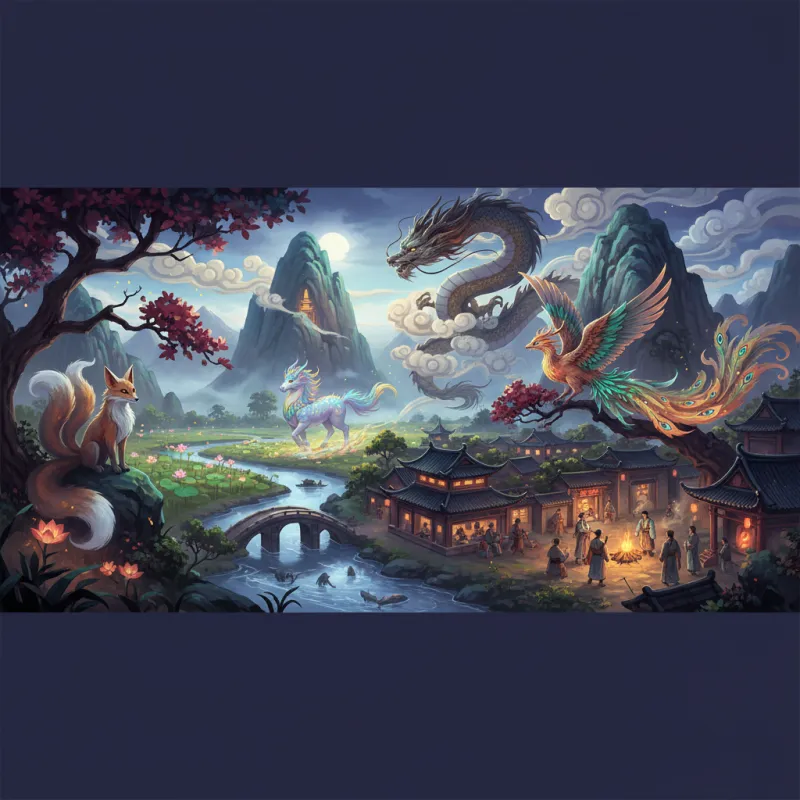
A fox spirit transforms into a beautiful woman under moonlight, her nine tails hidden beneath silk robes. A monkey born from stone achieves enlightenment and challenges heaven itself. A white snake falls in love with a mortal man, defying the cosmic order. These aren't just bedtime stories—they're the beating heart of Chinese cultural consciousness, passed down through 3,000 years of oral tradition and literary refinement.
The Ancient Origins: When Animals Spoke Truth to Power
Chinese animal tales didn't emerge from a vacuum. The earliest recorded examples appear in the Zhuangzi (庄子, Zhuāngzǐ), compiled around 300 BCE during the Warring States period. But here's what most people miss: these weren't children's stories. Zhuangzi used animal parables—like his famous butterfly dream—to challenge Confucian orthodoxy and question the nature of reality itself. The text features debates between fish, birds, and insects that would make Socrates jealous.
Even earlier, the Shanhaijing (山海经, Shānhǎijīng, "Classic of Mountains and Seas") from the 4th century BCE catalogued hundreds of mythical creatures, each embodying specific natural forces or moral qualities. The nine-tailed fox (jiǔwěihú, 九尾狐) first appears here not as a seductress but as an auspicious omen. It's a reminder that meanings shift across dynasties—what the Han dynasty celebrated, the Ming dynasty might demonize.
The Four Sacred Animals and Cosmic Symbolism
Every Chinese child learns about the sìlíng (四灵, Four Sacred Creatures): the dragon (lóng, 龙), phoenix (fènghuáng, 凤凰), tortoise (guī, 龟), and qilin (qílín, 麒麟). But their significance runs deeper than decorative motifs on temple walls. These creatures represent the fundamental forces governing the universe—the dragon controls water and weather, the phoenix embodies yin-yang balance, the tortoise symbolizes longevity and cosmic stability, and the qilin appears only during the reign of benevolent rulers.
What fascinates me is how these animals function as political commentary. When Tang dynasty poets wrote about phoenixes refusing to appear, they weren't discussing ornithology—they were critiquing corrupt emperors. The absence of auspicious animals spoke louder than direct criticism ever could, especially when criticizing the emperor meant execution.
The twelve zodiac animals (shíèr shēngxiào, 十二生肖) operate on similar principles. Yes, they mark birth years, but they also encode personality traits, compatibility matrices, and fortune-telling systems that millions still consult today. The rat's cleverness, the ox's diligence, the tiger's courage—these aren't random associations but distillations of centuries of observation and cultural values.
Fox Spirits and Shape-Shifters: The Dangerous Feminine
No animal dominates Chinese folklore quite like the fox spirit (húxiān, 狐仙). Strange Tales from a Chinese Studio (Liáozhāi Zhìyì, 聊斋志异), written by Pu Songling in the 17th century, contains dozens of fox spirit stories, and they're far more complex than the "seductive demon" stereotype suggests. Some fox spirits are benevolent scholars who help struggling students pass imperial examinations. Others are tragic figures seeking redemption after centuries of cultivation.
The most famous fox tale is probably "The Painted Skin" (Huàpí, 画皮), where a demon wears a beautiful woman's face like a mask, literally painting it on each night. It's been adapted into films, operas, and TV series because it taps into deep anxieties about appearance versus reality, desire versus danger. But here's the twist: in many versions, the fox spirit isn't purely evil—she's desperate, hungry, trying to survive in a world that fears her.
This ambiguity defines Chinese animal tales. Unlike Aesop's fables with their neat moral lessons, Chinese stories embrace contradiction. The same creature can be guardian and threat, teacher and trickster. The white snake Bai Suzhen in Legend of the White Snake (Báishé Zhuàn, 白蛇传) genuinely loves her human husband, yet her very existence threatens cosmic order. Is she villain or victim? The story refuses to choose.
The Monkey King: Rebellion and Redemption
Sun Wukong (孙悟空, Sūn Wùkōng), the Monkey King from Journey to the West (Xīyóujì, 西游记), might be China's most beloved literary character. Born from a stone egg on the Mountain of Flowers and Fruit, he masters transformation, rides clouds, and wields a staff that can shrink to needle-size or grow to pierce the heavens. His rebellion against the Jade Emperor—eating the peaches of immortality, trashing heaven's bureaucracy—resonates because it's fundamentally about refusing one's assigned place in the hierarchy.
But Journey to the West, written by Wu Cheng'en in the 16th century, isn't just a power fantasy. Sun Wukong's 500 years trapped under a mountain, then his journey protecting the monk Xuanzang, represents the Buddhist path from chaos to enlightenment. Every demon they encounter mirrors an internal obstacle—greed, lust, anger, ignorance. The animal demons aren't random monsters but specific spiritual challenges.
What I find remarkable is how Sun Wukong embodies contradictions: he's simultaneously Buddhist disciple and Daoist immortal, loyal protector and impulsive troublemaker, animal and enlightened being. He can't be reduced to a single meaning, which is precisely why he's endured for five centuries. For more on how animals represent spiritual transformation, see The Symbolism of Dragons in Chinese Mythology.
Animal Tales as Social Commentary
Here's what Western readers often miss: Chinese animal tales were rarely just entertainment. During periods of strict censorship—which is to say, most of Chinese history—writers used animal allegories to critique power without losing their heads. When Pu Songling wrote about corrupt fox spirits draining scholars' life force, educated readers understood he was commenting on the examination system that consumed young men's lives for a chance at bureaucratic position.
The Fengshen Yanyi (封神演义, Investiture of the Gods), a 16th-century novel, features the nine-tailed fox Daji who possesses a concubine and drives the Shang dynasty emperor to tyranny. On the surface, it's about demonic seduction. Dig deeper, and it's about how rulers' personal weaknesses destroy kingdoms—a dangerous message to convey directly.
Even children's stories carried weight. The tale of the grateful crane who repays a farmer's kindness by weaving magical cloth teaches reciprocity (bào'ēn, 报恩), a fundamental social obligation. The story of the frog in the well (jǐngdǐzhīwā, 井底之蛙) mocks narrow-mindedness and provincial thinking. These weren't just moral lessons but instructions for navigating complex social hierarchies.
Regional Variations and Minority Traditions
Chinese animal tales aren't monolithic. The Han majority's stories differ significantly from those of the Miao, Dai, Mongolian, and other ethnic groups. In southwestern China, the Miao people tell origin stories about butterflies creating the world—a stark contrast to the dragon-centric Han cosmology. Mongolian tales feature wolves as ancestors and protectors, reflecting nomadic culture's relationship with these animals.
The Peacock Princess (Kǒngquè Gōngzhǔ, 孔雀公主), a Dai minority tale from Yunnan, tells of a peacock spirit who marries a prince but must return to her true form. It shares DNA with swan maiden tales worldwide, but the Dai version emphasizes harmony between human and natural worlds rather than possession or transformation as tragedy. These regional variations remind us that "Chinese culture" encompasses vast diversity.
Modern Resonance: Why These Tales Still Matter
Walk through any Chinese city today, and you'll see these ancient animal tales everywhere. Fox spirit cafes in Shanghai. Monkey King theme parks in Jiangsu. White snake operas in Hangzhou. These aren't museum pieces but living traditions constantly reinterpreted.
Contemporary Chinese fantasy novels (xiūxiān, 修仙, cultivation fiction) draw heavily on animal transformation tropes. Films like Big Fish & Begonia (2016) and White Snake (2019) reimagine classic tales with stunning animation. Even Chinese tech companies use animal symbolism—Alibaba's Taobao features a cartoon cat, JD.com uses a dog mascot—tapping into centuries of animal-human relationships.
The environmental movement in China has also rediscovered these tales. When activists oppose dam construction, they invoke the dragon kings who control rivers. When protecting endangered species, they reference the cosmic balance maintained by sacred animals. Ancient stories provide vocabulary for modern concerns, proving their adaptability across millennia.
The Enduring Power of Transformation
What makes Chinese animal tales uniquely powerful is their central premise: the boundary between human and animal is permeable, negotiable, crossable. Unlike Western traditions that often emphasize human dominion over nature, Chinese tales suggest continuous exchange and transformation. Animals can become human through cultivation (xiūliàn, 修炼), humans can regress to animal nature through moral failure, and the wisest beings often exist in between.
This fluidity reflects deeper philosophical currents. Daoism teaches that all beings share the same cosmic energy (qi, 气), just in different configurations. Buddhism's concept of reincarnation means today's human might be tomorrow's fox, and vice versa. These aren't just religious doctrines but worldviews embedded in every animal tale, every transformation scene, every moment when a creature reveals its true nature.
The fox who studies for 1,000 years to become human, the snake who practices Buddhist compassion, the monkey who achieves enlightenment—these stories ask: what makes us human? Is it our form, our behavior, our moral choices, or our spiritual cultivation? After 3,000 years, Chinese animal tales still don't provide easy answers. They offer something better: endless possibilities for transformation, redemption, and becoming. For more on how these themes appear in specific creatures, explore The Cultural Significance of Tiger Folklore.
Related Reading
- Unraveling the Rich Tapestry of Chinese Animal Tales in Folklore
- Exploring the Rich Tapestry of Chinese Folklore, Legends, and Fairy Tales
- Confucius: The Key Teachings That Shaped East Asia
- Why Chinese Food Tastes Different in China: A Culinary Reality Check
Explore Chinese Culture
- Explore feng shui in daily life
- Explore supernatural folklore
- Explore classical Chinese literature