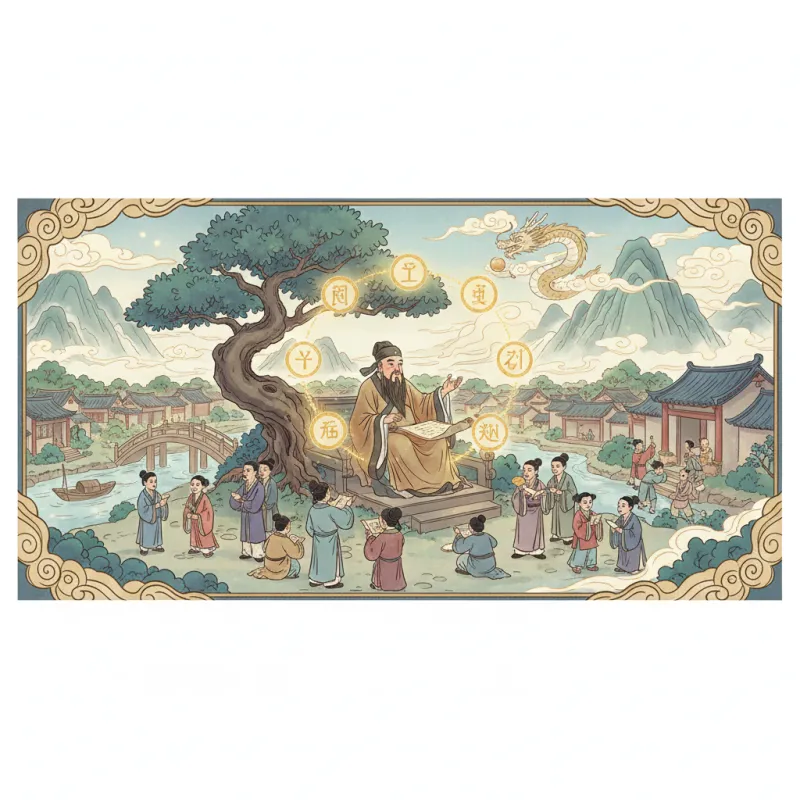
A man in his sixties trudges through the gates of his hometown, Lu, after fourteen years of wandering. He's been rejected by every ruler he approached, mocked by hermits who called him a "dog without a home," and watched his disciples scatter to find more promising teachers. 孔子 (Kǒngzǐ, Confucius, 551–479 BCE) returns to teach a handful of students and edit old texts—work he considers consolation for a failed political career. He dies five years later, convinced his life's mission ended in disappointment. What he couldn't know: his "failure" would architect the moral foundation of East Asian civilization for the next twenty-five centuries.
The paradox of Confucius is that he achieved immortality by being relentlessly practical. While other philosophers of the Warring States period debated metaphysics and mysticism, Confucius obsessed over how people should treat each other at dinner parties. His collected sayings, the 论语 (Lúnyǔ, Analects), reads less like scripture and more like a handbook for being a decent human in an indecent world. Yet these mundane observations about family dinners, funeral etiquette, and office politics became the operating system for Chinese imperial governance, the curriculum for civil service exams that lasted until 1905, and the unspoken rules that still govern social interactions from Beijing to Seoul to Tokyo.
仁 (Rén): The Art of Being Human
If you had to reduce Confucius's entire philosophy to one character, it would be 仁 (rén). Usually translated as "benevolence" or "humaneness," but those English words feel too soft, too passive. Rén is the active practice of recognizing others as fully human and treating them accordingly. It's what makes you human rather than just a clever animal.
When a student asked Confucius to define rén in one word, he said: 恕 (shù, reciprocity). Then he gave the formula that predates the Golden Rule by five centuries: "Do not impose on others what you yourself do not desire." Notice the negative phrasing—Confucius wasn't telling you to actively do good things to others (that's presumptuous; maybe they don't want your help). He's saying: don't be an asshole. Don't inflict on others what you'd hate experiencing yourself.
But rén goes deeper than just not being terrible. In the Analects, Confucius describes it as a muscle you build through practice. You start with 孝 (xiào, filial piety)—learning to care for your parents not out of duty but genuine affection. Then you extend that care outward in concentric circles: siblings, friends, community, strangers. The person who has cultivated rén doesn't need rules to tell them how to act; they've internalized the capacity to respond appropriately to each situation. They've become, in Confucius's terms, a 君子 (jūnzǐ, exemplary person or "gentleman").
This concept profoundly shaped how East Asian societies think about morality. Unlike Western ethics that often focus on universal rules or individual rights, Confucian ethics emphasizes relationships and context. The right action depends on who you're dealing with and what role you occupy. This flexibility can look like situational ethics to Western eyes, but Confucians would argue it's actually more sophisticated—moral reasoning that accounts for the messy reality of human relationships rather than pretending one-size-fits-all rules can cover every situation.
礼 (Lǐ): Why Rituals Matter More Than You Think
Confucius was obsessed with 礼 (lǐ, ritual propriety). Not in a superstitious way—he explicitly said he didn't care much about spirits and the afterlife—but because he believed rituals were technology for shaping human character and maintaining social harmony.
Consider the elaborate rituals surrounding funerals in Confucian tradition. You might think: why does it matter exactly how you bow, what you wear, how long you mourn? Confucius would say: because performing these actions correctly trains your emotions. The ritual doesn't express grief you already feel; it creates and shapes that grief. By going through the motions of mourning—wearing rough cloth, eating simple food, withdrawing from entertainment—you're not being hypocritical. You're using your body to educate your heart.
This idea that external behavior shapes internal character runs counter to modern Western assumptions that authenticity means expressing what you already feel inside. Confucius thought that was backwards. You become virtuous by practicing virtuous actions until they become second nature. The 君子 (jūnzǐ) isn't someone born good; they're someone who has practiced goodness so long it looks effortless.
The political implications were enormous. Confucius believed that if rulers performed the rituals of governance correctly—treating ministers with respect, honoring ancestors, conducting ceremonies with sincerity—they would actually become better rulers. The ritual wasn't window dressing for power; it was the mechanism that transformed power into legitimate authority. This is why Confucian scholars throughout Chinese history could criticize emperors for ritual violations—they weren't just being pedantic about etiquette; they were arguing the emperor had lost the moral foundation of his rule.
The 君子 (Jūnzǐ): Confucius's Ideal Human
The term 君子 (jūnzǐ) originally meant "son of a lord"—someone born into nobility. Confucius performed a quiet revolution by redefining it as a moral category rather than a hereditary one. Anyone could become a jūnzǐ through self-cultivation, regardless of birth. This was radical in a society where aristocratic bloodlines determined everything.
So what does a jūnzǐ look like? Confucius gives us snapshots throughout the Analects. The jūnzǐ is someone who:
- Seeks what is right rather than what is profitable
- Blames themselves when things go wrong rather than blaming others
- Is slow to speak but quick to act
- Is easy to serve but hard to please (because they judge by moral standards, not personal whims)
- Can disagree without being disagreeable
- Worries about their own lack of ability, not about others failing to recognize their ability
The opposite of the jūnzǐ is the 小人 (xiǎorén, small person or petty person). The xiǎorén seeks profit over righteousness, blames others for their failures, is quick to speak but slow to act, and constantly worries about whether others recognize their greatness. Reading Confucius's descriptions of the xiǎorén is like scrolling through social media—you realize these personality types haven't changed in 2,500 years.
What's interesting is that Confucius never claims to be a jūnzǐ himself. When students praise him, he deflects. He presents himself as someone still struggling toward this ideal, which makes the ideal more approachable. You don't need to be perfect; you need to be trying. The effort is what matters.
孝 (Xiào): Filial Piety as Foundation
Western readers often stumble over Confucian 孝 (xiào, filial piety) because it can sound like blind obedience to parents. But Confucius's version is more nuanced. When a student asked if filial piety meant always obeying your parents, Confucius said no—if your parents are doing something wrong, you should gently remonstrate with them. If they don't listen, you remain respectful but don't follow them into wrongdoing.
The point of xiào isn't obedience; it's learning to care for someone else's wellbeing as much as your own. Your parents are the first people you learn to love, and that love becomes the template for all other relationships. If you can't manage basic gratitude and care for the people who raised you, how will you extend that care to strangers?
This emphasis on family as the training ground for virtue shaped East Asian social structures in profound ways. The family became the basic unit of society, and family roles became the model for all other relationships. The emperor was the "father" of the nation; teachers were like parents to students; older siblings had quasi-parental authority over younger ones. This created a society organized around hierarchical relationships rather than individual rights—a structure that persists in modified form across East Asia today.
Critics argue this system enabled authoritarianism and stifled individualism. Defenders point out it created remarkably stable societies with strong social safety nets (your family takes care of you) and low crime rates (shame before your family is a powerful deterrent). The truth is probably that Confucian family structures, like any social technology, have tradeoffs. They excel at creating social cohesion and mutual obligation; they struggle with protecting individual autonomy and enabling social mobility.
正名 (Zhèngmíng): The Rectification of Names
One of Confucius's strangest-sounding ideas is 正名 (zhèngmíng, the rectification of names). When asked what he would do first if given political power, Confucius said: "Rectify names." His students were baffled. Fix the economy? Reform the military? No—make sure words mean what they're supposed to mean.
Here's what he meant: if you call yourself a father but don't act like a father, the problem isn't just your behavior—it's that the word "father" is losing its meaning. If rulers call themselves rulers but act like bandits, the word "ruler" becomes corrupted. When words lose their connection to the realities they're supposed to describe, society falls apart because we can no longer communicate clearly or hold each other accountable.
This idea became central to Confucian political philosophy. A legitimate ruler isn't just someone with power; they're someone who actually performs the role of ruler—protecting the people, maintaining justice, setting a moral example. If they don't do these things, they're not really a ruler, just a guy with an army. This gave Confucian scholars a philosophical basis for criticizing bad emperors: you're not living up to the name you claim.
The concept resonates today when we argue about whether certain leaders are "really" democratic, or whether companies that exploit workers are "really" creating value. Confucius would say: look at what they do, not what they call themselves. Names should describe reality, not obscure it.
The Mandate of Heaven and Political Legitimacy
Though the concept of 天命 (tiānmìng, Mandate of Heaven) predates Confucius, he refined it into a sophisticated theory of political legitimacy that shaped Chinese governance for millennia. Unlike the divine right of kings in Europe, the Mandate of Heaven was conditional. Heaven granted authority to rulers who governed virtuously and withdrew it from those who didn't.
How did you know Heaven had withdrawn its mandate? Natural disasters, famines, rebellions—these were signs that the cosmic order was out of balance because the ruler had failed in their duties. This created a fascinating paradox: successful rebellion proved the previous dynasty had lost the Mandate, but unsuccessful rebellion proved you were just a criminal. History is written by winners, but Confucianism gave those winners a philosophical framework to justify their victory.
This concept had real political consequences. It meant Chinese emperors couldn't claim absolute authority based purely on heredity or force. They had to at least perform virtue, maintain rituals, and respond to disasters with self-criticism and reform. Confucian scholars served as a check on imperial power, reminding emperors that their authority was conditional. When emperors ignored this, as they often did, the scholars could point to floods and famines as evidence that Heaven was displeased.
The Mandate of Heaven also influenced how East Asian societies think about leadership and governance—authority must be earned through virtue and can be lost through vice. This is why corruption scandals hit East Asian politicians particularly hard; they're not just breaking laws, they're violating the fundamental basis of their legitimacy.
Why Confucius Still Matters
Walk through any East Asian city and you're walking through Confucius's world, even if nobody's reading the Analects. The emphasis on education as the path to success, the respect for teachers, the importance of saving face, the complex etiquette around gift-giving and social hierarchy, the expectation that children will care for aging parents—these are all Confucian inheritances, so deeply embedded they feel like natural law rather than philosophical choices.
But Confucianism's influence goes beyond cultural habits. It shaped how East Asian societies industrialized, creating what some economists call "Confucian capitalism"—market economies that emphasize long-term relationships over short-term profits, group harmony over individual achievement, and education over natural talent. Whether this model is superior to Western capitalism is debatable, but it's undeniably different, and those differences trace back to a teacher who died thinking he'd failed.
The irony is that Confucius would probably be horrified by some of what's been done in his name. He never claimed to be founding a religion, yet Confucian temples dot East Asia. He emphasized flexibility and context in moral reasoning, yet his ideas were often rigidified into oppressive social codes. He believed anyone could become a 君子 through effort, yet Confucian societies often became deeply hierarchical and resistant to social mobility.
Still, the core insights remain valuable. In an age of social media performance and personal branding, Confucius reminds us that character is built through practice, not proclaimed through posts. In an era of polarization, his emphasis on maintaining relationships even through disagreement offers a model for civil discourse. In a culture obsessed with authenticity and "being yourself," his argument that we become ourselves through ritual and role-playing challenges our assumptions about identity.
Confucius believed that if you wanted to change society, you started by changing yourself. Cultivate 仁 (rén), practice 礼 (lǐ), become a 君子 (jūnzǐ), and your example would ripple outward. It's an optimistic philosophy, almost naively so. But for a man who considered himself a failure, he proved remarkably successful at planting seeds that grew into forests. The question isn't whether Confucius still matters—it's whether we're paying enough attention to what he actually said versus what we assume he meant.
For more on how Confucian thought intersects with other Chinese philosophical traditions, explore Daoism and the Art of Wu Wei and The Yin-Yang Philosophy.
Related Reading
- Zhuangzi's Butterfly Dream: What Is Reality?
- Wu Wei: The Taoist Art of Doing Nothing (and Getting Everything Done)
- The Complete Guide to Chinese Culture: Everything You Need to Know
- Mencius on Human Nature: Are We Born Good?
- Laozi and the Tao Te Ching: A Practical Guide
- Exploring Transformation in Chinese Folklore: Legends, Fairy Tales, and Cultural Traditions
- Unveiling the Celestial Tales of Chinese Folklore and Legends
- Chinese New Year: The Complete Guide to Spring Festival
Explore Chinese Culture
- Explore feng shui in daily life
- Explore supernatural folklore
- Explore classical Chinese literature