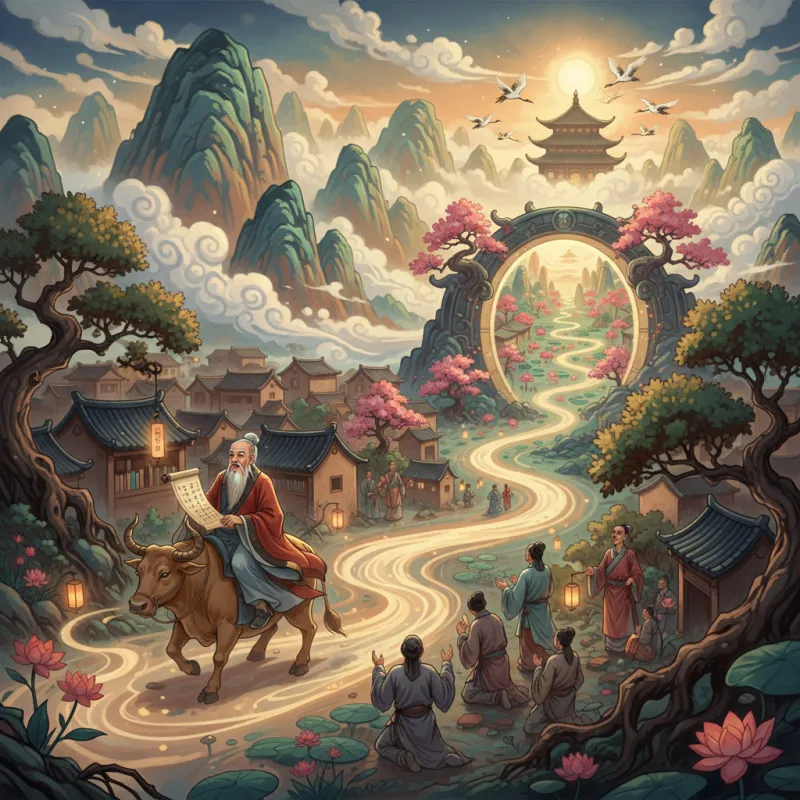
A palace archivist grows weary of court politics, packs his belongings onto an ox, and heads west toward the mountain passes. At the border, a guard recognizes the old man's wisdom and refuses to let him leave until he writes down his teachings. Three days later, the guard receives a slim manuscript of 5,000 characters that would become one of history's most translated texts. Whether this story actually happened doesn't matter—what matters is that the Tao Te Ching (道德经, Dàodé Jīng) emerged from ancient China as a radical challenge to everything we think we know about power, success, and the good life.
The Mystery of Laozi
Laozi (老子, Lǎozǐ), meaning "Old Master," may not have existed as a single historical person. Scholars have debated this for centuries, with some placing him in the 6th century BCE as a contemporary of Confucius, others arguing for a 4th century BCE compilation by multiple authors. The Records of the Grand Historian by Sima Qian offers three possible identities for Laozi, which tells you everything about how comfortable ancient Chinese historians were with ambiguity.
Here's what we can say with reasonable confidence: someone—or several someones—during the Warring States period (475-221 BCE) compiled a collection of paradoxical wisdom that directly contradicted the Confucian emphasis on ritual, hierarchy, and social order. While Confucius was teaching rulers how to govern through virtue and ceremony, the Tao Te Ching was suggesting that the best government is the one people barely notice exists.
The traditional biography claims Laozi served as the Keeper of the Archives at the Zhou court, which would have given him access to ancient texts and the inner workings of power. Supposedly, Confucius himself visited Laozi seeking advice, and came away bewildered, comparing the old master to a dragon—a creature beyond ordinary comprehension. Whether this meeting happened or not, it perfectly captures the relationship between these two philosophical giants: Confucius building elaborate systems of social harmony, Laozi suggesting we'd be better off with less system and more spontaneity.
What the Tao Te Ching Actually Says
The Tao Te Ching consists of 81 short chapters, divided roughly into two sections: the "Tao" (道, Dào) or "Way" in the first 37 chapters, and "Te" (德, Dé) or "Virtue/Power" in the remaining chapters. But don't expect a systematic philosophy textbook. This is poetry, paradox, and political advice rolled into cryptic verses that often contradict themselves—deliberately.
The opening line sets the tone: "The Tao that can be told is not the eternal Tao" (道可道,非常道, Dào kě dào, fēi cháng dào). Right away, Laozi is telling you that language fails to capture ultimate reality. Yet here he is, using language anyway, because what else can we do? This isn't nihilism—it's an invitation to hold your concepts lightly.
The core teaching revolves around wu wei (无为, wú wéi), often translated as "non-action" or "effortless action." This doesn't mean doing nothing. It means acting in harmony with the natural flow of things rather than forcing outcomes through aggressive intervention. Water is Laozi's favorite metaphor: it's soft, yielding, flows around obstacles, yet over time it carves through solid rock. The Tao Te Ching repeatedly suggests that softness overcomes hardness, emptiness is more useful than fullness, and the low position is stronger than the high.
Chapter 11 makes this concrete: a wheel's usefulness comes from its empty hub, a room's value lies in its empty space, a cup serves us because it's hollow. We obsess over the material—the spokes, walls, and clay—but utility emerges from emptiness. This principle extends to leadership: the best rulers empty themselves of personal agenda and create space for people to flourish naturally.
Practical Applications for Modern Life
Strip away the mystical language, and the Tao Te Ching offers surprisingly practical advice for navigating contemporary challenges. Take Chapter 33: "Knowing others is intelligence; knowing yourself is true wisdom. Mastering others is strength; mastering yourself is true power." In an age of social media comparison and external validation, this distinction between outer achievement and inner cultivation feels urgently relevant.
The text's political philosophy is equally applicable. Chapter 57 advises: "The more prohibitions you have, the less virtuous people will be. The more weapons you have, the less secure people will be. The more subsidies you have, the less self-reliant people will be." Whether you agree with this libertarian-leaning perspective or not, it's a coherent critique of bureaucratic overreach that resonates across political divides.
For personal development, consider Chapter 24's warning against self-promotion: "He who stands on tiptoe doesn't stand firm. He who rushes ahead doesn't go far. He who tries to shine dims his own light." This isn't about false modesty—it's about sustainable effort versus burnout. The person constantly broadcasting their achievements on LinkedIn is like someone standing on tiptoes: impressive for a moment, exhausting to maintain, ultimately unstable.
The Tao Te Ching also offers a radical reframe on failure and setback. Chapter 22 states: "Yield and overcome; bend and be straight; empty and be full; wear out and be new." What looks like defeat might be strategic retreat. What feels like emptiness might be preparation for fullness. This isn't positive thinking—it's a different way of interpreting events that doesn't require constant winning to maintain self-worth.
How Taoism Differs from Confucianism
Understanding the Tao Te Ching requires understanding what it's arguing against. Confucianism, which dominated Chinese intellectual life, emphasized li (礼, lǐ)—ritual propriety, social roles, and hierarchical relationships. Confucius believed human nature needed cultivation through education, ceremony, and moral example. Society required clear structures: ruler-subject, father-son, husband-wife, elder-younger, friend-friend.
Laozi found this exhausting and artificial. Chapter 18 sarcastically notes: "When the great Tao is forgotten, kindness and morality arise. When wisdom and intelligence appear, great pretense begins. When there is no peace in the family, filial piety appears. When the country falls into chaos, loyal ministers emerge." In other words, we only need elaborate moral systems when we've lost touch with natural spontaneity. The fact that we're constantly talking about virtue proves we don't have it.
This philosophical divide shaped Chinese culture for millennia. Confucianism became the official state ideology, governing education and bureaucracy. Taoism remained the counterculture—the path of hermits, artists, and officials who'd grown disillusioned with court politics. Many Chinese intellectuals lived as Confucians in public and Taoists in private, following social obligations during the day and reading the Tao Te Ching at night.
The tension between these worldviews appears throughout Chinese literature and folklore. The Journey to the West features both Taoist immortals and Buddhist monks, while Chinese festivals often blend Confucian family obligations with Taoist nature worship and Buddhist compassion.
The Tao Te Ching's Influence on Chinese Culture
The Tao Te Ching didn't just spawn a religion—it permeated Chinese aesthetics, medicine, martial arts, and statecraft. Traditional Chinese painting emphasizes empty space as much as brushstrokes, a direct application of Taoist principles. The concept of qi (气, qì) in Chinese medicine and practices like tai chi derives from Taoist ideas about natural energy flow and balance.
Even Chinese military strategy absorbed Taoist thinking. Sun Tzu's Art of War, written around the same period, shares the Tao Te Ching's emphasis on indirect action, strategic retreat, and winning without fighting. Both texts suggest that the greatest victories come from positioning yourself so well that conflict becomes unnecessary.
During the Tang Dynasty (618-907 CE), Taoism reached its peak influence, with emperors claiming descent from Laozi and sponsoring Taoist temples. The religion developed elaborate rituals, a pantheon of deities, and alchemical practices aimed at physical immortality—ironically, exactly the kind of complexity Laozi would have mocked. Religious Taoism and philosophical Taoism diverged significantly, though both claimed the Tao Te Ching as their foundation.
The text's influence extended beyond China through trade routes and cultural exchange. Japanese Zen Buddhism absorbed Taoist spontaneity and paradox. Korean and Vietnamese philosophy integrated Taoist concepts alongside Confucian and Buddhist ideas. In the 20th century, the Tao Te Ching became one of the most translated texts in the world, second only to the Bible, finding eager audiences in Western counterculture movements.
Reading the Tao Te Ching Today
Approaching the Tao Te Ching requires accepting that you won't fully understand it—and that's the point. The text deliberately uses paradox and contradiction to break down our habitual ways of thinking. When Laozi says "the Tao does nothing, yet nothing is left undone," he's not offering a logical proposition to analyze. He's pointing toward an experience of effortless effectiveness that can't be captured in concepts.
Start with a good translation. Stephen Mitchell's version is poetic and accessible, though it takes liberties with the original Chinese. D.C. Lau's translation is more literal and scholarly. Ursula K. Le Guin's rendition brings a novelist's sensibility to the text. Read multiple translations side by side—the differences illuminate how much interpretation shapes meaning.
Don't read it straight through like a novel. Open randomly and sit with a single chapter. The Tao Te Ching works better as a meditation prompt than a systematic argument. Chapter 48 advises: "In the pursuit of learning, every day something is acquired. In the pursuit of Tao, every day something is dropped." What could you drop today? What would happen if you stopped trying so hard?
The text's political advice might seem naive—do less, govern lightly, trust people's natural goodness. But before dismissing it, consider how often our solutions create new problems, our interventions generate unintended consequences, our attempts to control situations make them worse. Laozi isn't saying never act. He's saying act with awareness of how action ripples through complex systems, and sometimes the most powerful move is restraint.
The Enduring Relevance of Ancient Wisdom
Twenty-five centuries after its composition, the Tao Te Ching still challenges our assumptions about success, power, and the good life. In a culture obsessed with optimization, productivity, and constant improvement, Laozi suggests that maybe we're trying too hard. In a political climate of polarization and rigid ideologies, he offers the flexibility of water. In an economy that measures everything, he reminds us that the most valuable things—space, silence, emptiness—can't be quantified.
The text won't give you a five-step plan for enlightenment or a productivity hack for achieving your goals. It might, however, make you question whether those goals are worth pursuing in the first place. It might suggest that the life you're frantically chasing is less satisfying than the one you're already living, if you'd just stop and notice.
Laozi's final lesson, according to legend, was leaving. After writing the Tao Te Ching at the border, he continued west into the mountains and was never seen again. No followers, no institution, no legacy to manage. Just 5,000 characters of cryptic wisdom and an empty road stretching toward the horizon. For a philosophy that values emptiness, absence, and letting go, it's the perfect ending.
Related Reading
- Mencius on Human Nature: Are We Born Good?
- Confucius Was Not Confucian (And Other Surprises About China's Most Famous Philosopher)
- Confucius: The Key Teachings That Shaped East Asia
- The Complete Guide to Chinese Culture: Everything You Need to Know
- Wu Wei: The Taoist Art of Doing Nothing (and Getting Everything Done)
- Exploring Transformation in Chinese Folklore: Legends, Fairy Tales, and Cultural Traditions
- Modern Retellings of Chinese Folklore: Bridging Ancient Legends and Contemporary Culture
- Chinese Martial Arts in the Real World: What Actually Works
Explore Chinese Culture
- Explore feng shui in daily life
- Explore supernatural folklore
- Explore classical Chinese literature