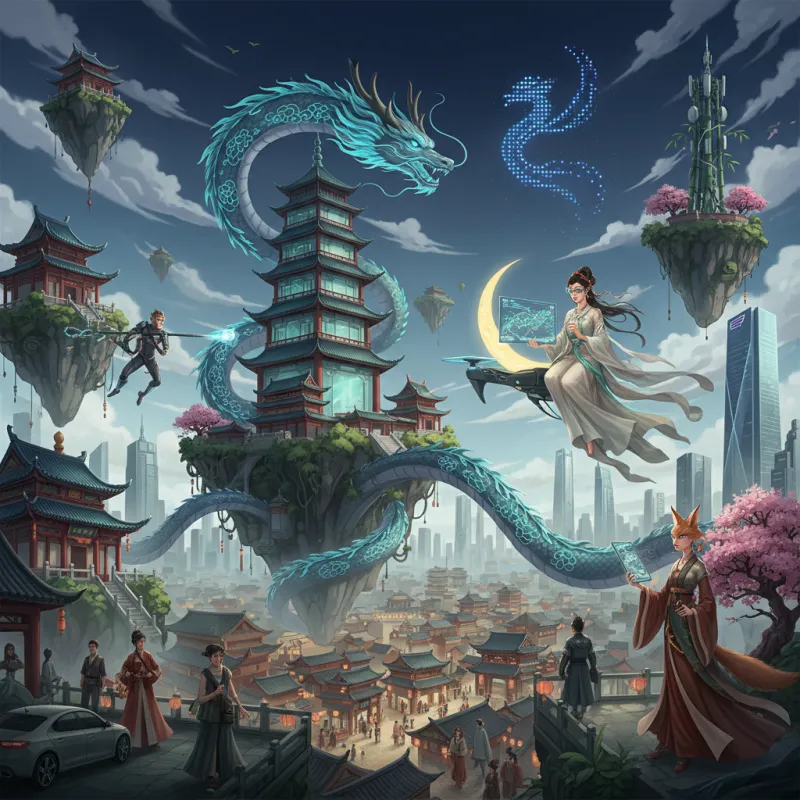
A teenage girl scrolls through her phone, watching a CGI dragon battle unfold on screen—the same dragon her grandmother once described in hushed bedtime stories about the Dragon King's underwater palace. This scene, playing out in millions of homes across China and the diaspora, captures something profound: ancient folklore isn't gathering dust in forgotten scrolls. It's alive, shape-shifting, adapting to TikTok attention spans and Netflix budgets while somehow retaining the soul that made these stories matter for millennia.
The Folklore Renaissance Nobody Saw Coming
Around 2015, something unexpected happened in Chinese entertainment. While Hollywood was mining Greek mythology and Nordic sagas, Chinese creators began seriously interrogating their own narrative heritage—not with the reverent distance of museum curators, but with the irreverent energy of remix culture. The animated film Big Fish & Begonia (2016) reimagined passages from Zhuangzi (庄子, Zhuāngzǐ) as a Studio Ghibli-esque fantasy. The Untamed (2019) took classical wuxia tropes and added queer subtext that resonated globally. Suddenly, the Monkey King wasn't just Sun Wukong (孙悟空, Sūn Wùkōng) from your grandfather's Journey to the West—he was a PlayStation character, an anime protagonist, a metaphor for anti-authoritarian rebellion.
This wasn't mere nostalgia. It was cultural reclamation. After decades of looking westward for narrative models, a generation of creators realized they were sitting on storytelling gold. The difference? They weren't interested in faithful adaptations. They wanted conversation, not preservation.
When Folklore Meets Feminism
Traditional Chinese tales don't exactly have a stellar track record with female agency. The classic four beauties were defined by how their looks toppled kingdoms. Meng Jiangnu (孟姜女, Mèng Jiāngnǚ) wept so hard she collapsed the Great Wall—romantic, sure, but hardly empowering. Modern retellings are systematically dismantling these passive archetypes.
Take the recent surge in Mulan reinterpretations beyond Disney's attempts. Chinese web novels and manhua have reimagined Hua Mulan (花木兰, Huā Mùlán) as everything from a strategic military genius to a gender-fluid warrior questioning the binary thinking of Tang Dynasty society. The 2020 live-action film Mulan (despite its flaws) at least attempted to give her qi powers—a nod to internal cultivation practices from Daoist tradition that were always gendered male in classical texts.
Even more radical are the retellings of the White Snake legend. White Snake (2019) and its sequel transformed Bai Suzhen (白素贞, Bái Sùzhēn) from a demon seductress who needed saving into a powerful entity making autonomous choices about love, identity, and sacrifice. The animated films don't just give her better fight choreography—they fundamentally rewrite the power dynamics. She's not punished for transgressing boundaries between human and demon worlds; she's celebrated for it. This matters in a culture still negotiating women's roles in public and private spheres.
Digital Immortals: Folklore in Gaming and VR
Video games have become the unexpected custodians of Chinese mythology. Genshin Impact, Black Myth: Wukong, and Honor of Kings aren't just entertainment—they're interactive mythology primers for Gen Z. When a teenager in Shenzhen plays as Nezha (哪吒, Nézhā), they're not reading about the lotus-born deity who fought the Dragon King; they're embodying him, making split-second decisions that echo the original character's rebellious spirit.
Black Myth: Wukong (2024) deserves particular attention. This AAA game doesn't simplify Journey to the West for Western audiences—it assumes players will do homework. References to Buddhist cosmology, the 81 tribulations, and obscure demon hierarchies are woven into gameplay without hand-holding exposition. The result? International players are actually reading Journey to the West to understand game lore. When was the last time a video game drove people to 16th-century literature?
The VR space is even more experimental. Projects like The Palace Museum VR let users walk through digitally reconstructed imperial gardens while folklore characters from Strange Tales from a Chinese Studio materialize around them. You're not watching a fox spirit transform—you're standing three feet away as it happens. This immersive approach creates emotional connections that traditional media can't match, making ancient stories feel immediate and personal rather than historical and distant.
The Donghua Revolution
Chinese animation—donghua (动画, dònghuà)—has quietly become the most innovative space for folklore retellings. Unlike their Japanese anime counterparts, donghua creators are mining specifically Chinese narrative traditions with increasing sophistication. The Legend of Hei (2019) takes the concept of yaoguai (妖怪, yāoguài)—supernatural creatures—and explores themes of environmental destruction and chosen family. Jiang Ziya (2020) dared to make one of Chinese mythology's most revered figures morally ambiguous, questioning whether the ends justify the means in cosmic warfare.
What makes donghua retellings particularly effective is their willingness to blend aesthetics. Fog Hill of Five Elements combines traditional Chinese ink wash painting with kinetic action sequences that would make any anime studio jealous. The visual language itself becomes a bridge—honoring classical art forms while proving they can convey modern storytelling dynamism. When characters fight using wuxing (五行, wǔxíng) elemental theory, it's not just cool magic; it's a crash course in Chinese cosmological thinking.
The international success of these animations has created a feedback loop. As global audiences engage with Chinese folklore through donghua, domestic creators feel emboldened to go deeper, assuming viewers will meet them halfway. This is how we get shows like Yao-Chinese Folktales (2023), an anthology series where each episode uses a different animation style to match its source material's historical period. It's experimental, unapologetically Chinese, and utterly captivating.
Literature's Quiet Transformation
While visual media grabs headlines, contemporary Chinese literature has been quietly revolutionizing folklore for decades. Authors like Su Tong, Can Xue, and A Yi weave mythological elements into psychological realism, creating what critic Jeffrey Kinkley calls "root-seeking fiction with supernatural characteristics." These aren't fantasy novels—they're explorations of how folklore shapes consciousness, memory, and national identity.
The real innovation is happening in online literature. Platforms like Qidian host thousands of xianxia (仙侠, xiānxiá) and xuanhuan (玄幻, xuánhuàn) novels that treat folklore as a living, malleable tradition. Writers freely combine elements from different dynasties, regions, and mythological systems, creating syncretic universes that would horrify purists but resonate with readers seeking stories that feel both rooted and limitless. When a web novel like Grandmaster of Demonic Cultivation becomes a global phenomenon, it's not despite its deep folklore roots—it's because of them, filtered through contemporary concerns about justice, loyalty, and chosen family.
These retellings often engage directly with traditional festivals and their meanings, showing how ancient celebrations evolve in modern contexts. They also draw heavily from Chinese food culture and symbolism, using culinary traditions as narrative shorthand for cultural continuity and change.
The Authenticity Debate
Not everyone celebrates these transformations. Critics argue that modern retellings dilute essential meanings, that turning the Monkey King into a Marvel-style superhero strips away Buddhist allegory and Daoist philosophy. They have a point. When Journey to the West becomes primarily about spectacular fight scenes rather than spiritual cultivation, something is lost.
But something is also gained. Folklore has always evolved—the stories we consider "traditional" were themselves adaptations, retellings, and regional variations that eventually calcified into canonical versions. The Journey to the West we revere today is Wu Cheng'en's 16th-century synthesis of centuries of oral tradition. Complaining about modern adaptations is like complaining that Wu Cheng'en didn't stick to the Tang Dynasty originals.
The more interesting question isn't whether modern retellings are "authentic" but whether they're generative—do they create new entry points into the tradition, or do they close them off? The best retellings do both: they're accessible enough to hook newcomers while containing enough depth to reward those who dig deeper. The Untamed works as a fantasy romance, but it's exponentially richer if you understand the Confucian ethics and Daoist cultivation practices underlying its world-building.
Why This Matters Beyond Entertainment
These retellings are doing cultural work that extends far beyond entertainment. For diaspora communities, they provide connection to heritage without requiring fluency in classical Chinese or academic study. A second-generation Chinese-American kid might not read Strange Tales from a Chinese Studio, but they'll watch Over the Moon and absorb ideas about Chang'e (嫦娥, Cháng'é) and the Mid-Autumn Festival that become part of their identity toolkit.
Domestically, folklore retellings are part of larger conversations about what it means to be Chinese in the 21st century. When Nezha (2019) became the highest-grossing animated film in Chinese history, audiences weren't just enjoying a well-made movie—they were embracing a vision of Chinese identity that's rebellious, individualistic, and willing to challenge authority. That the hero is a literal demon-child who defies heaven itself wasn't lost on anyone.
Internationally, these retellings are shifting perceptions. For too long, Chinese culture in Western imagination meant either ancient exoticism or modern authoritarianism. Folklore retellings present a third option: a living, evolving tradition that's simultaneously ancient and contemporary, specific and universal. When a Brazilian teenager cosplays as Wei Wuxian or a Nigerian artist draws fan art of the White Snake, they're engaging with Chinese culture on terms that feel personally meaningful rather than academically distant.
The Future Is Hybrid
The most exciting retellings aren't happening in single mediums but across them. The Untamed started as a web novel, became a live-action series, spawned an animated adaptation, inspired audio dramas, and generated countless fan works. Each iteration adds layers, interpretations, and possibilities. This transmedia approach mirrors how folklore originally functioned—as stories that existed in multiple versions simultaneously, adapted by each teller to their audience and moment.
We're also seeing increasing fusion with non-Chinese traditions. American Born Chinese (2023) explicitly combines Chinese mythology with American superhero narratives, using the Monkey King to explore immigrant identity. These hybrid forms aren't dilution—they're evolution, proof that folklore remains vital precisely because it can absorb and reflect new contexts while maintaining core resonances.
The question isn't whether modern retellings will continue—they're too commercially successful and culturally resonant to stop. The question is whether they'll deepen or flatten, whether they'll use folklore as mere aesthetic or engage with the philosophical and ethical frameworks that made these stories meaningful in the first place. The best retellings do both: they're entertaining enough to compete in global markets while containing enough substance to reward serious engagement.
That teenage girl watching the dragon battle on her phone? She's participating in a tradition thousands of years old, even if the medium would baffle her ancestors. The dragon still represents power, transformation, and the mysterious forces that shape human destiny. It just happens to be rendered in Unreal Engine 5 now. And somehow, that's exactly as it should be.
Related Reading
- Acupuncture: What Science Actually Says
- Delving into Chinese Water Legends: Tales of Spirits and Serpents
- Chinese Arts: The Four Treasures of the Study and Beyond
Explore Chinese Culture
- Explore feng shui in daily life
- Explore supernatural folklore
- Explore classical Chinese literature