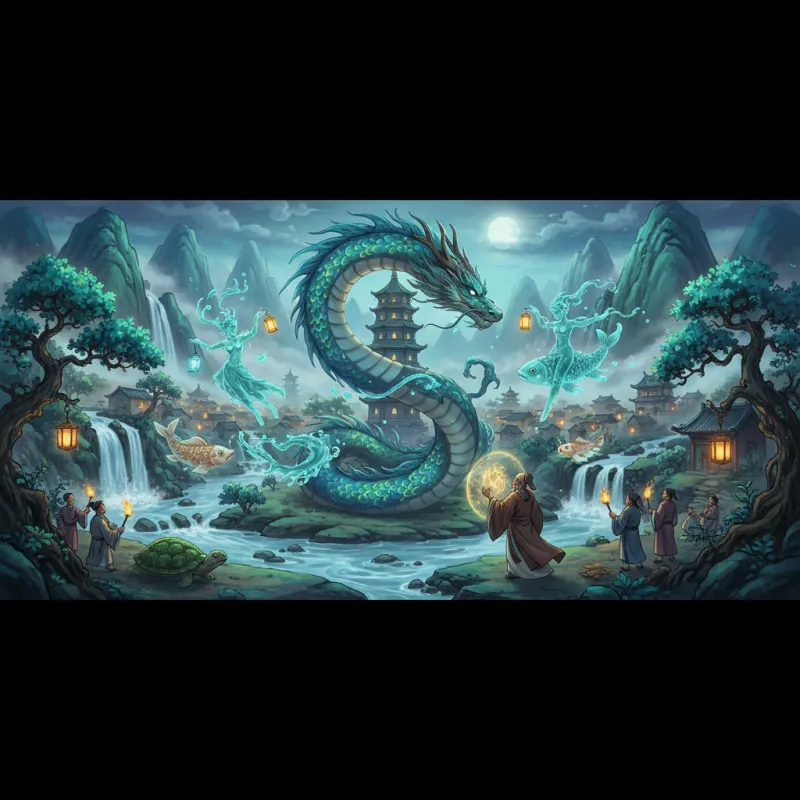
The old fisherman knew better than to cast his nets near the whirlpool at dawn. His grandfather had warned him about the pale woman who combed her hair on the rocks there, singing songs that made men forget their wives and children. But desperation makes fools of us all, and the fish weren't biting anywhere else that morning. By the time he heard the melody drifting across the water, it was already too late.
Chinese water legends aren't just quaint stories about mythical creatures—they're survival manuals disguised as folklore. For thousands of years, communities living along the Yellow River, the Yangtze, and countless lakes and streams developed elaborate mythologies to explain the unpredictable, often deadly nature of water. These tales served as warnings, moral lessons, and attempts to negotiate with forces that could drown entire villages or bring life-giving rain. The spirits, serpents, and shape-shifters that populate these legends reveal how deeply the Chinese understood that water gives life with one hand and takes it away with the other.
The Dragon Kings: Bureaucrats of the Deep
The Dragon Kings (龙王, lóng wáng) rule Chinese water mythology with the same hierarchical precision that governed imperial China. These aren't the treasure-hoarding monsters of European fairy tales—they're celestial officials managing water resources across the realm. Four Dragon Kings control the seas in each cardinal direction, while countless lesser dragons oversee rivers, lakes, and wells. Ao Guang (敖广), the Dragon King of the East Sea, appears frequently in Journey to the West (西游记, Xī Yóu Jì), where Sun Wukong raids his underwater palace for the magical staff that becomes his signature weapon.
What makes Dragon Kings fascinating is their bureaucratic nature. They report to the Jade Emperor, maintain detailed records, and can be petitioned through proper ritual channels. During droughts, communities would parade dragon effigies and perform elaborate ceremonies to request rain—essentially filing a formal complaint with the water management department. This reflects the Confucian worldview that even supernatural forces operate within an orderly system of ranks and responsibilities. The Dragon Kings could be benevolent or wrathful, but they weren't arbitrary. They responded to merit, ritual propriety, and sometimes bribery, just like earthly officials.
Water Spirits: The Dangerous Feminine
Chinese water spirits skew heavily female, and they're rarely benign. The most notorious are the shuǐ guǐ (水鬼, water ghosts)—spirits of drowning victims who must lure others to watery deaths to escape their own limbo. But the more complex figures are the various female spirits who inhabit rivers and lakes, embodying water's seductive and treacherous nature.
The luó chà (罗刹, rakshasa) of Buddhist origin merged with indigenous water spirits to create terrifying female demons who could appear beautiful or monstrous. More ambiguous are spirits like the hé bó (河伯, River Earl), originally male deities who demanded virgin brides as tribute. The practice of "marrying" young women to river gods—essentially ritual drowning—persisted in some regions until reformers like Ximen Bao (西门豹) in the 5th century BCE exposed it as a scam run by corrupt officials and shamans. His story, recorded in the Records of the Grand Historian (史记, Shǐ Jì), shows how water legends could be weaponized for exploitation.
The jiāo rén (鲛人, shark people) present a more melancholic image—aquatic beings whose tears become pearls. Unlike Western mermaids, jiāo rén appear in classical texts like Soushen Ji (搜神记, In Search of the Supernatural) as skilled weavers who produce waterproof fabric. Their legends emphasize craftsmanship and sorrow rather than seduction, though they share the mermaid's liminal existence between human and animal worlds.
Serpents and Floods: The White Snake Legend
No discussion of Chinese water legends is complete without Bai Suzhen (白素贞), the White Snake spirit whose love story has been retold in opera, film, and television for centuries. The Legend of the White Snake (白蛇传, Bái Shé Zhuàn) centers on a snake spirit who cultivates herself for a thousand years to achieve human form, falls in love with a mortal scholar named Xu Xian (许仙), and faces persecution from the monk Fa Hai (法海) who believes demons and humans cannot coexist.
What elevates this legend beyond a simple romance is its exploration of identity and transformation. Bai Suzhen isn't pretending to be human—she has genuinely cultivated virtue and humanity through centuries of spiritual practice. The story asks uncomfortable questions: What makes someone human? Is a spirit who acts with compassion and loyalty less worthy than a cruel human? When Fa Hai traps Bai Suzhen under Leifeng Pagoda (雷峰塔) after she floods Jinshan Temple (金山寺) to save her husband, the audience's sympathy lies entirely with the "demon."
The legend's connection to water runs deeper than Bai Suzhen's serpentine origins. The flooding of Jinshan Temple represents water's destructive power unleashed by love and desperation. West Lake (西湖) in Hangzhou, where the story is set, becomes a character itself—beautiful, mysterious, and dangerous. The tale reminds us that water spirits in Chinese folklore often represent transformation and the possibility of transcending one's nature, themes that resonate with Buddhist and Daoist concepts of cultivation and enlightenment.
River Monsters and Local Terrors
Beyond the famous legends lie countless regional water monsters that terrorized specific communities. The shuǐ hóu (水猴, water monkey), also called shuǐ guǐ in some regions, supposedly lurks in rivers and ponds, dragging swimmers underwater. Descriptions vary wildly—some say it resembles a child, others a monkey, still others a turtle-like creature. What remains consistent is its method: grabbing victims' ankles and pulling them down.
These localized legends served practical purposes. Parents used water monkey stories to keep children away from dangerous swimming holes. Communities marked certain areas as haunted to prevent accidents. The shuǐ hóu legend might have originated from observations of drowning patterns—undertows, sudden drop-offs, or submerged debris that could trap swimmers. By personifying these dangers as malevolent spirits, communities created memorable warnings that children would actually heed.
The bà xià (霸下), one of the nine sons of the dragon, takes the form of a giant turtle and appears in architecture throughout China, depicted as carrying heavy stone tablets. While not strictly a water monster, bà xià represents water's patient, enduring strength. Its image adorns bridges and waterways, a protective symbol against floods and a reminder that water, like the turtle, outlasts everything through persistence rather than force.
Daoist Immortals and Water Magic
Water plays a crucial role in Daoist cultivation practices, and several immortals demonstrate mastery over aquatic realms. Lü Dongbin (吕洞宾), one of the Eight Immortals, famously crossed the sea using only his sword, demonstrating the Daoist principle of transcending physical limitations. The collective tale of the Eight Immortals crossing the sea (八仙过海, bā xiān guò hǎi) showcases different approaches to the same challenge—each immortal uses their unique magical implement to traverse the water, illustrating that there are multiple paths to enlightenment.
He Xiangu (何仙姑), the only female among the Eight Immortals, achieved immortality partly through her connection to water sources. According to legend, she ate powdered mica from a sacred stream and gained the ability to float across water. Her story connects to ancient Chinese beliefs about water's role in spiritual transformation and physical immortality, themes explored extensively in Daoist practices and festivals.
The concept of shuǐ xíng (水行, water element) in Daoist five-element theory positions water as the most yin element—receptive, flowing, and associated with wisdom and adaptability. Daoist water magic emphasizes working with water's nature rather than controlling it, a philosophy that influenced everything from feng shui to traditional Chinese medicine. The legendary Daoist master Zhang Daoling (张道陵) supposedly commanded water spirits and dragons, not through force but through spiritual authority and understanding of natural principles.
Modern Echoes of Ancient Waters
These water legends haven't disappeared into dusty archives—they continue evolving in contemporary Chinese culture. The 2019 animated film White Snake reimagined Bai Suzhen's origin story with stunning visuals and modern sensibilities while maintaining the core themes of transformation and forbidden love. Video games like Black Myth: Wukong feature Dragon Kings and water spirits as both allies and adversaries, introducing ancient legends to new generations.
Environmental concerns have given water legends renewed relevance. As China grapples with pollution, flooding, and water scarcity, the old stories about respecting water spirits and maintaining balance with aquatic realms resonate differently. The Dragon Kings' role as water managers takes on new meaning when real-world water management becomes increasingly critical. Perhaps the ancients understood something we're relearning: water demands respect, negotiation, and humility.
The next time you see a still pond or rushing river, remember that Chinese folklore sees more than H₂O. It sees the Dragon King's domain, the White Snake's home, the water ghost's hunting ground, and the Daoist immortal's path to transcendence. These legends emerged from thousands of years of living alongside water—learning its moods, fearing its power, and marveling at its mysteries. They remind us that water is never just water. It's life, death, transformation, and everything that flows between.
Related Reading
- Acupuncture: What Science Actually Says
- Unveiling the Rich Tapestry of Chinese Folklore and Festival Origins
- Decoding Chinese Internet Culture: From Baidu Tieba to Bilibili
Explore Chinese Culture
- Explore feng shui in daily life
- Explore supernatural folklore
- Explore classical Chinese literature