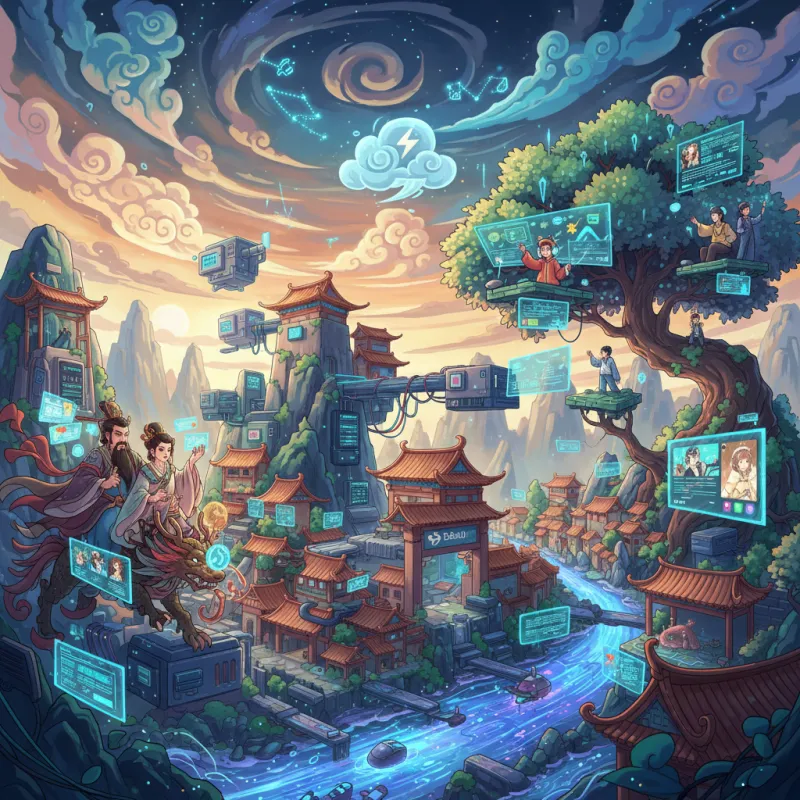
If you've ever stumbled into a Chinese livestream at 3 AM and found yourself utterly bewildered by the barrage of "233333" flooding the chat, congratulations — you've just experienced your first brush with Chinese internet culture. What looks like random numbers is actually laughter. What seems like gibberish is often political commentary. And that cute cartoon character? It might be banned by tomorrow morning.
China's digital landscape operates on its own logic, with its own platforms, its own humor, and its own elaborate systems for saying things without actually saying them. With over 1.05 billion internet users as of 2023, the Chinese-language internet (中文互联网, Zhōngwén hùliánwǎng) isn't just large — it's a parallel universe with rules that would make Alice's Wonderland look straightforward.
The Platforms That Built a Digital Nation
Forget Facebook, Twitter, and YouTube. In China, the digital ecosystem revolves around platforms most Westerners have never heard of, each with its own culture and unwritten rules.
Baidu Tieba (百度贴吧, Bǎidù tiēbā) — literally "Baidu Post Bar" — launched in 2003 and became China's largest online community forum. Think Reddit meets old-school bulletin boards, but with over 300 million users at its peak. Each "bar" (贴吧, tiēbā) is dedicated to a specific topic, from celebrity fandoms to obscure historical debates. The Li Yi Bar (李毅吧, Lǐ Yì bā), originally created for fans of a mediocre soccer player, evolved into one of the internet's most influential meme factories, spawning the term "diaosi" (屌丝, diǎosī) — a self-deprecating label for young men who see themselves as losers, which became a defining generational identity.
Weibo (微博, Wēibó), launched in 2009, is often called "Chinese Twitter," but that comparison doesn't do it justice. With 584 million monthly active users, Weibo is where news breaks, celebrities cultivate their images, and social movements begin before they're inevitably censored. The platform's 140-character limit (later expanded to 2,000) forced users to become masters of concision and wordplay.
Bilibili (哔哩哔哩, Bīlībīlī), affectionately called "B站" (B zhàn), started in 2009 as a haven for anime fans and has evolved into China's YouTube for Gen Z. What makes Bilibili unique is its "danmaku" (弹幕, dànmù) system — real-time comments that scroll across the video like bullet curtains. Watching a popular video on Bilibili means seeing hundreds of viewers' reactions simultaneously, creating a communal viewing experience that's part commentary, part performance art. To even register on Bilibili, new users must pass a 100-question exam testing their knowledge of internet culture and platform etiquette — a digital initiation ritual that keeps the community relatively cohesive.
WeChat (微信, Wēixìn) deserves special mention not as a platform but as the platform — the super-app that's simultaneously messaging service, social network, payment system, news source, and mini-app ecosystem. With over 1.3 billion monthly active users, WeChat isn't just used in China; it is China's internet for many people, especially those over 30.
The Art of Speaking in Code
Chinese internet slang isn't just creative — it's necessary. With sophisticated censorship algorithms scanning for sensitive keywords, netizens have developed elaborate systems of linguistic camouflage that would impress cryptographers.
The most basic technique is homophone substitution. When direct terms get censored, users find words that sound similar. "River crab" (河蟹, héxiè) became code for "harmonize" (和谐, héxié) — the government's euphemism for censorship. "Grass mud horse" (草泥马, cǎo ní mǎ) sounds like a vulgar insult but is written with innocent characters describing a fictional alpaca-like creature. This mythical beast became an internet sensation in 2009, complete with a children's song-style video, as a form of protest against censorship itself.
Pinyin abbreviations offer another layer of obfuscation. "NMSL" doesn't stand for anything wholesome — it's the pinyin initials for an extremely vulgar insult. "YYDS" (永远的神, yǒngyuǎn de shén) means "eternal god" and is used to express extreme admiration. "XSWL" (笑死我了, xiào sǐ wǒ le) means "laughing to death" — essentially LOL, but cooler.
Then there's numerical code. "233333" represents laughter because "233" was the number of a laughing emoticon on the Mop forum in the early 2000s. "666" (pronounced liù liù liù) sounds like "溜溜溜" (liū liū liū), meaning "smooth" or "skilled," and is spammed in livestream chats to show appreciation. "520" sounds like "I love you" (我爱你, wǒ ài nǐ) in Chinese, making May 20th an unofficial Valentine's Day.
The creativity reaches absurd heights with visual substitution. When Winnie the Pooh comparisons to Xi Jinping led to the character's censorship, users started using blank spaces, asterisks, or even just the color yellow to reference him. When "翠" (cuì, meaning "jade green") was briefly censored for unclear reasons, people used the color green or jade emojis instead.
Meme Culture: From Emoticons to Entire Mythologies
Chinese meme culture operates on multiple levels simultaneously — visual, linguistic, and cultural — creating inside jokes so layered that even native speakers need guides to keep up.
Emoticons and emoji evolved differently in China. While the West embraced emoji, Chinese users developed an elaborate system of text-based emoticons that convey subtle emotional nuances. The "捂脸" (wǔ liǎn, "face palm") emoji became so popular on WeChat that it transcended digital space — people now make the gesture in real life. The "doge" meme, featuring a Shiba Inu, became "旺柴" (wàng chái) in Chinese and spawned an entire subculture of dog-related memes.
Character-based memes leverage the visual nature of Chinese writing. "囧" (jiǒng), an archaic character meaning "bright," looks like a sad face and became the symbol for embarrassment or awkwardness in the mid-2000s. It was so popular that a 2012 comedy film was titled "人再囧途之泰囧" (Rén Zài Jiǒng Tú Zhī Tài Jiǒng, "Lost in Thailand"), which became one of China's highest-grossing films at the time.
Catchphrases from variety shows, dramas, and viral videos become instant memes. "蓝瘦香菇" (lán shòu xiāng gū), a mishearing of "难受想哭" (nán shòu xiǎng kū, "sad and want to cry") spoken in a heavy Guangxi accent, went viral in 2016. The phrase literally means "blue thin mushroom" and spawned countless variations and merchandise.
The "social death" (社死, shè sǐ) meme captures the mortifying embarrassment of public humiliation — the kind that makes you want to disappear from society entirely. It's become the go-to term for describing cringe-worthy moments, from accidentally sending a message to the wrong person to your parents discovering your secret social media account.
The Fandom Wars and Fan Circle Culture
Chinese fan culture — "fan circle" (饭圈, fàn quān) — operates with an intensity that makes Western stan culture look casual. Organized like military campaigns, fan groups coordinate mass voting, streaming, and purchasing to boost their idols' rankings and visibility.
The infrastructure is sophisticated. Fans organize into hierarchies with "big fans" (大粉, dà fěn) who coordinate activities, "data fans" (数据粉, shùjù fěn) who manipulate streaming numbers and social media metrics, and "control and comment fans" (控评粉, kòng píng fěn) who flood comment sections to shape narratives. They use specialized apps to coordinate mass actions, create elaborate spreadsheets tracking their idol's every appearance, and even hire professional services to boost online presence.
But this intensity has a dark side. Fan wars (粉丝大战, fěnsī dàzhàn) between rival fandoms can be vicious, involving doxxing, coordinated harassment, and even real-world confrontations. In 2021, the government cracked down on "chaotic fan culture," banning rankings and limiting fan spending, after incidents where fans were buying massive quantities of milk just to get voting codes, then dumping the milk — a waste that sparked public outrage.
The relationship between fans and anti-fans (黑粉, hēi fěn) creates its own ecosystem. Some people dedicate as much energy to hating a celebrity as fans do to loving them, creating elaborate "black material" (黑料, hēi liào) — compilations of scandals, rumors, and unflattering moments designed to damage reputations.
The Livestreaming Economy and Virtual Gifts
Chinese livestreaming culture has created an entire economy based on virtual gifts and parasocial relationships. Platforms like Douyin (the Chinese version of TikTok), Kuaishou, and Bilibili host millions of streamers who broadcast everything from gaming to eating to
Related Reading
- Modern China Through the Lens of Its Ancient Past
- Chinese Internet Culture: Memes, Slang and Digital Life
- Chinese Pop Culture: A Guide for the Curious Outsider
- First Time in China? Essential Tips for Culture-Minded Travelers
- Exploring Transformation in Chinese Folklore: Legends, Fairy Tales, and Cultural Traditions
- The Enchanting World of Chinese Folklore: Legends and Cultural Traditions
- How to Start Learning Chinese Calligraphy
Explore Chinese Culture
- Explore feng shui in daily life
- Explore supernatural folklore
- Explore classical Chinese literature