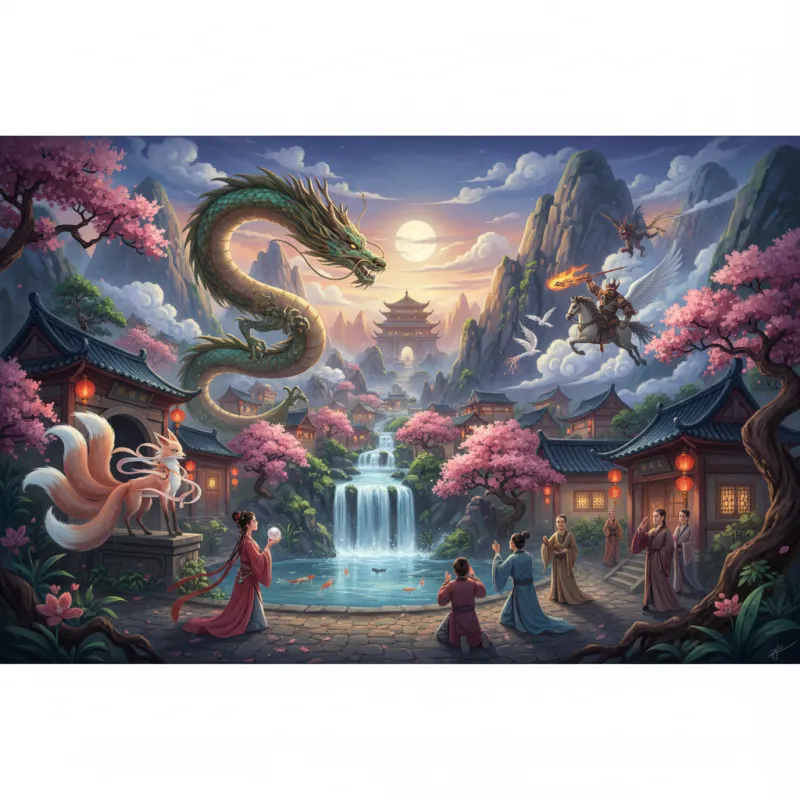
When the Monkey King first leapt from his stone egg on the Mountain of Flowers and Fruit, he didn't just enter the world—he shattered it. Sun Wukong's rebellion against heaven wasn't merely a plot device in Journey to the West (西游记, Xīyóu Jì); it was a crystallization of something far older and more subversive lurking in Chinese folklore. These stories don't just entertain—they encode thousands of years of philosophical wrestling with power, mortality, and what it means to be human in a cosmos indifferent to human concerns.
The Architecture of Chinese Mythological Time
Chinese folklore operates on a timeline that makes Western mythology look positively linear. The Pangu (盘古, Pángǔ) creation myth places the universe's birth at roughly 18,000 years before recorded history, when a cosmic giant's body literally became the world. But here's what makes Chinese folklore fascinating: it doesn't treat this as ancient history. During the Han dynasty (206 BCE-220 CE), scholars were already debating whether these myths were literal truth, metaphorical wisdom, or political propaganda dressed in divine clothing.
The Yellow Emperor (黄帝, Huángdì), supposedly ruling around 2697 BCE, exists in this strange liminal space between god and historical figure. Did he actually invent the compass, the calendar, and Chinese medicine? Probably not. But the fact that every major Chinese innovation gets retroactively attributed to him tells us something crucial: Chinese folklore isn't about what happened, but about what should have happened to create the culture that exists today. The Dragon King legends operate on similar logic—they're less about explaining weather and more about encoding proper relationships between human communities and natural forces.
The Bureaucracy of Heaven
If you want to understand Chinese folklore, start with this: the celestial realm is organized like an imperial government, complete with paperwork, hierarchies, and petty office politics. The Jade Emperor (玉皇大帝, Yùhuáng Dàdì) doesn't rule through raw power—he rules through administrative authority. When Sun Wukong rebels in Journey to the West, he's not fighting a tyrant; he's fighting a bureaucrat who gave him a humiliating job title.
This isn't accidental. During the Tang dynasty (618-907 CE), when many of these stories crystallized into their current forms, China had the most sophisticated civil service in the world. The imperial examination system meant that power came from literacy and administrative skill, not just birth or military prowess. So naturally, heaven got reorganized to match. The Kitchen God (灶神, Zàoshén) literally files annual reports on each household's behavior. The City God (城隍, Chénghuáng) manages the dead like a municipal administrator. Even death has a bureaucracy—the Ten Courts of Hell process souls with the efficiency of a well-run customs office.
This bureaucratic heaven creates a unique type of folklore. Western myths often feature heroes who overthrow corrupt systems. Chinese folklore more often features clever individuals who manipulate the system's rules to achieve justice. The story of Meng Jiangnu (孟姜女, Mèng Jiāngnǚ), whose tears brought down a section of the Great Wall, isn't about destroying authority—it's about exposing how rigid adherence to rules can violate deeper moral principles.
The Fox Spirit Problem
No creature better embodies the moral complexity of Chinese folklore than the fox spirit (狐狸精, húlijīng). In Pu Songling's Strange Tales from a Chinese Studio (聊斋志异, Liáozhāi Zhìyì), written during the Qing dynasty (1644-1912), fox spirits are scholars, lovers, tricksters, and occasionally murderers. They're not simply good or evil—they're interesting.
The most famous fox spirit, Daji (妲己, Dájǐ), supposedly seduced the last Shang dynasty emperor and caused the dynasty's collapse around 1046 BCE. But here's the thing: historical records suggest the Shang fell because of military defeat and economic problems. The fox spirit story came later, during the Zhou dynasty, as propaganda to justify the conquest. By the time Investiture of the Gods (封神演义, Fēngshén Yǎnyì) was written in the 16th century, Daji had become a cosmic scapegoat—literally possessed by a demon sent by the goddess Nüwa.
This layering is typical of Chinese folklore. Stories don't replace each other; they accumulate. A fox spirit can simultaneously be a dangerous seductress, a loyal wife, a Buddhist practitioner seeking enlightenment, and a metaphor for female sexuality that threatens Confucian social order. The tales of supernatural beings rarely resolve into simple moral lessons because they're encoding multiple, sometimes contradictory, cultural anxieties.
The Filial Piety Industrial Complex
Twenty-four paragons of filial piety (二十四孝, Èrshísì Xiào)—that's how many exemplary stories of children serving their parents got codified during the Yuan dynasty (1271-1368). Some are touching: a son who tastes his father's medicine to ensure it's not too bitter. Others are horrifying: a son who cuts flesh from his own thigh to make soup for his sick mother.
Modern readers often find these stories disturbing, and they should. They were meant to be extreme. Filial piety (孝, xiào) wasn't just a virtue in traditional Chinese society—it was the foundational virtue that held the entire social order together. If children didn't obey parents, students wouldn't obey teachers, subjects wouldn't obey rulers, and the whole Confucian system would collapse.
But here's what's fascinating: Chinese folklore also contains countless stories of children who don't obey their parents and are rewarded for it. Mulan (花木兰, Huā Mùlán) disguises herself as a man and joins the army, directly violating her father's authority (though she does it for him, which provides cover). The cowherd in the Qixi Festival legend marries a goddess against all celestial rules. These counter-narratives don't negate the filial piety stories—they exist in tension with them, creating a folklore that's more honest about human complexity than any single moral framework could be.
The Monkey King's Immortality Addiction
Sun Wukong achieves immortality five different ways in Journey to the West. He learns Daoist cultivation techniques. He eats the peaches of immortality. He drinks the elixir of life. He has his name erased from the Register of Death. He consumes immortality pills. This isn't redundancy—it's the point.
The Monkey King's quest for immortality is a satire of the entire Chinese religious landscape during the Ming dynasty (1368-1644). Daoists promised immortality through alchemy and meditation. Buddhists offered escape from the cycle of rebirth. Folk religion provided protective talismans and rituals. Sun Wukong tries everything, and none of it brings him peace. He only finds meaning when he stops trying to escape death and starts serving others on the journey to retrieve Buddhist scriptures.
This is Chinese folklore at its most sophisticated—using a fantasy adventure to critique the very religious traditions that produced the fantasy. The novel was written during a period of intense religious syncretism, when Buddhist temples had Daoist shrines and Confucian scholars practiced meditation. The Monkey King's journey mirrors China's own spiritual journey: trying every path to transcendence before realizing that meaning comes from engagement with the world, not escape from it.
The Ghost Marriage Market
In traditional Chinese belief, unmarried dead people are dangerous. They're stuck in limbo, unable to move on to the afterlife because they never fulfilled their social role. The solution? Ghost marriages (冥婚, mínghūn), where families arrange marriages between deceased individuals or between a living person and a dead one.
This practice, documented from the Zhou dynasty through the 20th century, reveals something crucial about Chinese folklore: it's not about the supernatural—it's about social order. Ghosts aren't scary because they're dead; they're scary because they're unmarried dead. They represent social obligations unfulfilled, relationships incomplete, the cosmic bureaucracy thrown into disorder.
The folklore surrounding ghost marriages is extensive and often darkly comic. Stories tell of families negotiating dowries for corpses, of wedding ceremonies conducted at gravesides, of living brides who discover their husbands died years ago. These aren't horror stories—they're social commentary dressed in supernatural clothing, exploring what happens when ritual obligations collide with human mortality.
Why These Stories Still Matter
Chinese folklore isn't a museum piece. It's a living tradition that continues to evolve. When the Chinese government launched its space program, they named the lunar rover Yutu (玉兔, Yùtù)—the Jade Rabbit who lives on the moon with the goddess Chang'e. When Chinese science fiction writers like Liu Cixin imagine the future, they draw on folklore's cosmic bureaucracies and moral complexity.
The stories endure because they're not simple. They don't offer easy answers about good and evil, duty and freedom, mortality and transcendence. Instead, they provide a framework for thinking about these questions—a framework built over thousands of years by countless storytellers, each adding their own layer of meaning. The Monkey King is still leaping from his stone egg, still rebelling against heaven, still searching for immortality. And we're still watching, still learning, still arguing about what it all means.
Related Reading
- The Chinese Zodiac: Complete Guide to the 12 Animals
- Unraveling the Rich Tapestry of Chinese Animal Tales in Folklore
- Chinese Herbal Medicine: A Beginner's Guide
Explore Chinese Culture
- Explore feng shui in daily life
- Explore supernatural folklore
- Explore classical Chinese literature