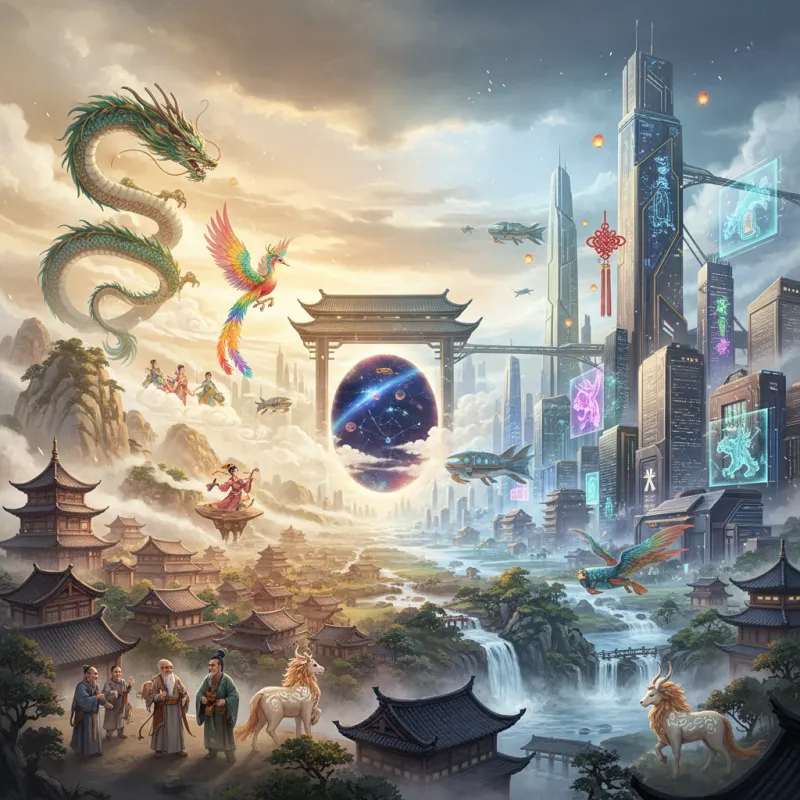
The taxi driver in Shanghai who quotes Confucius while complaining about traffic. The tech entrepreneur in Shenzhen who consults the I Ching before major business decisions. The government official who frames policy announcements using phrases from the Analects. Modern China doesn't just remember its past — it actively lives through it, reinterpreting ancient patterns for contemporary circumstances.
The Pendulum Between Unity and Chaos
Walk through any Chinese bookstore and you'll find the history section dominated by accounts of dynastic transitions — those violent, chaotic periods when one ruling house falls and another rises. There's a reason for this obsession: China has experienced this cycle so many times that it's become a cultural template for understanding political change.
The pattern is stark. Strong centralized control under dynasties like the Han (206 BCE - 220 CE), Tang (618-907 CE), and Qing (1644-1912 CE) eventually gives way to fragmentation. The Warring States period (475-221 BCE) saw seven major kingdoms battling for supremacy. The Three Kingdoms era (220-280 CE) became so culturally significant that a 14th-century novel about it remains one of China's most beloved stories. The Five Dynasties and Ten Kingdoms period (907-979 CE) carved the empire into competing regional powers.
The 20th century repeated this pattern with brutal efficiency. The Qing collapse led to warlord fragmentation in the 1910s and 1920s, followed by Japanese invasion and civil war, before the People's Republic re-established centralized control in 1949. Today's emphasis on "stability" (wending, 稳定) and "harmony" (hexie, 和谐) makes perfect sense when you understand that fragmentation isn't an abstract historical concept — it's a living memory, passed down through grandparents who survived it.
The Mandate of Heaven in Modern Dress
The ancient concept of tianming (天命, Mandate of Heaven) claimed that rulers governed with cosmic approval — but only as long as they governed well. Natural disasters, economic collapse, or widespread suffering signaled that heaven had withdrawn its mandate, legitimizing rebellion and dynastic change.
This isn't just ancient philosophy gathering dust in university libraries. The Chinese Communist Party's legitimacy rests on a secularized version of this same principle: performance-based governance. The implicit contract is clear — deliver economic growth, maintain stability, improve living standards, and the people will accept authoritarian rule. Fail at these tasks, and the mandate evaporates.
This explains the government's obsessive focus on GDP growth rates, poverty alleviation campaigns, and rapid response to natural disasters. When COVID-19 hit, the state's aggressive containment measures weren't just public health policy — they were a demonstration that the government could protect its people, that the mandate remained intact. The contrast with Western responses became a propaganda tool precisely because it reinforced this ancient bargain in modern terms.
Confucian Hierarchy in the Digital Age
Confucius (551-479 BCE) built his philosophy around proper relationships and social harmony through hierarchical order. The five cardinal relationships (wulun, 五伦) defined how people should interact: ruler-subject, father-son, husband-wife, elder-younger, friend-friend. Only the last was theoretically equal.
Visit any Chinese workplace and you'll see these hierarchies operating with remarkable consistency. The deference shown to senior colleagues, the importance of guanxi (关系, relationships and networks), the expectation that younger employees will defer to older ones regardless of competence — these aren't corporate culture quirks. They're Confucian principles adapted to office environments.
Even Chinese social media reflects this. The term da V (大V, "big V") refers to verified accounts with large followings, and the respect accorded to these digital elders mirrors traditional hierarchies. When a prominent blogger speaks, younger users listen — not because the argument is necessarily better, but because hierarchy itself carries weight. The evolution of Chinese internet culture shows how ancient social structures migrate seamlessly into new technological spaces.
The Scholar-Official Returns
For over a thousand years, China selected its governing elite through the imperial examination system (keju, 科举). Mastery of Confucian classics determined who would govern, creating a meritocratic bureaucracy that was remarkably stable and sophisticated for its time.
The system was abolished in 1905, but its ghost haunts modern China. The gaokao (高考, national college entrance examination) is the imperial exam reborn. Millions of students spend years preparing for this single test that determines university placement and, by extension, career trajectory and social status. The pressure is immense, the competition brutal, the stakes existential.
But it's not just about education. The Chinese civil service examination (gongwuyuan kaoshi, 公务员考试) attracts millions of applicants for limited government positions. Becoming an official still carries the prestige it did in imperial times. The scholar-official ideal — that the educated should govern — remains deeply embedded in Chinese society.
Legalism's Iron Fist
While Confucianism gets most of the attention, Legalism (fajia, 法家) has always been the other half of Chinese governance. The Legalist philosopher Han Feizi (280-233 BCE) argued that humans are fundamentally self-interested and must be controlled through strict laws and harsh punishments. The state that unified China — Qin (221-206 BCE) — did so through Legalist principles: centralized control, standardization, and ruthless enforcement.
Modern China's governance combines Confucian rhetoric with Legalist practice. The social credit system, extensive surveillance networks, and swift punishment for dissent are pure Legalism. The government speaks the language of harmony and virtue while wielding the tools of control and coercion. This isn't hypocrisy — it's a governing strategy refined over two millennia.
The relationship between traditional values and modern governance reveals how these ancient philosophies continue to shape policy decisions that affect 1.4 billion people.
Dynastic Cycles and Economic Patterns
Chinese historians identified a recurring pattern in dynastic decline: a strong founding emperor establishes order, subsequent generations consolidate power, then corruption spreads, land becomes concentrated in elite hands, peasants lose their holdings, rebellions erupt, and the dynasty falls. The cycle then repeats.
Contemporary China shows concerning parallels. Wealth concentration is accelerating. The Gini coefficient (measuring inequality) has risen dramatically since the 1980s. Property ownership is increasingly difficult for young people. Local government debt has ballooned. Corruption, despite aggressive campaigns against it, remains endemic.
These aren't just economic statistics — they're warning signs that Chinese leaders recognize from historical precedent. The government's recent crackdowns on tech billionaires, emphasis on "common prosperity" (gongtong fuyu, 共同富裕), and attempts to cool the property market are responses to these historical patterns. Whether they'll succeed in breaking the cycle or merely postponing its next phase remains the defining question of contemporary China.
The Long View
Understanding modern China through its historical patterns doesn't mean the past determines the future. But it does mean that Chinese leaders, intellectuals, and ordinary citizens interpret current events through a framework built over thousands of years. When Western observers see authoritarianism, many Chinese see stability after centuries of chaos. When outsiders see censorship, many Chinese see necessary social harmony. When critics point to inequality, the government responds with policies drawn from ancient precedents.
The patterns don't repeat exactly — history never does. But they rhyme, and in China, the echoes are loud enough that anyone who listens can hear them. The question isn't whether ancient patterns influence modern China. The question is whether China can adapt these patterns to challenges its ancestors never imagined: climate change, technological disruption, global interdependence, and the expectations of an educated, connected population that has tasted prosperity and wants more.
The taxi driver quoting Confucius understands something profound: in China, the past isn't past. It's the lens through which the present becomes visible and the future takes shape.
Related Reading
- Decoding Chinese Internet Culture: From Baidu Tieba to Bilibili
- Chinese Internet Culture: Memes, Slang and Digital Life
- First Time in China? Essential Tips for Culture-Minded Travelers
- Chinese Pop Culture: A Guide for the Curious Outsider
- Temple Etiquette: How to Visit Chinese Temples
- Discovering Love Legends of Chinese Folklore: Tales of Passion and Destiny
- Mid-Autumn Festival: Mooncakes, Legends and Lunar Beauty
Explore Chinese Culture
- Explore feng shui in daily life
- Explore supernatural folklore
- Explore classical Chinese literature