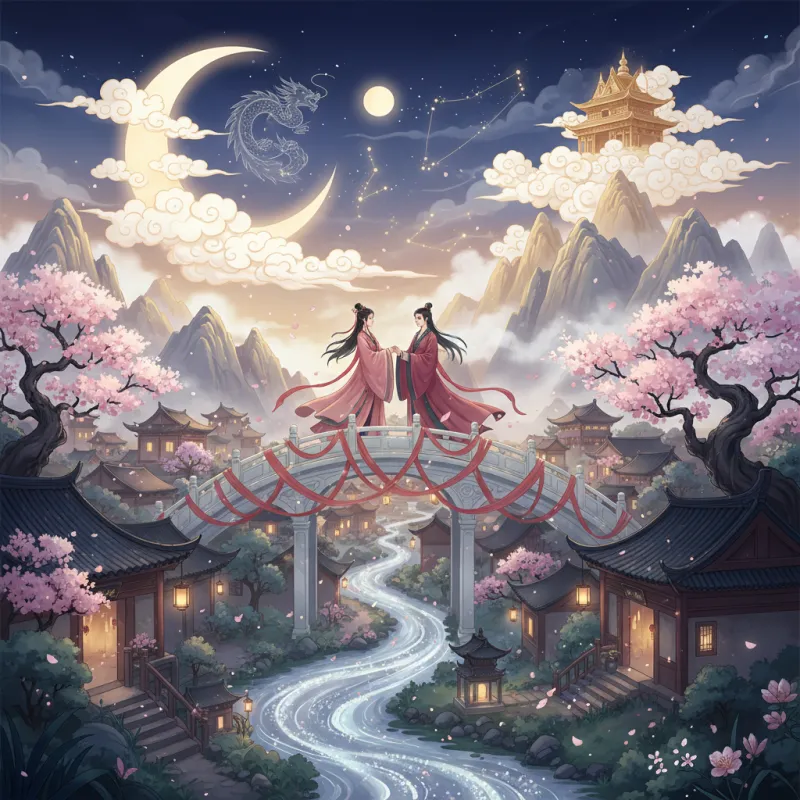
Picture this: A young woman binds her chest, cuts her hair, and walks out the door dressed as a scholar—not for a costume party, but to claim an education her society denies her. Three years later, she'll watch the man she loves die of heartbreak, then throw herself into his tomb. The earth will crack open, swallow her whole, and from that grave, two butterflies will emerge, dancing together for eternity. This isn't Gothic fiction—it's the Butterfly Lovers, one of China's four great folktales, and it's been making audiences weep for over 1,600 years.
Chinese love legends don't do subtlety. They feature star-crossed deities banished to opposite sides of the Milky Way, fox spirits who seduce scholars and steal their life force, and snake demons who flood entire cities for love. These aren't just romantic tales—they're philosophical treatises on fate (命运, mìngyùn), moral instruction manuals, and sometimes thinly veiled social criticism. The lovers rarely get their happy ending in this life, but that's precisely the point. Chinese folklore asks a harder question than "will they end up together?"—it asks "what are you willing to sacrifice for love?"
The Butterfly Lovers: When Education Meets Heartbreak
The legend of Liang Shanbo (梁山伯) and Zhu Yingtai (祝英台) originated during the Eastern Jin Dynasty (317-420 CE), though the story reached its definitive form during the Tang Dynasty. Zhu Yingtai, daughter of a wealthy family in Shangyu, convinces her father to let her study in Hangzhou by disguising herself as a man—a radical act when women were expected to remain secluded in the inner quarters.
For three years, she studies alongside Liang Shanbo, a poor but brilliant scholar from Kuaiji. They become sworn brothers, sharing a room, studying together, and developing what Liang believes is an unusually intense friendship. The dramatic irony is delicious: Zhu drops hints constantly (comparing them to mandarin ducks, offering to introduce him to her "sister"), but Liang remains oblivious. When Zhu is finally summoned home, she tells him to visit her family, where all will be revealed.
By the time Liang arrives and discovers the truth—that his sworn brother is actually a woman, and he's been in love without knowing it—Zhu has already been betrothed to Ma Wencai, son of a wealthy merchant. The engagement was arranged by her parents, and in Confucian society, filial piety (孝, xiào) trumps personal desire every time. Liang falls ill from grief and dies. On her wedding day, Zhu Yingtai's bridal procession passes his grave. She demands to pay respects, and when she approaches the tomb, it splits open. She throws herself inside, and the tomb closes. Two butterflies emerge and fly away together—the only happy ending this story allows.
The Butterfly Lovers became China's most performed opera and inspired countless adaptations. The 1959 Butterfly Lovers Violin Concerto by He Zhanhao and Chen Gang remains one of the most famous pieces of Chinese orchestral music. What makes this legend endure isn't just the romance—it's Zhu Yingtai's agency. She defies gender norms, pursues education, and ultimately chooses death over a loveless marriage. She's no passive maiden waiting for rescue.
The Cowherd and Weaver Girl: Love Across the Milky Way
If the Butterfly Lovers is Chinese folklore's tragic romance, then the Cowherd and Weaver Girl (牛郎织女, Niúláng Zhīnǚ) is its cosmic love story. This legend dates back over 2,600 years, with references in the Classic of Poetry (诗经, Shījīng), and it gave birth to the Qixi Festival (七夕节, Qīxì Jié)—China's Valentine's Day, celebrated on the seventh day of the seventh lunar month.
Niulang is a poor orphan who lives with his cruel brother and sister-in-law. They eventually kick him out with nothing but an old ox. This ox, it turns out, is actually a fallen deity, and he tells Niulang that heavenly maidens will descend to bathe in a nearby lake. If Niulang takes one maiden's clothes, she won't be able to return to heaven. It's essentially celestial theft, which should probably raise more ethical red flags than it does in the traditional telling.
The maiden is Zhinü, the Jade Emperor's seventh daughter and the heavens' most skilled weaver. Unable to return home, she agrees to marry Niulang. They fall genuinely in love, have two children, and live happily for years. But heaven notices that Zhinü has stopped weaving the clouds and celestial robes—she's too busy being happy. The Queen Mother of the West (西王母, Xī Wángmǔ) descends, drags Zhinü back to heaven, and creates the Silver River (the Milky Way) to separate the lovers forever.
Here's where the story gets interesting: magpies, moved by the couple's grief, form a bridge across the Milky Way once a year so the lovers can reunite. This annual meeting became the Qixi Festival, when young women would pray to Zhinü for skill in needlework and a good marriage. The legend reflects deep anxieties about duty versus desire—Zhinü's cosmic responsibilities conflict with her earthly happiness, and the universe literally tears her family apart to restore order.
Modern astronomers have identified the stars: Niulang is Altair in the constellation Aquila, and Zhinü is Vega in Lyra, separated by the "river" of the Milky Way. The legend has inspired everything from Tang Dynasty poetry to contemporary films like "The Monkey King 3" (2018). Unlike the Butterfly Lovers, this story offers hope—separation isn't permanent, just painful. It's a more mature take on love: sometimes you can't be together, but that doesn't make the love less real.
The White Snake: When Demons Love Better Than Humans
The Legend of the White Snake (白蛇传, Báishé Zhuàn) is Chinese folklore's most morally complex love story, and it asks uncomfortable questions: Can a demon truly love? Is a relationship built on deception real? And who's the actual villain—the snake spirit or the Buddhist monk who destroys her family?
The story centers on Bai Suzhen (白素贞), a white snake spirit who has cultivated herself for a thousand years to achieve human form. She falls in love with Xu Xian (许仙), a gentle pharmacist in Hangzhou, and marries him without revealing her true nature. They open a medicine shop together and live happily until Fahai (法海), a Buddhist monk from Jinshan Temple, decides that human-demon relationships violate the natural order.
Fahai tricks Xu Xian into giving Bai Suzhen realgar wine during the Dragon Boat Festival, which forces her to reveal her true snake form. Xu Xian dies of fright (he's not the most robust hero in Chinese folklore). Bai Suzhen travels to Kunlun Mountain, steals a magical herb, and resurrects him—an act of devotion that should prove her love is real. But Fahai isn't satisfied. He eventually traps Bai Suzhen under Leifeng Pagoda, separating her from Xu Xian and their newborn son.
The earliest written version appears in Feng Menglong's "Stories to Caution the World" (警世通言, Jǐngshì Tōngyán) from 1624, but the story evolved significantly over time. In early versions, Bai Suzhen is more demonic and threatening. Later adaptations, especially after the 1950s, reimagine her as a tragic heroine fighting against oppressive religious authority. The 1992 television series "The New Legend of Madame White Snake" starring Angie Chiu became a cultural phenomenon, cementing Bai Suzhen's status as a feminist icon.
What makes this legend fascinating is its ambiguity. Bai Suzhen does deceive Xu Xian about her nature, but she's also loyal, brave, and willing to sacrifice everything for her family. Fahai claims to protect cosmic order, but he's rigid, cruel, and destroys a loving family. The story works as a critique of religious extremism and social prejudice—Bai Suzhen's only crime is being different. For more tales of supernatural romance, explore fox spirit legends in Chinese folklore.
Chang'e and Houyi: The Moon's Loneliest Goddess
The Mid-Autumn Festival (中秋节, Zhōngqiū Jié) celebrates the moon, mooncakes, and the legend of Chang'e (嫦娥), the goddess who lives in lunar exile. Her story with the archer Houyi (后羿) is less about romance and more about the consequences of immortality, ambition, and betrayal—depending on which version you believe.
In the most common telling, Houyi is a legendary archer who shoots down nine of the ten suns scorching the earth, saving humanity. As a reward, the Queen Mother of the West gives him an elixir of immortality—enough for two people to become immortal, or one person to become a god. Houyi wants to share it with his wife Chang'e, but before they can decide, his apprentice Fengmeng tries to steal it. To prevent this, Chang'e drinks the entire elixir herself and floats up to the moon, where she lives forever in the Moon Palace with only a jade rabbit for company.
That's the sympathetic version. Earlier texts suggest Chang'e stole the elixir out of selfishness, wanting immortality for herself. The "Huainanzi" (淮南子), a 2nd-century BCE philosophical text, presents her as ambitious and willing to abandon her husband for divine status. Later dynasties softened her character, transforming her from a selfish wife into a protective one.
The legend reflects Chinese ambivalence about immortality. Unlike Western mythology, where eternal life is usually desirable, Chinese folklore often presents it as a curse—Chang'e gains immortality but loses everything that made life meaningful. She's separated from Houyi forever, trapped in a beautiful but empty palace. The moon becomes a symbol of longing and separation, which is why the Mid-Autumn Festival emphasizes family reunion. When families gather to eat mooncakes and admire the moon, they're acknowledging that separation—like Chang'e's—is painful, and togetherness should be cherished.
The Enduring Power of Tragic Love
Chinese love legends rarely end with "happily ever after," and that's not a bug—it's a feature. These stories emerged from a Confucian society that valued duty, hierarchy, and social harmony over individual desire. Romantic love, especially when it conflicted with filial piety or social order, was dangerous. These legends acknowledge love's power while reinforcing social norms: yes, love is real and profound, but it cannot override your obligations to family and society.
Yet these stories survived and evolved precisely because they also critique those norms. Zhu Yingtai's suicide is an act of rebellion. Bai Suzhen's fight against Fahai challenges religious authority. Even Chang'e's exile raises questions about the price of ambition and the value of earthly love versus divine status. These legends work as both reinforcement and resistance, which is why they remain relevant.
Modern adaptations continue to reinterpret these tales. The 2020 animated film "Over the Moon" reimagines Chang'e's story for contemporary audiences, emphasizing themes of grief and moving forward. The Butterfly Lovers has been adapted into rock operas, ballets, and even a 2008 martial arts film starring Charlene Choi and Wu Chun. Each generation finds new meaning in these ancient stories, proving that love—whether tragic, cosmic, or supernatural—remains humanity's most compelling subject.
For those interested in how these romantic ideals connect to broader cultural practices, explore Chinese wedding traditions and their folklore origins or discover how festivals celebrate legendary lovers. These legends aren't just stories—they're the foundation of how Chinese culture understands love, sacrifice, and the eternal tension between personal happiness and social duty.
Related Reading
- Acupuncture: What Science Actually Says
- Exploring the Rich Tapestry of Chinese Folklore, Legends, and Fairy Tales
- Discovering the Rich Tapestry of Chinese Folklore: Myths, Legends, and Traditions
Explore Chinese Culture
- Explore feng shui in daily life
- Explore supernatural folklore
- Explore classical Chinese literature