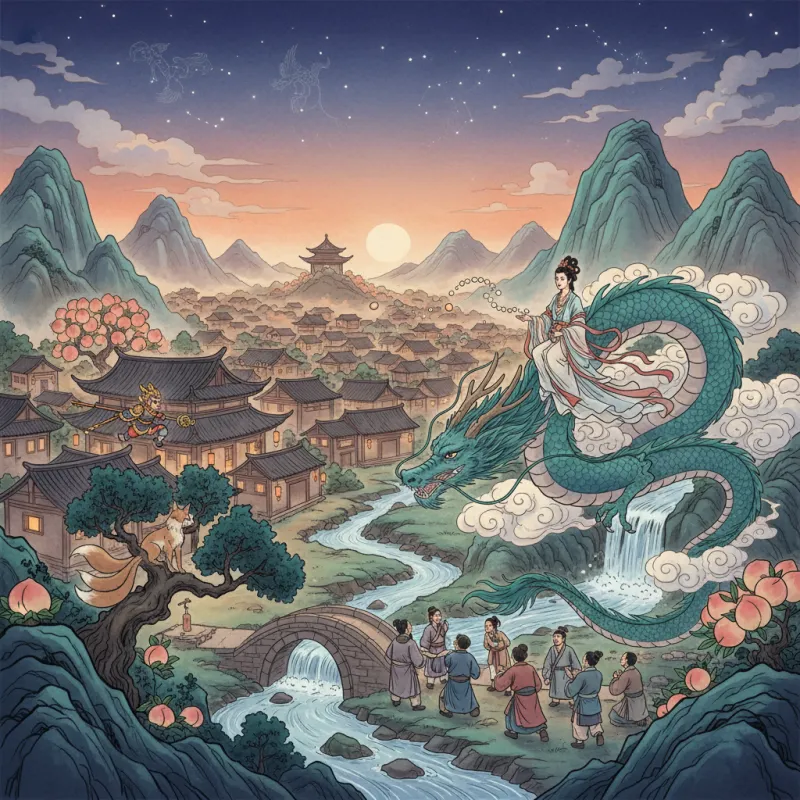
A white snake transforms into a beautiful woman, falls in love with a mortal scholar, and defies the natural order—only to be imprisoned beneath a pagoda by a meddling monk. This isn't just another love story. It's a 1,000-year-old meditation on the boundaries between human and divine, duty and desire, that still sparks heated debates in Chinese teahouses today. Welcome to the world of Chinese folklore, where every tale carries the weight of dynasties and the wisdom of countless retellings.
The Living Archive of Chinese Moral Tales
Chinese folklore isn't preserved in dusty museum cases—it lives and breathes through opera performances, grandmother's bedtime stories, and blockbuster films. Unlike Western fairy tales that were sanitized by the Brothers Grimm, Chinese folk narratives maintained their moral complexity through oral tradition and classical literature. The Soushen Ji 搜神记 (Search for the Supernatural), compiled by Gan Bao during the Eastern Jin Dynasty (317-420 CE), stands as one of the earliest written collections, capturing 464 tales of spirits, transformations, and karmic justice that common people had been telling for generations.
What makes these stories remarkable is their refusal to offer simple answers. Take the tale of Meng Jiangnu 孟姜女, the woman whose tears brought down the Great Wall. On the surface, it's about wifely devotion. Dig deeper, and you'll find a scathing critique of Emperor Qin Shi Huang's tyranny and the human cost of grand imperial projects. The story emerged during the Qin Dynasty (221-206 BCE) but evolved through each retelling, absorbing the grievances of every generation that suffered under forced labor. This is folklore as living history—each dynasty adding its own footnotes to the margins.
The Supernatural as Social Commentary
Chinese legends deploy ghosts, fox spirits, and dragons not for cheap thrills but as vehicles for social critique. Pu Songling's Liaozhai Zhiyi 聊斋志异 (Strange Tales from a Chinese Studio), written during the Qing Dynasty (1644-1912), features hundreds of supernatural encounters that expose the corruption of the imperial examination system, the hypocrisy of Confucian scholars, and the suffocating constraints on women. His fox spirits are often more virtuous than the human men who pursue them—a pointed reversal that didn't escape contemporary readers.
The Legend of the White Snake 白蛇传 (Bai She Zhuan) exemplifies this layered storytelling. Bai Suzhen, the white snake spirit, practices medicine and helps the poor, while the Buddhist monk Fahai, supposedly representing righteousness, destroys her family in the name of cosmic order. Who's the real villain? Audiences have argued for centuries. The tale gained its current form during the Ming Dynasty (1368-1644), but its themes of religious authority versus personal freedom resonated so powerfully that it became one of China's most adapted stories, from Peking Opera to modern television dramas.
The Geography of Chinese Fairy Tales
Chinese folklore maps onto the landscape itself. The Journey to the West 西游记 (Xi You Ji), written by Wu Cheng'en in the 16th century, traces the monk Xuanzang's pilgrimage from Chang'an to India, but the real journey is through a symbolic China where every mountain harbors demons and every river tests faith. The Flaming Mountains represent desire, the River of Flowing Sands symbolizes the difficulty of crossing from ignorance to enlightenment, and the various demon kings embody specific human failings—greed, lust, pride.
Regional variations reveal how folklore adapts to local concerns. Southern tales from the Yangtze River Delta feature water spirits and dragon kings, reflecting the region's relationship with floods and fishing. Northern stories from the Yellow River basin emphasize agricultural cycles and earth deities. The Miao and Dong ethnic minorities in Guizhou preserve creation myths involving butterflies and ancient floods that predate Han Chinese narratives by centuries. This geographical diversity means "Chinese folklore" is really a constellation of regional traditions that sometimes overlap, sometimes contradict, but always illuminate local values and anxieties.
The Moral Architecture of Folk Narratives
Chinese fairy tales operate on a strict karmic economy. Good deeds accumulate merit across lifetimes; evil actions guarantee retribution, if not in this life, then the next. The Twenty-Four Filial Exemplars 二十四孝 (Ershisi Xiao), compiled during the Yuan Dynasty (1271-1368), presents stories of extreme filial piety—children who taste their parents' excrement to diagnose illness, who lie naked on ice to catch fish for their stepmother. Modern readers find these tales disturbing, even darkly comic, but they reveal how Confucian values penetrated popular culture through narrative.
Yet folklore also subverts official morality. The Investiture of the Gods 封神演义 (Fengshen Yanyi) features Nezha 哪吒, the rebellious child deity who kills himself to repay his debt to his parents, then returns as a lotus-incarnated warrior to fight them. This isn't a simple morality tale—it's a complex exploration of filial duty's limits and the cost of absolute obedience. Stories like these gave ordinary people permission to question authority while maintaining plausible deniability through the supernatural frame.
Women Who Refuse Their Fate
Chinese folklore preserves a counter-narrative to Confucian patriarchy through its powerful female characters. Mulan 木兰, who disguises herself as a man to fight in her father's place, appears in the Ballad of Mulan from the Northern Wei Dynasty (386-534 CE). Unlike the Disney version, the original Mulan returns home, resumes women's clothing, and shocks her comrades who never suspected her true identity. She doesn't need the emperor's approval—she's already proven herself.
The Cowherd and Weaver Girl 牛郎织女 (Niulang Zhinü) legend, celebrated during the Qixi Festival, tells of a celestial weaver goddess who falls in love with a mortal cowherd. When the Queen Mother of Heaven separates them, they're allowed to meet once a year across a bridge of magpies. It's often read as a romantic tragedy, but it's also about a woman who chose love over divine duty and forced the cosmos to accommodate her desire. These stories provided imaginative space for women in a society that severely restricted their actual choices, which explains why they've endured for millennia.
The fox spirit tales deserve special mention. In stories like those found in Liaozhai, fox spirits (usually female) seduce scholars, drain their life force, or sometimes genuinely fall in love and become devoted wives. They're dangerous, yes, but also free in ways human women could never be—sexually autonomous, financially independent, capable of transformation. They represent both male anxiety about female power and female fantasy about escaping social constraints. This ambiguity makes them endlessly fascinating.
The Transmission and Transformation of Tales
Chinese folklore survived through multiple channels: oral storytelling in marketplaces, written collections by literati, performance traditions like shadow puppetry and opera, and religious texts from Buddhist and Daoist temples. Each medium shaped the stories differently. Oral versions emphasized dramatic reversals and memorable characters. Literary versions added classical allusions and moral commentary. Opera versions heightened emotional content and added musical elaboration.
The Song Dynasty (960-1279 CE) marked a turning point when professional storytellers in urban entertainment districts began performing extended narratives. These huaben 话本 (prompt books) were later collected and refined by scholars, creating a feedback loop between popular and elite culture. This is how stories like The Butterfly Lovers 梁山伯与祝英台 (Liang Shanbo yu Zhu Yingtai)—China's Romeo and Juliet—evolved from local legend to national treasure, with each region claiming its own version and historical sites.
Modern adaptations continue this tradition. The 1986 television series Journey to the West shaped how an entire generation visualizes these characters. Recent films like Ne Zha (2019) reimagine ancient tales with contemporary themes of self-determination and fighting prejudice. These aren't betrayals of tradition—they're the latest chapter in folklore's endless evolution, proving these stories remain relevant because they address fundamental human questions about justice, love, duty, and identity.
Why These Stories Still Matter
Chinese folklore offers something increasingly rare: narratives that embrace complexity and resist easy resolution. The Legend of the White Snake doesn't definitively answer whether Bai Suzhen should have revealed her true nature to her husband. Journey to the West doesn't pretend that enlightenment is simple or that authority figures are always wise. These ambiguities aren't flaws—they're features that allow each generation to find new meanings.
For those exploring Chinese festivals and traditions, folklore provides the mythological foundation. The Mid-Autumn Festival's moon cakes connect to Chang'e's flight to the moon. Dragon Boat Festival commemorates Qu Yuan's suicide but also invokes dragon deities and protective rituals. Understanding the stories deepens appreciation for the celebrations.
These tales also offer a window into Chinese philosophical thought that's more accessible than reading Confucius or Laozi directly. When the Monkey King rebels against Heaven, you're seeing Daoist skepticism toward hierarchy. When characters suffer for breaking cosmic rules, you're witnessing Buddhist karma in action. When families reunite after trials, you're experiencing Confucian values of harmony and filial piety. The stories don't preach—they dramatize these ideas through characters you care about.
Perhaps most importantly, Chinese folklore reminds us that moral tales don't need to be simple to be powerful. The best stories trust their audience to grapple with contradictions, to see themselves in both heroes and villains, to understand that wisdom often comes from unexpected sources—sometimes even from a white snake who dared to love a human, or a monkey who challenged the gods themselves. These aren't just old stories. They're invitations to think deeply about what it means to be human, Chinese or not, in a world where the boundaries between right and wrong are rarely as clear as we'd like them to be.
Related Reading
- Chinese New Year: The Complete Guide to Spring Festival
- Exploring Enchanting Chinese Folklore: Legends and Fairy Tales for Children
- Modern Retellings of Chinese Folklore: Bridging Ancient Legends and Contemporary Culture
Explore Chinese Culture
- Explore feng shui in daily life
- Explore supernatural folklore
- Explore classical Chinese literature