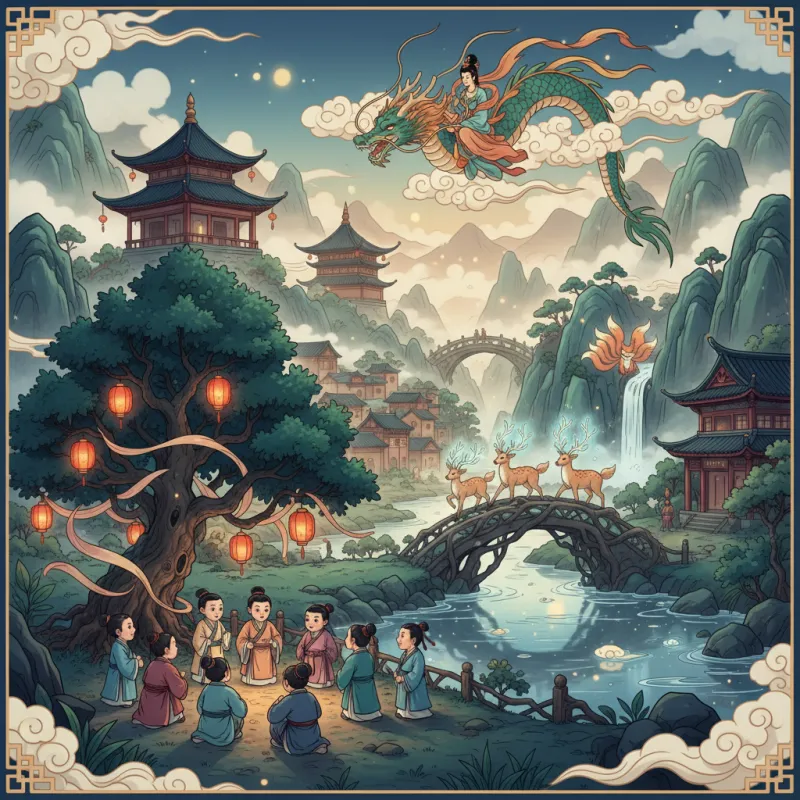
Picture a young girl sitting cross-legged on a silk cushion, eyes wide as her grandmother's voice drops to a whisper: "And then the dragon prince emerged from the Eastern Sea, his scales shimmering like a thousand jade mirrors..." For over three thousand years, Chinese children have grown up with stories like these—tales so vivid and enduring that they've shaped not just bedtime routines, but entire philosophies, festivals, and ways of seeing the world. Unlike Western fairy tales that often end with "happily ever after," Chinese folklore weaves together cosmic battles, shape-shifting foxes, and celestial bureaucracies into narratives that teach children how to navigate duty, cleverness, and the delicate balance between humans and the supernatural realm.
Why Chinese Folklore Captivates Young Minds
Chinese folklore operates on a fundamentally different logic than Western fairy tales. There's no clear division between the magical and the mundane—a kitchen god (灶神, Zàoshén) reports your family's behavior to the Jade Emperor annually, while fox spirits might be your neighbor in disguise. This seamless blending teaches children that wonder exists everywhere, not just in faraway kingdoms. The stories also refuse to simplify morality into pure good versus evil. Take the Monkey King from Journey to the West (西游记, Xīyóujì)—he's simultaneously a trickster, a rebel, a protector, and a student seeking enlightenment. Children learn that heroes can be flawed, that redemption is possible, and that wisdom often comes through mischief and mistakes.
What makes these tales particularly powerful for children is their emphasis on transformation. Characters constantly change forms—humans become animals, gods descend as beggars, and ordinary objects gain consciousness after a hundred years. This fluidity mirrors childhood itself, that liminal space where identity is still forming. When a child hears about the White Snake (白蛇, Báishé) who transforms into a beautiful woman and falls in love with a human scholar, they're learning that appearances deceive, that love transcends boundaries, and that persecution of the different is a recurring human failing.
The Cowherd and Weaver Girl: Love Across the Milky Way
Every year on the seventh day of the seventh lunar month, Chinese children look up at the night sky searching for two stars—Altair and Vega—separated by the luminous river of the Milky Way. The story of Niulang and Zhinu (牛郎织女, Niúláng Zhīnǚ) is perhaps the most romantic tale in Chinese folklore, yet it's fundamentally a story about the consequences of crossing social boundaries. Zhinu, a celestial weaver and granddaughter of the Jade Emperor, descends to Earth and falls in love with a humble cowherd. They marry and have children, living in blissful poverty until the Queen Mother of Heaven discovers the transgression and drags Zhinu back to the heavens, creating the Milky Way as an impassable barrier between the lovers.
The genius of this tale lies in what it teaches children about longing and constancy. The couple is allowed to reunite just once a year, when magpies form a bridge across the stars. Rather than a tragic ending, Chinese culture frames this as a celebration—the Qixi Festival (七夕节, Qīxì Jié), often called Chinese Valentine's Day. Children learn that love endures despite separation, that even cosmic forces cannot completely sever true connection, and that patience and loyalty are virtues worth cultivating. The story also subtly critiques rigid class systems while acknowledging their power—a sophisticated message for young minds beginning to understand social hierarchies.
Ne Zha: The Rebellious Child God
If you want to understand Chinese attitudes toward childhood rebellion, look no further than Ne Zha (哪吒, Nézhā), the lotus-born deity who embodies both filial piety and spectacular defiance. Born after a three-year pregnancy, Ne Zha emerges as a fully-formed child wielding magical weapons. At seven years old, he kills the Dragon King's son, triggering a cosmic conflict. To save his parents from the Dragon King's wrath, Ne Zha commits suicide, then is reborn from a lotus flower, returns, and battles his own father.
This is not your typical children's story, and that's precisely the point. Ne Zha represents the tension every Chinese child navigates: the duty to honor parents versus the need to forge one's own path. His story doesn't resolve this tension neatly—he literally dies and is reborn to escape it. Modern adaptations, like the 2019 animated film, have made Ne Zha even more explicitly about a child fighting against predetermined fate and social prejudice. Children watching or hearing this tale learn that righteousness sometimes requires breaking rules, that adults (even divine ones) can be wrong, and that self-sacrifice for family is the ultimate expression of love, even when that family relationship is fraught with conflict. For more stories about legendary heroes, explore Chinese mythological heroes and their adventures.
The Monkey King's Journey: Chaos, Discipline, and Enlightenment
Sun Wukong (孙悟空, Sūn Wùkōng), the Monkey King from Journey to the West, is arguably China's most beloved literary character, and for good reason—he's the ultimate wish-fulfillment figure for children. Born from a stone, he masters supernatural powers, declares himself equal to heaven, defeats celestial armies, and earns immortality multiple times over through various schemes. He's clever, irreverent, powerful, and completely uncontrollable. The Jade Emperor can't handle him, so Buddha traps him under a mountain for five hundred years.
But here's where the story becomes profound: the Monkey King's real journey begins when he's released to protect the monk Xuanzang on a pilgrimage to India. Fitted with a golden headband that tightens painfully when he misbehaves, Sun Wukong must learn discipline, patience, and humility. Children adore his early rebellious phase—who hasn't wanted to eat all the immortal peaches and wreck heaven's bureaucracy? But they also witness his gradual transformation into a protector and, eventually, a Buddha himself. The message is sophisticated: raw talent and power mean nothing without discipline and purpose. Freedom without responsibility is just chaos. And redemption is always possible, no matter how badly you've messed up.
The Monkey King's relationship with his master Xuanzang also teaches children about different kinds of strength. Xuanzang is physically weak, naive, and frequently captured by demons, yet his moral clarity and compassion are unwavering. Sun Wukong has all the power but needs Xuanzang's guidance to channel it properly. It's a beautiful illustration of how wisdom and strength must work together—a lesson that resonates whether you're seven or seventy.
Fox Spirits and Shape-Shifters: The Allure of the Unknown
Chinese folklore is populated with huli jing (狐狸精, húlijīng)—fox spirits who can transform into beautiful humans after cultivating their powers for centuries. Unlike Western werewolves or vampires, fox spirits occupy a moral gray zone. Some seduce scholars and drain their life force; others fall genuinely in love and become devoted wives. The most famous collection of these tales, Strange Tales from a Chinese Studio (聊斋志异, Liáozhāi Zhìyì) by Pu Songling, written in the 17th century, features dozens of fox spirit stories that blur the line between horror and romance.
For children, fox spirit tales serve as cautionary stories about deception and desire, but they're also remarkably empathetic toward the supernatural. Many fox spirits are portrayed as victims of prejudice—they want to live peacefully among humans but are hunted simply for being different. The scholar who discovers his wife is a fox spirit faces a choice: reject her based on what she is, or accept her based on who she's been to him. These stories teach children to look beyond surface appearances and question their assumptions about the "other." They also introduce the concept that immortals and spirits envy human mortality—that our brief lives have a poignancy and meaning that eternal existence lacks.
The Practical Magic of Kitchen Gods and Door Guardians
Not all Chinese folklore involves epic quests or celestial romance. Some of the most enduring stories are about household deities who watch over daily life. The Kitchen God (灶神, Zàoshén) lives above the family stove and reports to the Jade Emperor each New Year about the household's behavior. Before he ascends, families traditionally smear honey on his lips—either to sweeten his report or to stick his mouth shut, depending on which version you hear. This delightfully practical approach to the divine teaches children that the sacred and the silly can coexist, and that even gods can be influenced by a little strategic bribery.
Door gods (门神, ménshén) are fierce warriors painted on doorways to ward off evil spirits. The most famous pair are Qin Shubao and Yuchi Gong, generals from the Tang Dynasty who once guarded Emperor Taizong's bedroom against demons. When the emperor felt guilty about keeping them up all night, he had their portraits painted on the doors instead—and it worked. Children learn from these stories that protection comes in many forms, that loyalty extends beyond death, and that art and symbol have real power in the world. For more about protective traditions, see Chinese guardian spirits and protective deities.
Teaching Values Through Timeless Tales
The enduring power of Chinese folklore lies in its refusal to condescend to children. These stories don't shy away from death, injustice, or moral complexity. The Cowherd and Weaver Girl are separated by cosmic forces they cannot overcome. Ne Zha must die to resolve his conflict. The Monkey King spends five centuries imprisoned under a mountain. Yet these aren't depressing stories—they're realistic ones that prepare children for a world where not every problem has a solution, where authority isn't always just, and where persistence and virtue matter even when they don't guarantee victory.
Chinese folklore also emphasizes collective responsibility over individual heroism. Even the Monkey King, for all his power, cannot complete the journey to the West alone—he needs his fellow pilgrims, each contributing their unique strengths. Mulan (花木兰, Huā Mùlán) fights not for personal glory but to protect her father and serve her country. The Weaver Girl's tragedy stems from prioritizing personal happiness over cosmic order, a cautionary tale about the consequences of purely individual desire. These narratives teach children that they're part of larger systems—family, community, cosmos—and that their actions ripple outward in ways they might not immediately see.
What makes these tales particularly valuable for modern children is their emphasis on transformation and second chances. Characters are rarely static—they grow, fail, learn, and try again. The Monkey King goes from chaos to enlightenment. Fox spirits can cultivate themselves into immortals. Even the Kitchen God, that most bureaucratic of deities, can be influenced by a family's sincere efforts to improve. In a world that often feels fixed and deterministic, Chinese folklore insists that change is always possible, that today's troublemaker might be tomorrow's Buddha, and that the journey toward wisdom is more important than any single destination.
These stories have survived thousands of years not because they're quaint relics, but because they address fundamental human questions through unforgettable characters and imagery. When you share them with children today—whether through books, animated films, or oral storytelling—you're not just entertaining them. You're connecting them to a vast tradition of wisdom, wonder, and moral complexity that has shaped one of the world's oldest continuous civilizations. And in an age of simplified narratives and binary thinking, that might be the most valuable gift folklore can offer.
Related Reading
- Learning Chinese: An Honest Guide for Complete Beginners
- Chinese Calligraphy: The Five Major Styles
- Exploring the Rich Tapestry of Chinese Folklore, Legends, and Fairy Tales
Explore Chinese Culture
- Explore feng shui in daily life
- Explore supernatural folklore
- Explore classical Chinese literature