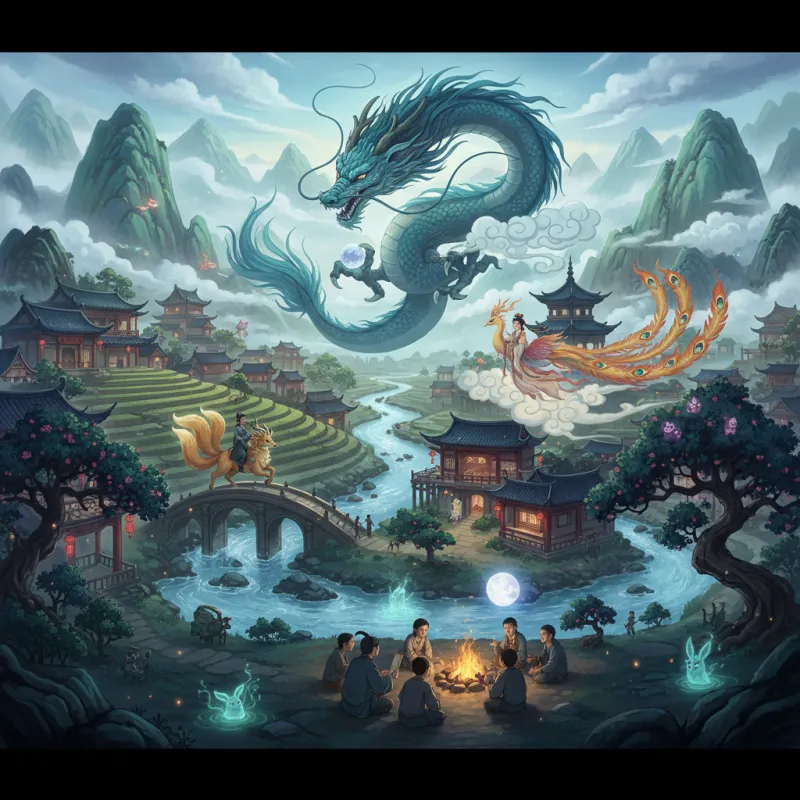
The old storyteller's voice drops to a whisper as villagers lean closer around the fire: "Before the Yellow Emperor tamed the floods, before Confucius walked the earth, there were the stories." This scene has played out for millennia across China, where folklore isn't just entertainment—it's the living memory of a civilization that has survived longer than any other on Earth. Chinese folklore weaves together creation myths, ghost stories, moral fables, and historical legends into a tapestry so rich that scholars still debate whether certain "mythical" figures like the Yellow Emperor (黄帝, Huángdì) were actual historical rulers or pure invention.
The Cosmic Origins: Creation Myths That Shaped a Civilization
Chinese creation mythology stands apart from Western traditions in one crucial way: there's no single creator deity who speaks the world into existence. Instead, we get Pangu (盘古, Pángǔ), a cosmic giant who literally becomes the universe. According to texts dating back to the Three Kingdoms period (220-280 CE), Pangu emerged from a cosmic egg and spent 18,000 years separating yin from yang, earth from sky. When he finally died from exhaustion, his body transformed—his breath became wind, his voice thunder, his left eye the sun, his right eye the moon. It's a profoundly materialist creation story for a culture that would later embrace both Daoist mysticism and Confucian pragmatism.
Then there's Nüwa (女娲, Nǚwā), the serpent-bodied goddess who created humanity from yellow clay. The myth gets interesting in its details: she hand-crafted the nobles and wealthy from carefully molded clay, but grew tired and started flinging mud around with a rope to create commoners. This isn't just a charming origin story—it's a Bronze Age explanation for social hierarchy that persisted through imperial China. When the pillars of heaven cracked and floods threatened to destroy humanity, Nüwa melted five-colored stones to repair the sky, a myth that resonates with China's long history of flood control and engineering projects.
The Pantheon of Immortals: Where History Meets Mythology
Walk into any Chinese temple and you'll encounter a bewildering array of deities, immortals, and legendary figures whose stories blur the line between history and myth. The Eight Immortals (八仙, Bāxiān) exemplify this perfectly—each represents a different social class and possesses unique magical powers. Lü Dongbin (吕洞宾, Lǚ Dòngbīn), the scholarly immortal with his demon-slaying sword, appears in countless folk tales as a trickster who tests mortals' virtue. He Xiangu (何仙姑, Hé Xiāngū), the only female immortal, carries a lotus flower and represents purity, though her backstory involves eating a magical peach that granted her immortality—a detail that connects her to the broader mythology of Peach Blossom Spring and Daoist paradise traditions.
The Jade Emperor (玉皇大帝, Yùhuáng Dàdì) rules this celestial bureaucracy with the same administrative complexity as earthly Chinese emperors. This isn't coincidence—Chinese folk religion essentially mirrors the imperial government structure, complete with heavenly ministries, celestial officials, and even divine corruption scandals. The classic novel "Journey to the West" (西游记, Xīyóujì) from the Ming Dynasty satirizes this system brilliantly, with Sun Wukong the Monkey King causing chaos in heaven by eating immortality peaches and stealing elixirs.
Ghosts, Demons, and the Spirit World
Chinese folklore takes the supernatural seriously in ways that might surprise Western readers. Ghosts (鬼, guǐ) aren't just scary—they're a social problem requiring proper ritual management. The Hungry Ghost Festival (中元节, Zhōngyuánjié) in the seventh lunar month acknowledges that neglected spirits become dangerous, so families burn paper money and offer food to appease wandering souls. This reflects a deeper cultural anxiety: dying without descendants to perform ancestral rites means becoming a hungry ghost, forever unsatisfied and potentially malevolent.
Fox spirits (狐狸精, húlijīng) occupy a particularly fascinating niche in Chinese folklore. These shape-shifting creatures, usually appearing as beautiful women, can be either benevolent or malicious. The 18th-century collection "Strange Tales from a Chinese Studio" (聊斋志异, Liáozhāi Zhìyì) by Pu Songling contains dozens of fox spirit stories that read like supernatural romance novels. Scholar meets mysterious woman, falls in love, discovers she's a fox spirit, and must choose between human society and supernatural love. These tales often critique arranged marriages and social restrictions while exploring themes of desire and transformation.
The White Snake (白蛇传, Báishé Zhuàn) legend takes this further—a white snake spirit practices Daoist cultivation for a thousand years to become human, falls in love with a mortal man, and faces persecution from a meddling Buddhist monk. This story, performed in countless opera versions, asks uncomfortable questions about what makes someone truly human and whether love transcends species boundaries. It's been adapted so many times that modern versions sometimes make the monk the villain and the snake spirit the hero, showing how folklore evolves with changing values.
Legendary Heroes and Historical Figures
Chinese folklore has a peculiar habit of turning historical figures into supernatural heroes. Guan Yu (关羽, Guān Yǔ), a general from the Three Kingdoms period (220-280 CE), became Guan Gong, the God of War and patron saint of businessmen, police officers, and triads alike. His red face and long beard appear in temples across Asia, and his story from "Romance of the Three Kingdoms" (三国演义, Sānguó Yǎnyì) has been retold so many times that most Chinese people can't distinguish between the historical Guan Yu and his legendary counterpart.
The legend of Mulan (木兰, Mùlán) predates Disney by about 1,500 years, first appearing in the "Ballad of Mulan" (木兰辞, Mùlán Cí) from the Northern Wei Dynasty. The original poem is remarkably spare—just 392 characters describing a daughter who takes her elderly father's place in the army, serves for twelve years, and returns home to resume her life as a woman. No romance, no dragon sidekick, just a meditation on duty, gender, and identity that resonates across centuries. The story's power lies in what it doesn't say, leaving generations of readers to imagine Mulan's inner life.
Folklore in Daily Life: Festivals and Traditions
Chinese folklore isn't locked in ancient texts—it lives in annual festivals that millions still celebrate. The Mid-Autumn Festival (中秋节, Zhōngqiū Jié) centers on the legend of Chang'e (嫦娥, Cháng'é), who swallowed an immortality pill and floated to the moon, forever separated from her husband Hou Yi. Families eat mooncakes and gaze at the full moon, ostensibly to appreciate its beauty but really to participate in a story about sacrifice, separation, and longing that dates back over 2,000 years.
The Dragon Boat Festival (端午节, Duānwǔ Jié) commemorates Qu Yuan (屈原, Qū Yuán), a poet-official from the Warring States period who drowned himself in 278 BCE after his state fell to enemies. Villagers supposedly raced boats and threw rice dumplings into the river to prevent fish from eating his body. Today's dragon boat races and zongzi (粽子, zòngzi) dumplings connect modern Chinese people to a 2,300-year-old story about political integrity and tragic loyalty. The festival also involves hanging mugwort, drinking realgar wine, and wearing perfume pouches—layers of folk practice that accumulated over centuries, each with its own story.
The Living Tradition: How Folklore Adapts and Survives
What makes Chinese folklore remarkable isn't just its age but its adaptability. The same stories that entertained Tang Dynasty (618-907 CE) audiences appear in modern video games, television dramas, and films, often with radical reinterpretations. "The King's Avatar," a popular web novel and animation, transplants the structure of martial arts legends into competitive gaming. "The Untamed," a 2019 drama based on a web novel, reimagines cultivation immortals (修仙, xiūxiān) for a generation raised on fantasy literature and BL romance.
This isn't cultural dilution—it's how folklore has always worked. The stories we call "traditional" were once innovative adaptations of earlier tales. "Journey to the West" combined Buddhist sutras, Daoist immortal legends, and folk tales about a historical monk's pilgrimage to India. "Strange Tales from a Chinese Studio" borrowed ghost story frameworks from earlier collections while adding Pu Songling's distinctive literary style and social commentary. Each generation remakes folklore in its own image while maintaining threads of continuity that stretch back millennia.
The challenge facing Chinese folklore today isn't modernization but homogenization. When everyone watches the same television adaptations and reads the same popular novels, regional variations disappear. The fox spirit stories from Shandong Province differ from those in Guangdong, but these local flavors risk being lost to standardized national versions. Yet folklore has survived book burnings, dynastic changes, and political upheavals—it will likely survive the internet age too, though perhaps in forms the old storytellers wouldn't recognize.
Why These Stories Still Matter
Chinese folklore offers something increasingly rare: narratives that aren't individualistic hero journeys but explorations of duty, family, and cosmic balance. When Nüwa repairs the sky, she's not seeking personal glory—she's maintaining cosmic order. When Mulan joins the army, she's fulfilling filial duty, not pursuing self-actualization. These values might seem foreign to Western readers raised on stories about breaking free from tradition, but they reflect a different way of understanding human existence within larger social and cosmic systems.
The stories also preserve pre-modern ways of thinking about nature, spirits, and the boundaries between categories. In Chinese folklore, humans can become immortals through cultivation, animals can become human through practice, and ghosts remain part of the social world requiring proper management. This fluid ontology contrasts sharply with Western traditions that draw firm lines between human and animal, natural and supernatural, living and dead. Reading these stories means entering a worldview where transformation is always possible and categories are always negotiable.
Perhaps most importantly, Chinese folklore demonstrates how stories function as cultural memory. When families gather for Mid-Autumn Festival, they're not just eating mooncakes—they're participating in a 2,000-year-old conversation about love, loss, and longing. When children hear about the Monkey King's rebellion against heaven, they're learning about authority, tricksterism, and redemption through frameworks their ancestors would recognize. These stories don't just entertain; they transmit ways of being Chinese that survive political systems, economic transformations, and technological revolutions. As long as people tell these stories, something essential about Chinese civilization persists, adapting but never quite disappearing, like the immortals who retreat to mountains but never truly leave the human world behind.
Related Reading
- Real Chinese Martial Arts: Beyond the Movie Myths
- Unveiling Chinese Creation Myths: The Stories that Shaped a Civilization
- Food Symbolism in Chinese Culture: Every Dish Tells a Story
Explore Chinese Culture
- Explore feng shui in daily life
- Explore supernatural folklore
- Explore classical Chinese literature