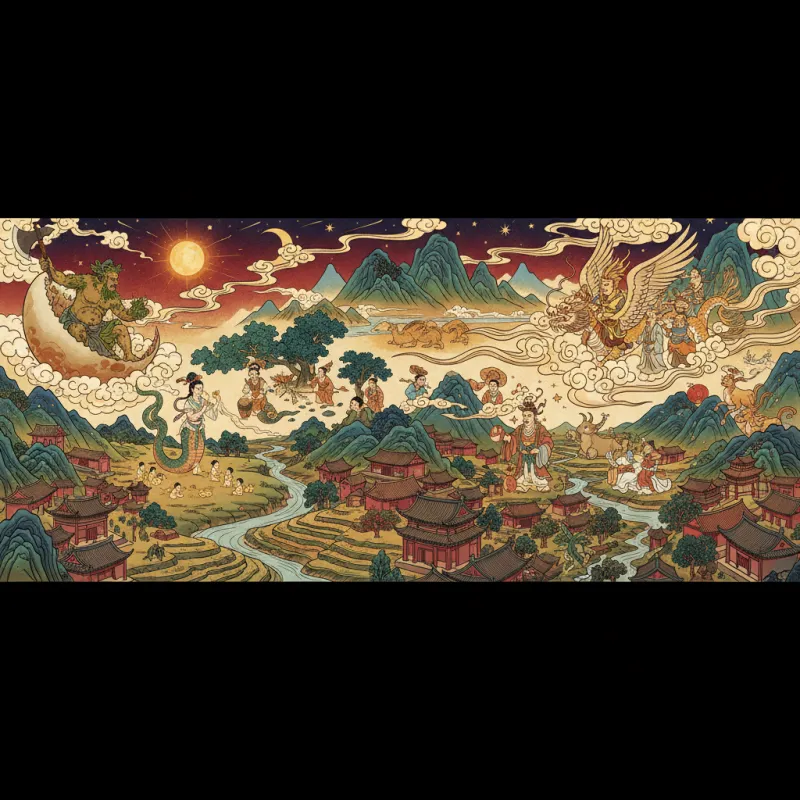
The universe began as an egg. Not the kind you crack for breakfast, but a cosmic egg floating in absolute nothingness—no light, no sound, no time. Inside this egg slept Pangu (盘古, Pángǔ), a giant who would sleep for eighteen thousand years before cracking open existence itself. This image, strange and primal, sits at the heart of Chinese cosmology, a creation story that feels less like divine proclamation and more like the slow, patient work of nature itself.
Pangu: The Giant Who Became Everything
Unlike creation myths where gods speak worlds into being, Pangu's story is one of physical labor and sacrifice. When he finally woke inside that cosmic egg, he found himself trapped between two forces: the heavy yin (阴, yīn) sinking below and the light yang (阳, yáng) rising above. Using a chisel—or in some versions, simply his own strength—he split them apart. The clear yang became the sky; the murky yin became the earth.
But here's where the myth gets interesting: Pangu didn't just create and walk away. He stood between heaven and earth for another eighteen thousand years, growing ten feet taller each day, pushing them apart to prevent them from collapsing back into chaos. When he finally died from exhaustion, his body didn't simply disappear. His breath became wind and clouds, his voice thunder, his left eye the sun, his right eye the moon. His limbs formed the four cardinal directions and the five sacred mountains. His blood filled the rivers, his muscles shaped the fields, his hair became the stars. Even his sweat turned into rain, and the fleas on his body—somewhat less poetically—became the ancestors of humanity.
This total transformation distinguishes Chinese creation from many other traditions. Pangu doesn't rule over his creation; he becomes it. The universe isn't separate from its creator—it is the creator, repurposed and redistributed. You can see echoes of Daoist philosophy here, written centuries before Laozi put brush to silk.
Nüwa: The Mother Who Molded Humanity
If Pangu created the stage, Nüwa (女娲, Nǚwā) populated it with actors. This serpent-bodied goddess appears in texts dating back to the Warring States period (475-221 BCE), making her one of China's oldest deities. The "Huainanzi" (淮南子, Huáinánzǐ), compiled around 139 BCE, describes her as a creator goddess, though earlier references suggest she may have originally been a fertility deity who evolved into a cosmic figure.
The story goes that Nüwa felt lonely in the newly formed world. She knelt beside the Yellow River and began molding figures from yellow clay, breathing life into each one. These carefully crafted humans became the nobility—the aristocrats and rulers. But hand-crafting humans is tedious work, even for a goddess. Growing impatient, she dipped a rope in mud and swung it around, flinging droplets everywhere. Each droplet that hit the ground became a person. These hastily made humans became the common people.
This origin story served as cosmic justification for China's rigid class system for millennia. But there's something more human in Nüwa's creation method than in Pangu's cosmic transformation. She creates out of loneliness, not duty. She gets tired and finds shortcuts. She's relatable in a way that most creation deities aren't.
Nüwa's most famous act came later, when the pillars holding up the sky began to crack—some versions blame the water god Gonggong (共工, Gònggōng) for ramming into Mount Buzhou in a fit of rage. The sky tilted, causing floods and fires. Nüwa gathered five-colored stones, melted them down, and patched the holes in heaven. She then killed a giant turtle and used its legs as new pillars. This myth explains why Chinese cosmology describes the sky as tilting toward the northwest and the earth sloping toward the southeast, causing rivers to flow eastward.
The Cosmic Egg and Primordial Chaos
Before Pangu, before anything, there was hundun (混沌, hùndùn)—primordial chaos. This concept appears throughout Chinese philosophy, from the "Zhuangzi" to the "Daodejing." Unlike the void of Western creation myths, hundun isn't empty nothingness. It's everything mixed together, undifferentiated potential waiting to be organized.
The cosmic egg that contained Pangu represents this perfectly. It's not creation from nothing (ex nihilo) but creation through separation and organization. This reflects a fundamentally different worldview from Abrahamic traditions. The Chinese cosmos wasn't created by an external god but emerged from within itself, self-organizing according to natural principles. You can see this same pattern in Chinese festival traditions, where renewal comes not from divine intervention but from cyclical natural processes.
The "Sanwu Liji" (三五历纪, Sānwǔ Lìjì), a text from the Three Kingdoms period (220-280 CE), provides the most detailed account of Pangu's emergence from this egg. But scholars debate whether Pangu was originally a Chinese deity or borrowed from southern minority groups. Some point to similarities with creation myths from the Miao and Yao peoples, suggesting Pangu may have been incorporated into Han Chinese mythology during periods of cultural exchange.
The Separation of Heaven and Earth
The act of separating heaven and earth—a process called kaitian pidi (开天辟地, kāitiān pìdì)—represents more than physical creation. It's the establishment of order, hierarchy, and the fundamental dualities that structure Chinese thought: heaven and earth, yin and yang, light and dark, male and female.
This separation wasn't violent or antagonistic. Pangu didn't battle chaos monsters or defeat rival gods. He simply stood firm, day after day, year after year, maintaining the space between opposites. There's something deeply Chinese about this—the idea that maintaining cosmic order requires constant, patient effort rather than a single dramatic act.
The myth also establishes the vertical axis that would dominate Chinese cosmology: heaven above, earth below, and humanity in between. The emperor would later claim to be the "Son of Heaven" (天子, Tiānzǐ), the intermediary between these realms. This three-tiered universe appears everywhere in Chinese culture, from temple architecture to traditional food symbolism, where certain dishes represent heaven, earth, and humanity in harmony.
Regional Variations and Minority Traditions
Chinese creation myths aren't monolithic. The Han Chinese versions centered on Pangu and Nüwa dominate written records, but China's fifty-five ethnic minorities preserve their own creation stories, many predating written Chinese texts.
The Yi people tell of a creator god named Zhyge Alu who hatched from a cosmic egg and created the world through song. The Bai people credit their goddess Azhimei with creating humanity from clay, similar to Nüwa but with distinct regional characteristics. The Naxi people's Dongba scriptures describe creation as emerging from the union of heaven and earth, personified as male and female principles.
These variations reveal how creation myths adapted to local geography and culture. Mountain-dwelling peoples often emphasize the creation of mountains and valleys. River valley cultures focus on water and floods. The diversity suggests that Chinese mythology developed through centuries of cultural exchange, with different traditions borrowing, adapting, and synthesizing elements from each other.
Some scholars argue that Pangu himself may have originated in southern China, possibly among the Yao or Miao peoples, before being adopted into mainstream Han mythology during the Han Dynasty (206 BCE - 220 CE). The earliest written reference to Pangu appears in the "Sanwu Liji," compiled by Xu Zheng during the Three Kingdoms period—relatively late compared to other Chinese myths.
Philosophical Underpinnings: Yin, Yang, and the Dao
Chinese creation myths aren't just stories—they're philosophical statements about the nature of reality. The separation of yin and yang from primordial chaos reflects the Daoist concept that all things emerge from the Dao (道, Dào), the nameless source of existence.
The "Daodejing" states: "The Dao produced One; One produced Two; Two produced Three; Three produced all things." This progression mirrors the creation sequence: from hundun (chaos/unity) to the separation of heaven and earth (duality) to the emergence of humanity (the third element) to the ten thousand things (all of creation).
Unlike creation myths that emphasize divine will or purpose, Chinese myths suggest a more organic, spontaneous process. Things emerge because conditions are right, not because a deity decided they should exist. This aligns with the Chinese philosophical emphasis on natural patterns (天理, tiānlǐ) rather than divine commandments.
The concept of wuwei (无为, wúwéi)—effortless action or non-forcing—also appears in these myths. Pangu doesn't force heaven and earth apart through violence; he simply stands between them, allowing natural processes to unfold. Nüwa doesn't impose order on chaos; she responds to needs as they arise, patching the sky when it breaks, creating humans when she feels lonely.
Legacy and Cultural Impact
These creation myths shaped Chinese civilization in profound ways. They established the cosmological framework that would influence everything from architecture to medicine to political theory. The concept of tianxia (天下, tiānxià)—"all under heaven"—derives directly from this creation cosmology, positioning China as the central kingdom beneath heaven's dome.
The myths also provided a model for understanding change and transformation. If Pangu could become mountains and rivers, then transformation itself was natural and expected. This idea permeates Chinese thought, from the "Yijing" (易经, Yìjīng, Book of Changes) to traditional Chinese medicine's understanding of the body as a microcosm of the universe.
Modern China continues to reference these myths. The Pangu Plaza in Shenzhen, named after the creator giant, symbolizes the city's role in China's economic transformation. Chinese space missions have been named after mythological figures, connecting ancient cosmology with modern space exploration. Even Chinese science fiction, like Liu Cixin's "The Three-Body Problem," engages with these deep-rooted cosmological concepts.
The myths remind us that creation isn't a single event but an ongoing process. Heaven and earth still need to be held apart. The sky still needs occasional patching. Order constantly threatens to collapse back into chaos. In this sense, Chinese creation myths aren't about the beginning—they're about the eternal work of maintaining existence itself, a task that continues in every generation.
Related Reading
- Discovering Chinese Creation Myths: Legends that Shape a Nation's Cultural Identity
- Unveiling the Rich Tapestry of Chinese Folklore and Festival Origins
- Chinese Dynasties: A Quick Guide to 5,000 Years
- Jade in Chinese Culture: The Stone of Heaven
Explore Chinese Culture
- Explore feng shui in daily life
- Explore supernatural folklore
- Explore classical Chinese literature