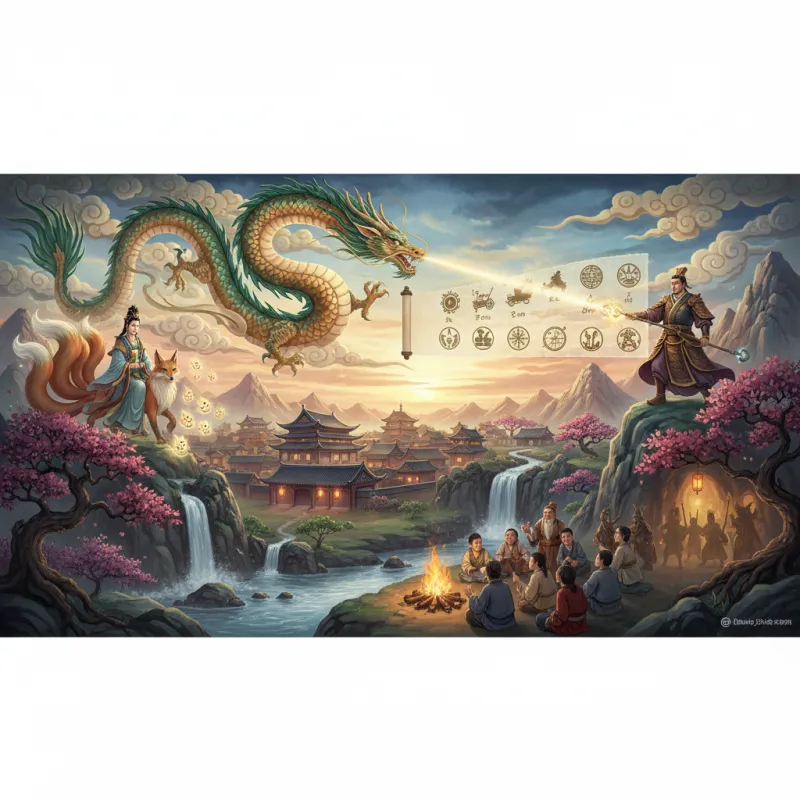
Picture this: a single family ruling for 800 years. Not a constitutional monarchy with ceremonial duties, but absolute power over millions of subjects, commanding armies, building monuments, and shaping the culture of an entire civilization. That's the Zhou Dynasty — and it's just one chapter in a story that makes the Roman Empire look like a brief experiment. Chinese dynastic history isn't just long; it's a masterclass in how civilizations rise, peak, and collapse, then rise again with lessons learned.
The Mythical Foundations: Where History Meets Legend
Before we get to the dynasties you can actually verify, there's the 三皇五帝 (Sānhuáng Wǔdì, Three Sovereigns and Five Emperors) — legendary rulers who supposedly invented fire, agriculture, writing, and basically everything that makes civilization possible. The Yellow Emperor, 黄帝 (Huángdì), is the most famous, credited with defeating the chaos god Chi You in an epic battle around 2700 BCE. Did this actually happen? Probably not as described. But these myths matter because they established the template: Chinese rulers weren't just political leaders, they were cosmic mediators between heaven and earth.
The first dynasty with archaeological evidence is the Xia (c. 2070-1600 BCE), though even this is debated. What we know for certain starts with the Shang Dynasty (1600-1046 BCE), whose oracle bones — turtle shells and ox bones inscribed with early Chinese characters — prove they were obsessed with divination and ancestor worship. These aren't just historical curiosities; they're the foundation of practices that continue today during Qingming Festival when families honor their ancestors.
Zhou to Qin: Philosophy Born from Chaos
The Zhou Dynasty (1046-256 BCE) gave us the 天命 (Tiānmìng, Mandate of Heaven) concept — the idea that rulers govern by divine right, but only as long as they govern well. Lose the mandate through corruption or incompetence, and rebellion becomes morally justified. This wasn't just political theory; it was revolutionary. It meant power wasn't permanent, and it gave every subsequent dynasty a built-in expiration date.
But here's the irony: the Zhou themselves lost control, fragmenting into the Spring and Autumn Period (770-476 BCE) and then the Warring States Period (475-221 BCE). Seven major kingdoms fought for supremacy while philosophers tried to make sense of the chaos. Confucius wandered from court to court, largely ignored, preaching about ritual and virtue. Laozi supposedly wrote the Dao De Jing and disappeared into the mountains. The Hundred Schools of Thought bloomed precisely because the old order had collapsed.
The Qin Dynasty (221-206 BCE) ended the chaos through brutal efficiency. Qin Shi Huang, the First Emperor, unified China, standardized writing and currency, built the early Great Wall, and buried scholars alive for disagreeing with him. His dynasty lasted only 15 years after his death, but he fundamentally transformed what "China" meant — no longer a collection of feuding states, but a unified empire with a single written language and centralized bureaucracy.
Han to Tang: The Classical Golden Ages
The Han Dynasty (206 BCE - 220 CE) is so foundational that ethnic Chinese still call themselves 汉人 (Hànrén, Han people). This is when Confucianism became state ideology, the civil service examination system began, and the Silk Road connected China to Central Asia and beyond. The Han also gave us paper, the seismograph, and significant advances in medicine and astronomy. When the Han fell, China fragmented into the Three Kingdoms period — the setting for the Romance of the Three Kingdoms, one of China's Four Great Classical Novels, where heroes like Liu Bei, Cao Cao, and Zhuge Liang became immortal in popular culture.
After centuries of division, the Sui Dynasty (581-618 CE) reunified China but collapsed quickly, exhausted by massive projects like the Grand Canal. The Tang Dynasty (618-907 CE) inherited this infrastructure and built what many consider Chinese civilization's peak. Tang poetry — Li Bai's romantic wanderings, Du Fu's social commentary — set standards that still define Chinese literature. Chang'an (modern Xi'an) became the world's largest city, a cosmopolitan hub where Persian merchants, Buddhist monks, and Central Asian musicians mingled. Women enjoyed relatively high status; Empress Wu Zetian even ruled in her own right, the only woman to do so in Chinese history.
Song to Ming: Innovation and Invasion
The Song Dynasty (960-1279 CE) doesn't get enough credit. While less territorially expansive than the Tang, the Song experienced an economic and technological revolution. Movable type printing, gunpowder weapons, the compass, paper money — innovations that would later transform Europe all emerged or matured during the Song. Neo-Confucianism, synthesized by Zhu Xi, became the dominant philosophy, emphasizing moral cultivation and rational inquiry.
But the Song faced constant pressure from northern nomadic peoples. Eventually, the Mongols conquered all of China, establishing the Yuan Dynasty (1271-1368 CE). Kublai Khan, Genghis Khan's grandson, ruled an empire stretching from Korea to Hungary. Marco Polo's accounts (however embellished) introduced Europe to Chinese wealth and sophistication. Yet the Mongols remained foreign rulers, never fully assimilating, and Chinese resentment eventually exploded in rebellion.
The Ming Dynasty (1368-1644 CE) restored Han Chinese rule with a vengeance. The Hongwu Emperor, a former peasant and Buddhist monk, built a paranoid, centralized state. The Ming rebuilt the Great Wall in its current form, constructed the Forbidden City, and sent Admiral Zheng He on massive naval expeditions that reached Africa decades before European exploration began. Then, inexplicably, they stopped, turned inward, and banned ocean-going vessels. This isolationism would have consequences.
Qing to Republic: The Long Decline
The Qing Dynasty (1644-1912 CE) was China's last imperial dynasty, ruled by Manchus from the northeast. Despite being foreign conquerors, the Qing expanded China to its greatest territorial extent, incorporating Tibet, Xinjiang, and Mongolia. The Kangxi and Qianlong emperors presided over prosperity and cultural flourishing. But by the 19th century, the dynasty faced crises it couldn't solve: population pressure, official corruption, and most devastatingly, Western imperialism backed by industrial military technology.
The Opium Wars (1839-1842, 1856-1860) shattered the illusion of Chinese superiority. Britain forced China to accept opium imports and cede Hong Kong. The Taiping Rebellion (1850-1864), led by a man who claimed to be Jesus Christ's younger brother, killed 20-30 million people — more than World War I. The Boxer Rebellion (1899-1901) tried to expel foreigners through martial arts and magic; eight foreign powers invaded Beijing in response.
By 1912, the dynastic system that had organized Chinese civilization for millennia simply collapsed. Sun Yat-sen's revolution established a republic, but China descended into warlordism, Japanese invasion, and civil war before the Communist victory in 1949. The dynastic era was over, but its patterns — centralized authority, bureaucratic governance, the tension between unity and fragmentation — continue to shape China today.
Why Dynasties Still Matter
Understanding Chinese dynasties isn't just memorizing dates and names. It's recognizing patterns that repeat: the cycle of unity and division, the tension between Confucian moralism and Legalist pragmatism, the recurring challenge of balancing central control with local autonomy. When modern Chinese leaders invoke "national rejuvenation" or the "Chinese Dream," they're referencing a historical consciousness shaped by these dynastic cycles.
The dynastic system also explains Chinese cultural continuity. Despite invasions, rebellions, and revolutions, certain elements persisted: the written language, Confucian values, ancestor worship, the ideal of the scholar-official. Even when foreign dynasties like the Yuan and Qing conquered China, they adopted Chinese administrative systems and cultural practices rather than imposing their own. This wasn't just pragmatism; it was recognition that Chinese civilization had developed sophisticated tools for organizing society.
For anyone interested in Chinese festivals, traditional food culture, or classical literature, the dynasties provide essential context. The Mid-Autumn Festival's mooncakes reference Ming Dynasty rebellion. Hot pot evolved from Mongol cooking methods during the Yuan. Journey to the West, written during the Ming, reflects Buddhist-Daoist syncretism that developed over centuries. You can't fully appreciate Chinese culture without understanding the historical layers beneath it.
The Mandate Never Really Ended
Here's the uncomfortable truth: the 天命 (Tiānmìng, Mandate of Heaven) concept still operates in Chinese political consciousness, just without the explicit language. Governments are expected to deliver prosperity, stability, and national dignity. When they fail — through corruption, incompetence, or foreign humiliation — they lose legitimacy. The Communist Party understands this implicitly, which is why economic growth and nationalist pride are so central to their governance strategy.
The dynastic cycle taught Chinese civilization that no political order is permanent, that competence matters more than ideology, and that heaven (or history, or the people) ultimately judges rulers by results. After 5,000 years, that lesson remains remarkably relevant. The dynasties are gone, but the patterns they established — and the cultural memory they created — continue to shape how China sees itself and its place in the world.
Related Reading
- Chinese History in 30 Minutes: From the Yellow Emperor to the Last Dynasty
- The Silk Road: How Trade Routes Shaped Chinese Culture
- The Century of Humiliation: How China Remembers
- Why Chinese History Matters: Lessons for the Modern World
- Legendary Heroes of Chinese Folklore: Tales That Shaped Culture and Identity
- Laozi and the Tao Te Ching: A Practical Guide
- Mid-Autumn Festival: Mooncakes and Moon Gazing
Explore Chinese Culture
- Explore feng shui in daily life
- Explore supernatural folklore
- Explore classical Chinese literature