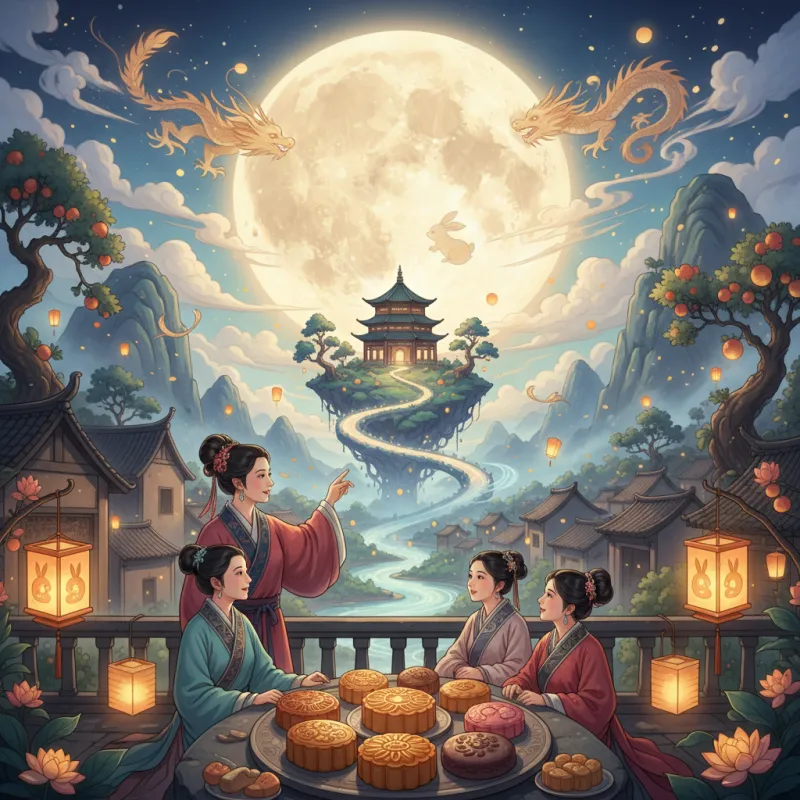
Picture this: It's the fifteenth night of the eighth lunar month, and across China, millions of families are doing something that would baffle most Westerners—they're sitting outside in the dark, staring at the moon, and eating dense pastries filled with sweet bean paste or salted egg yolks. But this isn't just stargazing with snacks. The Mid-Autumn Festival, or Zhongqiu Jie (中秋节, zhōngqiū jié), is when the moon reaches its fullest and brightest point of the year, and for over three millennia, Chinese people have marked this moment as a time when families must reunite, no matter the distance.
The Archer's Wife Who Became the Moon
Every festival needs its origin story, and the Mid-Autumn Festival has one of Chinese mythology's most tragic tales. The legend of Chang'e (嫦娥, cháng'é) begins during a catastrophic period when ten suns appeared in the sky simultaneously, scorching the earth and threatening all life. The archer Hou Yi (后羿, hòu yì) shot down nine of these suns, saving humanity and earning himself hero status—plus an elixir of immortality from the Queen Mother of the West as a reward.
Here's where it gets interesting. Hou Yi didn't want to become immortal without his beloved wife Chang'e, so he gave her the elixir for safekeeping. But when his apprentice Peng Meng tried to steal it while Hou Yi was out hunting, Chang'e made a split-second decision: she swallowed the entire elixir herself. The potion sent her floating upward, and she drifted all the way to the moon, where she's remained ever since, accompanied only by a jade rabbit who pounds medicine with a mortar and pestle.
The heartbreaking detail that makes this legend resonate? Hou Yi, devastated by his loss, would lay out Chang'e's favorite foods under the moonlight, hoping she could see his offerings from her lunar palace. This became the template for Mid-Autumn Festival celebrations—families gathering outdoors, presenting food to the moon, and thinking of those they're separated from.
Mooncakes: The Pastry That Launched a Revolution
If you've ever bitten into a traditional mooncake, you know they're not exactly what modern palates would call "light and fluffy." These dense, round pastries—typically filled with lotus seed paste, red bean paste, or the controversial salted egg yolk—are an acquired taste. But mooncakes, or yuebing (月饼, yuèbǐng), carry significance far beyond their flavor profile.
The most fascinating mooncake story comes from the end of the Yuan Dynasty (1271-1368). According to popular legend, Chinese rebels planning to overthrow their Mongol rulers needed a way to coordinate their uprising without alerting the authorities. Their solution? Hide secret messages inside mooncakes, which were being distributed for the Mid-Autumn Festival. The messages supposedly read "Kill the Mongols on the 15th day of the 8th month," and the plan worked—the coordinated rebellion helped establish the Ming Dynasty.
Historians debate whether this story is fact or patriotic fiction, but it doesn't matter. The tale has become inseparable from mooncake culture, adding a layer of revolutionary spirit to what might otherwise be just another festival food. Modern mooncakes have evolved dramatically—you can now find ice cream mooncakes, snow skin mooncakes, and even mooncakes filled with chocolate or durian. Luxury brands release designer mooncake boxes that cost hundreds of dollars, turning these pastries into status symbols and corporate gifts.
Moon Gazing as Spiritual Practice
While mooncakes get most of the attention, the festival's true heart is shangyue (赏月, shǎngyuè)—moon appreciation. This isn't casual glancing at the sky; it's a deliberate practice of gathering outdoors, often in gardens or on rooftops, to contemplate the full moon's beauty. Classical Chinese poetry is filled with moon-gazing verses, and the Mid-Autumn moon specifically symbolizes reunion and completeness because of its perfect roundness.
The Tang Dynasty poet Li Bai (701-762) famously wrote dozens of moon poems, including one where he describes trying to embrace the moon's reflection in a river while drunk—a story that supposedly led to his death by drowning, though this is likely apocryphal. The Song Dynasty poet Su Shi wrote "Shuidiao Getou" (水调歌头, shuǐdiào gētóu) during the Mid-Autumn Festival of 1076 while separated from his brother, creating what became the most famous Mid-Autumn poem in Chinese literature. Its opening lines—"When will the bright moon appear? I ask the blue sky with wine cup in hand"—are still recited during festival celebrations.
This tradition of moon-gazing connects to ancient Chinese cosmology, where the moon represented yin energy—feminine, receptive, and reflective—in contrast to the sun's yang. The harvest moon of the eighth lunar month was considered the most perfect expression of yin energy, making it an auspicious time for family gatherings and thanksgiving for the autumn harvest.
Regional Variations and Modern Celebrations
Travel across China during Mid-Autumn Festival and you'll discover that mooncakes are just the beginning. In Hong Kong, the festival features elaborate fire dragon dances, where a 67-meter dragon covered in incense sticks winds through the streets of Tai Hang. In southern China, particularly Guangdong province, people build pagoda-shaped towers from tiles and burn them as offerings—a practice called shaota (烧塔, shāotǎ).
The Hakka people have a unique tradition called yue guang ma ma (月光妈妈, yuèguāng māmā), where they create paper effigies of the moon goddess and burn them after worship. In Vietnam, which celebrates a similar festival called Tết Trung Thu, the focus shifts more toward children, with elaborate lantern processions and lion dances. This makes sense given that Vietnam's festival evolved separately, incorporating local traditions while maintaining the lunar calendar timing.
Modern celebrations have adapted to urban life and global diaspora. In cities like Shanghai and Beijing, luxury hotels host mooncake-making workshops and rooftop moon-viewing parties with champagne. Chinese communities worldwide organize Mid-Autumn festivals in public parks, introducing the tradition to new audiences. The festival has even reached space—Chinese astronauts aboard the Tiangong space station celebrated Mid-Autumn Festival in 2022, posting photos of their special space-grade mooncakes and views of Earth from orbit.
The Festival's Connection to Other Traditions
The Mid-Autumn Festival doesn't exist in isolation—it's part of a broader constellation of Chinese harvest celebrations and lunar observances. It shares thematic elements with the Qixi Festival, another celebration tied to romantic separation and celestial mythology, though Qixi focuses on the star-crossed lovers Niulang and Zhinu rather than Chang'e's solitary exile.
The festival also connects to traditional Chinese agricultural cycles. The eighth lunar month typically falls in September or early October, coinciding with harvest time for rice, wheat, and other staple crops. Before modern industrialization, this was when farming families could finally rest after months of intensive labor, making it a natural time for celebration and thanksgiving. The round shape of mooncakes and the full moon both symbolize abundance and completion—the successful conclusion of the agricultural year.
Some scholars draw parallels between the Mid-Autumn Festival and Western Thanksgiving, noting that both celebrate harvest abundance and emphasize family reunion. But the Chinese festival's focus on the moon adds a poetic, contemplative dimension that distinguishes it from purely harvest-focused celebrations. The moon becomes a mirror for human emotions—its brightness reflecting joy, its distance evoking longing for absent loved ones.
Why the Festival Still Matters
In an era of smartphones and artificial lighting, you might think moon-gazing would lose its appeal. Yet the Mid-Autumn Festival remains one of China's most widely celebrated holidays, with hundreds of millions traveling home for family reunions. The festival taps into something deeper than nostalgia—it's about acknowledging cycles, both celestial and human. The moon waxes and wanes, families separate and reunite, and the harvest comes whether we're ready or not.
The festival also serves as a counterbalance to modern life's fragmentation. In a society increasingly focused on individual achievement and urban migration, Mid-Autumn Festival insists that some things—family, tradition, the simple act of looking up at the sky together—remain non-negotiable. Even if you're eating a chocolate-filled mooncake while video-calling relatives across the ocean, you're participating in a ritual that connects you to three thousand years of shared human experience.
The legend of Chang'e resonates precisely because separation is universal. Whether she chose exile to protect the elixir or was forced into it by circumstance, she ended up alone, looking down at the world she left behind. Every Mid-Autumn Festival, when families gather under the full moon, they're acknowledging that same tension between duty and desire, between the lives we choose and the people we miss. And they're saying, through the simple act of sharing mooncakes and gazing upward together, that even across impossible distances, connection endures.
Related Reading
- Mid-Autumn Festival: Mooncakes, Legends and Lunar Beauty
- Chinese New Year Is Not Just a Day (It Is a Whole Season)
- Chinese Festivals Explained: The Stories Behind the Celebrations
- Chinese Festivals: The Calendar That Runs on Stories
- Dragon Boat Festival: Racing for Qu Yuan
- Delving into Chinese Water Legends: Tales of Spirits and Serpents
- The Sacred Mountains of China: Where Heaven Meets Earth
- Chinese Opera for Beginners: A Visual and Musical Feast
Explore Chinese Culture
- Explore feng shui in daily life
- Explore supernatural folklore
- Explore classical Chinese literature