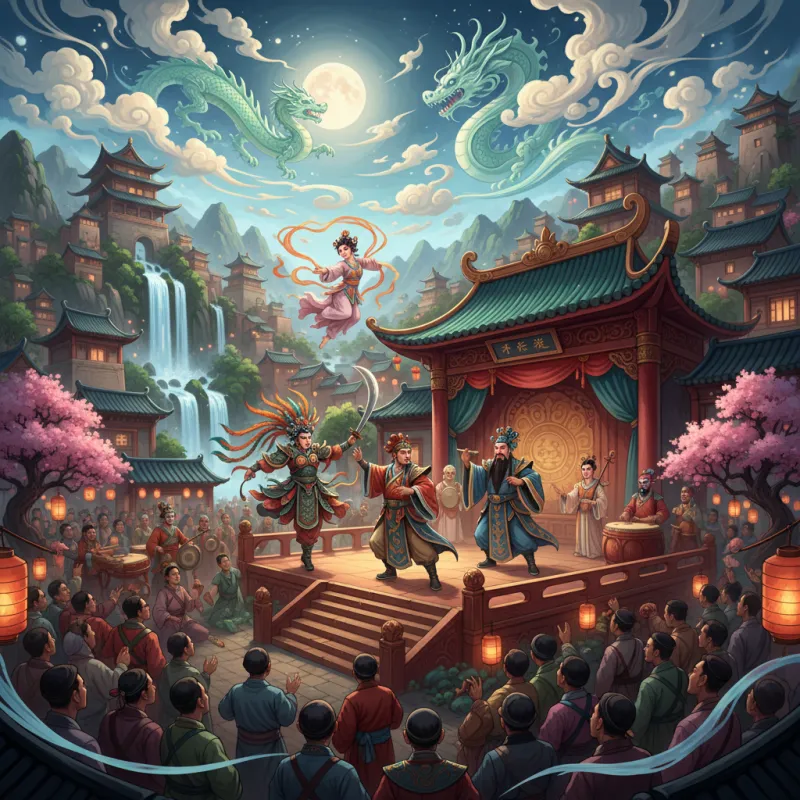
Walk into a Chinese opera performance for the first time and you'll encounter something Western theater simply doesn't prepare you for. Singers executing backflips. Warriors dueling with real-weight spears while singing in falsetto. Faces painted in patterns so specific that a knowledgeable audience member can identify a character's moral alignment from across the theater. This is 戏曲 (Xìqǔ), Chinese opera — a performance tradition that refuses to separate singing, dancing, acting, and acrobatics into different art forms.
A Thousand Years of Refusing to Specialize
The tradition stretches back over a millennium, with roots in the 宋朝 (Sòng Cháo, Song Dynasty, 960–1279), when variety shows called 杂剧 (Zájù) combined comedy, music, and acrobatics in teahouses and marketplaces. By the 元朝 (Yuán Cháo, Yuan Dynasty, 1271–1368), these performances had evolved into structured theatrical forms with complex plots drawn from historical epics and folklore.
What makes Chinese opera fundamentally different from Western opera isn't just the music or the costumes — it's the philosophy. Western theater inherited the Greek tradition of specialization: actors act, singers sing, dancers dance. Chinese opera developed under a different assumption: a complete performer masters all skills simultaneously. The term 四功五法 (Sì Gōng Wǔ Fǎ, Four Skills and Five Methods) defines the training regimen. The four skills are singing, speaking, acting, and martial arts. The five methods govern how performers use their hands, eyes, body, hair, and steps. Miss any one element and you're not performing Chinese opera — you're doing something else.
This integration creates moments impossible in other theatrical traditions. In the classic play "Farewell My Concubine," the character Yu Ji performs a sword dance while singing a lament, her movements synchronized to musical phrases, her facial expressions shifting between grief and determination. The sword isn't a prop — it's a 2-kilogram weapon that requires genuine martial skill to wield. The singing isn't background — it's the emotional core of the scene. Remove either element and the performance collapses.
The Face Paint Encyclopedia
The most visually striking element of Chinese opera is 脸谱 (Liǎnpǔ), the elaborate face painting that transforms performers into instantly recognizable character types. This isn't makeup in the Western sense — it's a symbolic language with strict rules developed over centuries.
Red faces indicate loyalty and courage. The most famous red-faced character is 关羽 (Guān Yǔ), the warrior-general from the Three Kingdoms period whose historical loyalty to his sworn brothers made him a cultural icon. When you see a performer with a red face, long beard, and specific eyebrow patterns, you're looking at Guan Yu before the actor speaks a word.
Black faces signal integrity and fierceness. 包拯 (Bāo Zhěng), the incorruptible Song Dynasty judge, appears with a black face and a white crescent moon on his forehead — the moon representing his ability to judge cases fairly by night as well as day. White faces are more complex: they indicate treachery and cunning, but also sophistication. 曹操 (Cáo Cāo), the brilliant strategist from the Three Kingdoms era, wears white because traditional opera casts him as a villain, though modern historians view him more sympathetically.
The patterns matter as much as the colors. Symmetrical designs suggest straightforward characters. Asymmetrical patterns indicate complexity or deviousness. The 花脸 (Huā Liǎn, painted face) roles require performers to paint their faces in patterns so intricate that application takes 45 minutes to an hour. Each line, each color block, each decorative element communicates information to the audience.
Regional Styles: More Than 300 Variations
Chinese opera isn't a single art form — it's a family of related traditions, each tied to a specific region and dialect. Scholars count over 300 distinct regional styles, though a handful dominate modern performance.
京剧 (Jīngjù, Peking Opera) is what most people mean when they say "Chinese opera." Developed in Beijing during the 清朝 (Qīng Cháo, Qing Dynasty, 1644–1912), it synthesized elements from several regional styles into a form that became the national standard. The singing uses 西皮 (Xīpí) and 二黄 (Èrhuáng) musical modes, creating the distinctive rising-and-falling melodic patterns. The percussion section — gongs, drums, and clappers — doesn't just keep time; it punctuates movements, signals entrances, and creates sound effects for battles and supernatural events.
昆曲 (Kūnqǔ, Kunqu Opera) predates Peking Opera by centuries and is considered the most refined style. Originating in 江苏 (Jiāngsū, Jiangsu Province) during the Ming Dynasty, Kunqu emphasizes lyrical singing and graceful movement. The melodies are slower, more ornate, with elaborate vocal ornamentation. UNESCO designated Kunqu as a Masterpiece of the Oral and Intangible Heritage of Humanity in 2001, recognizing its influence on virtually all other Chinese opera forms.
粤剧 (Yuèjù, Cantonese Opera) dominates southern China and overseas Chinese communities. Sung in Cantonese rather than Mandarin, it incorporates Western instruments like the violin and saxophone alongside traditional Chinese instruments. The costumes are more elaborate than Peking Opera, with heavier embroidery and more ornate headdresses. If you've watched Hong Kong films from the 1960s and 70s, you've heard Cantonese Opera's influence — many action film soundtracks borrowed its percussion patterns.
The Four Role Types That Structure Everything
Chinese opera organizes all characters into four basic role types called 行当 (Hángdang). Understanding these categories is essential to following any performance.
生 (Shēng) are male roles, subdivided into several types. 老生 (Lǎoshēng, old male) characters are dignified scholars or officials who sing in natural voice ranges. 小生 (Xiǎoshēng, young male) roles are romantic leads who sing in a higher register. 武生 (Wǔshēng, martial male) are warriors who emphasize acrobatics and combat over singing.
旦 (Dàn) are female roles, traditionally performed by male actors until the early 20th century. 青衣 (Qīngyī, blue dress) characters are virtuous, refined women who move with restrained elegance. 花旦 (Huādàn, flower female) are vivacious young women, often servants or unmarried daughters. 武旦 (Wǔdàn, martial female) are female warriors who perform the same acrobatic feats as their male counterparts.
净 (Jìng) are the painted-face roles discussed earlier — powerful, larger-than-life characters who sing in a forceful, declamatory style. These roles require the strongest voices and the most commanding stage presence.
丑 (Chǒu) are comic roles, marked by a white patch around the nose and eyes. Don't mistake them for simple clowns — many Chou characters are clever servants or witty scholars who comment on the action and provide social satire. They're the only roles permitted to improvise dialogue and interact directly with the audience.
The Music: Why It Sounds So Different
Western ears often struggle with Chinese opera music initially. The singing style uses techniques that sound harsh or strained to listeners raised on bel canto. This isn't a flaw — it's a different aesthetic system with different goals.
Chinese opera singing emphasizes clarity of diction over smooth tone production. Every word must be understood by the audience, even in large outdoor theaters without amplification. Singers use a technique called 喷口 (Pēnkǒu, explosive articulation) that projects consonants with percussive force. The result sounds sharp and precise rather than flowing and legato.
The melodic system is modal rather than harmonic. Western opera builds tension through chord progressions and harmonic movement. Chinese opera uses melodic contours and rhythmic patterns to create emotional effects. The 西皮 (Xīpí) mode sounds bright and energetic, used for scenes of action or joy. The 二黄 (Èrhuáng) mode sounds darker and more contemplative, used for scenes of sorrow or reflection.
The orchestra sits on stage in full view, not hidden in a pit. The lead instrument is the 京胡 (Jīnghú), a two-stringed fiddle with a piercing, nasal tone that cuts through the percussion. It doesn't accompany the singer — it engages in a musical dialogue, sometimes doubling the vocal line, sometimes answering it, sometimes playing independent countermelodies. The 月琴 (Yuèqín, moon guitar) and 三弦 (Sānxián, three-stringed lute) provide rhythmic and harmonic support.
The percussion section deserves special attention. The 板鼓 (Bǎngǔ, wooden drum) and 板 (Bǎn, wooden clappers) are played by the conductor, who controls the tempo and signals transitions. Large gongs and cymbals punctuate entrances and exits. Small gongs create specific sound effects — a particular rhythm pattern indicates a character mounting a horse, another signals opening a door. Experienced audience members can follow the plot through percussion alone.
How to Watch Your First Performance
Attending Chinese opera requires adjusting your expectations. Forget the hushed reverence of Western opera houses. Traditional Chinese opera audiences talk during performances, eat snacks, and arrive late. The performance isn't a sacred ritual — it's popular entertainment with deep cultural roots.
Start with a famous play you can research beforehand. "Farewell My Concubine" (霸王别姬, Bàwáng Bié Jī) tells the story of the warrior-king Xiang Yu and his concubine Yu Ji during the fall of the Qin Dynasty. "The Drunken Concubine" (贵妃醉酒, Guìfēi Zuì Jiǔ) features Yang Guifei, the Tang Dynasty imperial consort, in a solo performance that showcases the full range of female role techniques. Both plays are relatively short and visually spectacular.
Watch the hands. Chinese opera uses a vocabulary of hand gestures called 手势 (Shǒushì) that communicate specific meanings. A sleeve flicked upward indicates anger or dismissal. Hands held at chest level with palms facing each other suggest deep thought. Fingers extended and trembling show fear or cold. These gestures aren't random — they're codified movements passed down through generations.
Pay attention to the walking patterns. The way a character enters the stage tells you their social status and emotional state. Officials walk with measured, dignified steps. Young women take small, quick steps that make their long skirts sway. Warriors stride with exaggerated leg lifts that demonstrate martial prowess. The 圆场 (Yuánchǎng, circular walking) pattern — walking in a large circle around the stage — indicates traveling a long distance.
Don't worry about understanding every word. Even native Mandarin speakers struggle with the archaic language and stylized pronunciation. Many modern performances include electronic subtitles in Chinese and English. Focus on the visual storytelling, the music, and the physical performance. The emotional content comes through even without linguistic comprehension.
Why It Still Matters
Chinese opera faces challenges in the modern era. Young audiences prefer pop music and cinema. Training new performers takes a decade or more of intensive study, starting in childhood. Government subsidies keep major opera companies afloat, but smaller regional troupes struggle to survive.
Yet the art form persists because it contains something irreplaceable — a complete aesthetic system that integrates multiple art forms into a unified whole. Modern Chinese directors and choreographers draw on opera techniques even when creating contemporary work. Films like "Farewell My Concubine" (the 1993 Chen Kaige film, not just the opera) and "The Grandmaster" use opera movement vocabulary to create fight scenes that are simultaneously realistic and stylized.
The tradition also preserves historical memory in a unique way. The plays encode centuries of cultural values, historical events, and social commentary. Watching "The Orphan of Zhao" (赵氏孤儿, Zhào Shì Gū'ér) isn't just entertainment — it's engaging with a story that has shaped Chinese concepts of loyalty and sacrifice for over 700 years. These aren't museum pieces. They're living traditions that continue to evolve while maintaining connection to their roots.
For beginners, Chinese opera offers something rare in our specialized age — an art form that refuses to choose between spectacle and substance, between physical virtuosity and emotional depth, between entertainment and cultural preservation. It does everything at once, and it's been doing it for a thousand years. That's worth experiencing at least once, even if the singing sounds strange and the face paint seems excessive. Give it time. Let the visual and musical feast work on you. You might find yourself understanding why generations of audiences have found this theatrical tradition irresistible.
Related Reading
- Chinese Arts: The Four Treasures of the Study and Beyond
- Chinese Calligraphy for Beginners: The Art of the Brush
- Chinese Calligraphy: Why Writing Is Considered the Highest Art Form
- Traditional Chinese Music: Instruments, Scales and Soul
- Chinese Opera: A Living Art Form
- The Chinese Language: Why It Is Both Impossible and Beautiful
- Chinese Festivals the World Should Know About
- Modern Retellings of Chinese Folklore: Bridging Ancient Legends and Contemporary Culture
Explore Chinese Culture
- Explore feng shui in daily life
- Explore supernatural folklore
- Explore classical Chinese literature