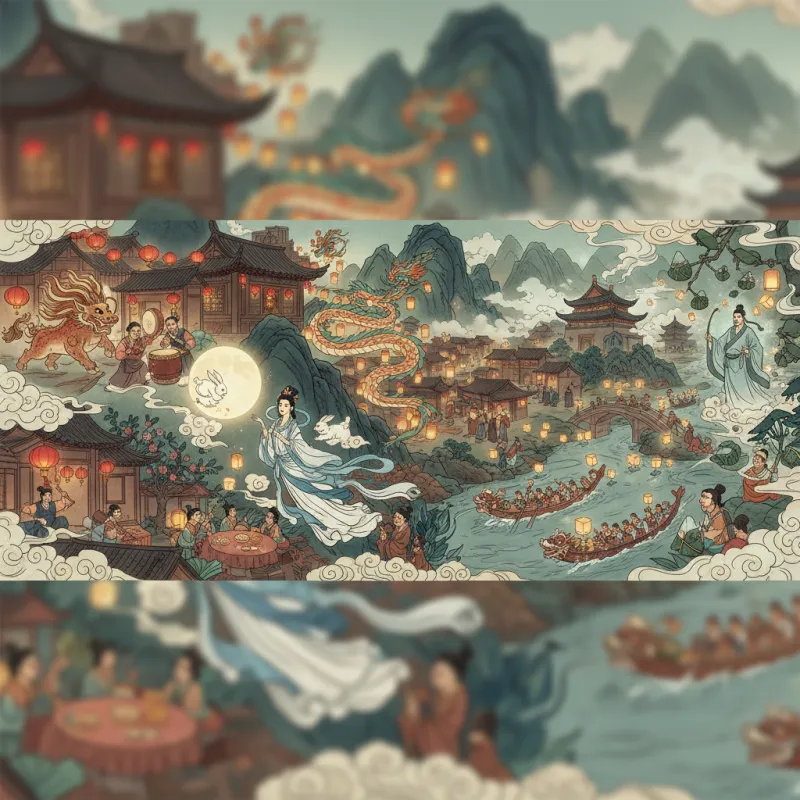
The first time I watched a Chinese family burn paper money at a cemetery, I thought I was witnessing something ancient and unchanging. Then the grandmother pulled out a paper iPad and a paper Mercedes-Benz to burn for her deceased husband. "He always wanted one," she explained. This is Chinese festivals in a nutshell — thousands of years old, yet constantly evolving, deeply spiritual yet refreshingly practical.
Western awareness of Chinese festivals rarely extends beyond Spring Festival fireworks and Mid-Autumn mooncakes. But China's festival calendar contains celebrations that would make Dionysus jealous, ghost stories that put Halloween to shame, and romantic traditions that predate Valentine's Day by over a millennium. These festivals aren't museum pieces — they're living traditions that millions observe with the same fervor Americans reserve for Thanksgiving, but with considerably more ghost appeasement and dragon boat racing.
Qingming Festival (清明节, Qīngmíng Jié) — When the Dead Get Their Spring Cleaning
Early April brings Qingming, and with it, one of China's most beautifully contradictory festivals. Families descend on cemeteries armed with cleaning supplies, incense, and increasingly creative paper offerings to burn for their ancestors. Traditional items include paper money and clothing, but modern additions reflect changing times — paper smartphones, luxury cars, even paper mistresses (yes, really, though this sparked considerable controversy).
The festival's genius lies in its refusal to treat death as purely somber. After tending graves and making offerings, families traditionally fly kites, take spring outings, and enjoy the season's first warm weather. The Tang Dynasty poet Du Mu captured this duality in his famous Qingming poem, describing "drizzling rain" and travelers whose "souls are deep in sorrow," yet the day also marks the greening of willows and the return of life to the land.
Qingming's origins trace back over 2,500 years to the Cold Food Festival (寒食节, Hánshí Jié), when people extinguished their fires for three days to honor Jie Zitui, a loyal retainer who refused to leave a burning mountain despite his lord's pleas. The festivals eventually merged, creating this unique blend of ancestor veneration and spring celebration that continues today.
Dragon Boat Festival (端午节, Duānwǔ Jié) — Racing to Save a Poet
The fifth day of the fifth lunar month (usually June) brings thundering drums, dragon-prowed boats slicing through water, and the consumption of roughly 1.8 billion zongzi (粽子) — sticky rice wrapped in bamboo leaves. All of this commemorates Qu Yuan, a 3rd-century BCE poet-official who drowned himself in the Miluo River after his state of Chu fell to Qin forces.
Legend says locals raced out in boats, beating drums to scare fish away from his body and throwing rice dumplings into the water to feed the fish so they wouldn't eat the poet. Whether this actually happened is debatable, but it makes for excellent festival mythology. What's certain is that Qu Yuan's poetry, collected in the Chu Ci (楚辞, Songs of Chu), influenced Chinese literature for millennia, and his principled suicide became a model of loyal dissent.
Modern Dragon Boat racing has gone global — there are international competitions from Singapore to London — but the festival retains distinctly Chinese elements. People hang calamus and mugwort over doorways to repel evil spirits, children wear silk pouches filled with fragrant herbs, and everyone argues about whether sweet or savory zongzi are superior (northern China prefers sweet with red bean paste or jujubes; southern China champions savory with pork and salted egg yolk).
The festival also marks the beginning of summer's heat and humidity, traditionally considered a dangerous time for disease. The herbal traditions aren't just superstition — mugwort has genuine insect-repelling properties, and the festival's timing coincides with increased mosquito activity and food spoilage risks.
Qixi Festival (七夕节, Qīxì Jié) — The Original Star-Crossed Lovers
Forget Romeo and Juliet. The story of the Cowherd and Weaver Girl predates Shakespeare by over a thousand years and involves actual celestial mechanics. On the seventh day of the seventh lunar month (usually August), the stars Altair and Vega — separated by the Milky Way for most of the year — appear closest together, and Chinese tradition says this is when the lovers reunite.
The legend goes that Zhinü (织女, the Weaver Girl), a goddess skilled at weaving clouds, fell in love with Niulang (牛郎, the Cowherd), a mortal. The Goddess of Heaven, furious at this breach of cosmic protocol, separated them with the Silver River (the Milky Way). But magpies, moved by their devotion, form a bridge once a year so they can meet.
Traditionally, young women would demonstrate their weaving and needlework skills on Qixi, praying to Zhinü for dexterity and good marriages. They'd thread needles under moonlight, make offerings of fruit, and compete in crafts. Modern celebrations have shifted toward romantic dinners and gift-giving — China's answer to Valentine's Day, though with considerably more astronomical accuracy.
What makes Qixi fascinating is how it blends astronomy, mythology, and social customs. Ancient Chinese astronomers identified these stars and their movements, then wove them into a narrative that reinforced social values about love, duty, and perseverance. The festival appears in countless poems, operas, and novels, including Journey to the West and Dream of the Red Chamber.
Zhongyuan Festival (中元节, Zhōngyuán Jié) — Ghost Month's Main Event
The fifteenth day of the seventh lunar month marks Zhongyuan, when the gates of the underworld swing open and ghosts walk among the living. If this sounds like Halloween, it's similar in spirit but vastly different in execution. Rather than costumes and candy, Zhongyuan involves elaborate rituals to feed hungry ghosts, stage operas for supernatural audiences, and ensure your ancestors are comfortable in the afterlife.
The entire seventh lunar month is considered Ghost Month, but Zhongyuan is the peak. Families set out food offerings, burn incense and paper money, and release water lanterns to guide lost souls. In some regions, people stage elaborate Chinese operas with the front row seats left empty — reserved for ghostly spectators. Businesses avoid major decisions, couples postpone weddings, and swimmers stay out of water (ghosts of drowning victims are said to seek substitutes).
This festival reveals Chinese cosmology's pragmatic side. The universe contains multiple realms — heaven, earth, and underworld — and they're not sealed off from each other. Ghosts aren't necessarily evil; they're just dead people with needs. Feed them, respect them, and they'll leave you alone. Ignore them, and you're asking for trouble.
Zhongyuan has Buddhist, Taoist, and folk religion elements blended together. Buddhists call it Yulanpen Festival (盂兰盆节), commemorating when the monk Mulian rescued his mother from hell. Taoists focus on the birthday of the Earthly Official, who grants pardons to souls. Folk tradition adds the hungry ghost element. This religious syncretism is typical of Chinese festivals, which rarely belong to just one tradition.
Laba Festival (腊八节, Làbā Jié) — The Porridge That Predicts Spring
The eighth day of the twelfth lunar month brings Laba, when families cook laba porridge (腊八粥) — a thick congee made with eight ingredients including rice, beans, nuts, and dried fruits. The number eight (八, bā) is auspicious in Chinese culture, sounding like the word for prosperity (发, fā), and this porridge is believed to bring good fortune for the coming year.
Laba marks the beginning of Spring Festival preparations, a countdown to the lunar new year. Traditionally, families also make laba garlic (腊八蒜), soaking garlic cloves in vinegar until they turn jade green — a condiment for the dumplings eaten during Spring Festival. The festival has Buddhist origins, commemorating the day Siddhartha Gautama achieved enlightenment after a village girl offered him rice porridge, ending his extreme asceticism.
What I love about Laba is its humility. While other festivals involve dragons, ghosts, and celestial lovers, Laba celebrates porridge. But this porridge carries meaning — it represents abundance (multiple ingredients), sharing (families distribute it to neighbors), and the Buddhist principle of the Middle Way (neither luxury nor deprivation). It's a festival that says: sometimes the most profound truths come in a bowl of warm congee on a cold winter morning.
Winter Solstice (冬至, Dōngzhì) — When Yin Peaks and Yang Returns
Around December 21st, the Winter Solstice marks the year's longest night and the turning point when yang energy begins its return. In traditional Chinese cosmology, this moment is as significant as the new year itself. Northern China eats dumplings (饺子, jiǎozi), southern China eats tangyuan (汤圆, sweet rice balls), and everyone acknowledges that from this point forward, days grow longer and spring approaches.
The festival's importance stems from ancient agricultural society's dependence on solar cycles. The Book of Han records Winter Solstice celebrations during the Han Dynasty (206 BCE – 220 CE), when officials received days off and the emperor performed sacrifices to heaven. The day was considered so important that some dynasties treated it as equal to the new year.
Modern celebrations are quieter but persistent. Families gather for meals, and the specific foods carry symbolic meaning. Dumplings resemble ancient gold ingots, promising wealth. Tangyuan's round shape represents family unity and completeness. In some regions, people still make offerings to ancestors, acknowledging that this cosmic turning point affects both the living and the dead.
Why These Festivals Matter Beyond China
These festivals aren't exotic curiosities — they're sophisticated systems for marking time, honoring relationships, and navigating the boundary between material and spiritual worlds. They reveal a culture that sees the cosmos as interconnected, where human actions affect supernatural realms and vice versa, where poetry and politics intertwine, and where the dead remain part of the family.
As Chinese communities spread globally, these festivals travel with them. Dragon boat races now happen on the Thames and the Hudson. Qingming observances occur in cemeteries from Vancouver to Sydney. The festivals adapt — paper offerings might include paper credit cards instead of paper coins — but their core purposes remain: connecting past and present, honoring relationships that transcend death, and marking the rhythms of a year that's both agricultural and astronomical, both earthly and cosmic.
Understanding these festivals means understanding that Chinese culture never fully separated the sacred from the secular, never drew hard lines between the living and the dead, and never stopped believing that a bowl of porridge or a dragon boat race could carry profound meaning. In a world increasingly disconnected from seasonal rhythms and ancestral memory, these festivals offer something worth knowing about — and perhaps worth adopting.
Related Reading
- Chinese New Year Is Not Just a Day (It Is a Whole Season)
- Chinese Festivals: The Calendar That Runs on Stories
- Dragon Boat Festival: Racing, Remembrance and Rice Dumplings
- Chinese New Year: The Complete Guide to Spring Festival
- Dragon Boat Festival: Racing for Qu Yuan
- Chinese Dynasties: A Quick Guide to 5,000 Years
- Martial Arts Films: A History of Flying Fists and Hidden Meaning
- The Dragon in Chinese Culture: Power and Good Fortune
Explore Chinese Culture
- Explore feng shui in daily life
- Explore supernatural folklore
- Explore classical Chinese literature