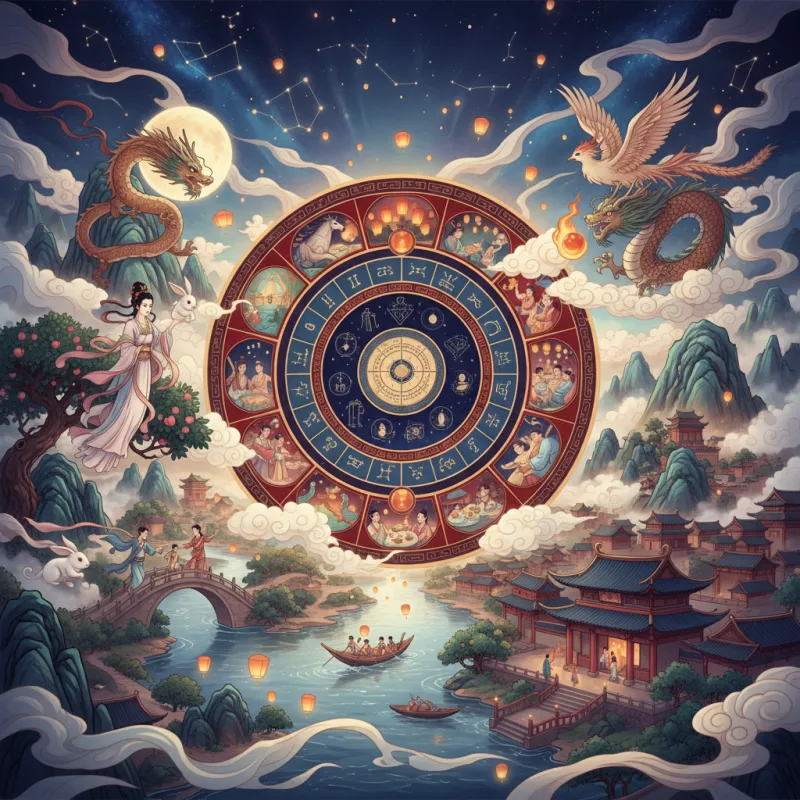
The kitchen god is watching you. Right now, from his paper portrait above the stove, Zao Jun (灶君, Zàojūn) observes every argument, every act of kindness, every burnt dumpling. And once a year, seven days before Chinese New Year, he ascends to heaven to report everything he's seen to the Jade Emperor. This is why families smear honey on his paper lips before burning the portrait — so his words will be sweet, or better yet, so sticky he can't speak at all. This is how Chinese festivals work: they're not just dates on a calendar. They're stories you live inside.
The Calendar That Remembers
The lunar calendar (农历, nónglì) doesn't just track time — it archives memory. While the Gregorian calendar marches forward in neat, predictable increments, the lunar calendar breathes with the moon, swells with the tides, and carries within its structure the accumulated weight of agricultural necessity and mythological drama. Chinese New Year drifts between January 21 and February 20 each year because the calendar is calibrated to lunar phases, not solar precision. This "drift" isn't a bug; it's a feature that kept farmers synchronized with planting seasons for over 4,000 years.
But here's what makes the lunar calendar genuinely radical: it refuses to separate practical timekeeping from storytelling. The same calendar that told farmers when to plant rice also told them when to honor the dead, when to fear hungry ghosts, and when to celebrate the moon goddess who lives in exile with only a jade rabbit for company. Every festival date is a narrative bookmark, a reminder that time itself is a story we're still telling.
Spring Festival: The Fifteen-Day Epic
Chinese New Year (春节, Chūnjié) — also called Spring Festival — is less a holiday than a serialized drama in fifteen acts. It begins with the Kitchen God's ascension and ends with the Lantern Festival (元宵节, Yuánxiāojié), and every day between has its own subplot, its own ritual logic, its own cast of characters both human and divine.
The preparation phase is its own story arc. Families engage in a frenzy of cleaning called "sweeping the dust" (扫尘, sǎochén), which sounds mundane until you realize the word for "dust" (尘, chén) is a homophone for "old" (陈, chén) — you're not just cleaning your house, you're narratively expelling the accumulated misfortunes of the previous year. Debts must be settled, not for financial reasons alone, but because entering the new year with unresolved obligations is like starting a novel mid-sentence.
New Year's Eve dinner (年夜饭, niányèfàn) is the climactic scene. Families who've scattered across provinces and continents converge for a meal that's less about food than about physical proof of continuity. The dishes themselves are symbolic sentences: whole fish (鱼, yú) because it sounds like "surplus" (余, yú), dumplings shaped like ancient gold ingots, long noodles for longevity. You're not just eating — you're performing a ritual that declares, "We persist. We continue. We remain."
The fifteen days that follow are a cascade of smaller stories. The fifth day is when you welcome the God of Wealth (财神, Cáishén). The seventh day is "everyone's birthday" (人日, Rénrì), when humanity itself was created according to Nüwa's seven-day creation sequence. The festival concludes with the Lantern Festival, when the sky fills with floating lights and families eat glutinous rice balls (汤圆, tāngyuán) — round like the full moon, round like family unity, round like the year completing its circle.
Mid-Autumn Festival: The Loneliest Immortal
The Mid-Autumn Festival (中秋节, Zhōngqiūjié) on the fifteenth day of the eighth lunar month is built around one of Chinese mythology's most devastating love stories. Chang'e (嫦娥, Cháng'é), the moon goddess, didn't choose immortality — she swallowed the elixir of eternal life to prevent her husband's tyrannical apprentice from stealing it. The potion worked too well. She floated to the moon and has been stranded there ever since, separated from her husband Hou Yi by the entire distance between earth and sky.
This is why Mid-Autumn Festival feels melancholic even in celebration. Families gather to eat mooncakes (月饼, yuèbǐng) — dense, sweet pastries that are frankly too rich for most people's taste but that's not the point — and gaze at the full moon. You're not just looking at the moon; you're looking at Chang'e's prison, acknowledging that sometimes love means permanent separation, that immortality might be a curse, that the brightest light in the night sky marks the loneliest exile in the cosmos.
The festival's genius is how it transforms astronomical observation into emotional communion. Everyone looking at the same moon is, in that moment, connected across whatever distances separate them. It's a festival that weaponizes longing, that makes separation itself the basis for unity.
Qingming: Sweeping Graves, Telling Stories
Qingming Festival (清明节, Qīngmíngjié) — Tomb-Sweeping Day — falls around April 5th and is the calendar's most explicit acknowledgment that the dead are still part of the family. Families visit ancestral graves, clear away weeds, make offerings of food and paper money, and tell stories about the deceased to children who never met them.
This isn't morbid; it's narrative maintenance. The dead remain characters in the family story, and Qingming is when you update their chapters, when you ensure they're not forgotten, when you physically demonstrate that memory is a form of care. The offerings aren't symbolic — families genuinely believe the dead need sustenance, that hell has an economy, that burning paper replicas of houses and cars and iPhones will somehow materialize in the afterlife.
The festival originated from the story of Jie Zitui (介子推, Jiè Zǐtuī), a loyal advisor who cut flesh from his own thigh to feed his starving lord during exile. When the lord later became Duke Wen of Jin and wanted to reward Jie, the advisor refused and retreated to the mountains. The duke set fire to the forest to smoke him out, but Jie chose to burn to death rather than accept honors. The duke, devastated, declared that no fires should be lit on the anniversary of Jie's death — hence the festival's alternative name, Cold Food Festival (寒食节, Hánshíjié).
That story — of loyalty, refusal, and tragic miscalculation — shadows every Qingming observance. You're not just honoring your own dead; you're participating in a tradition born from one man's catastrophic misjudgment of another's character.
Dragon Boat Festival: Racing Against Tragedy
The Dragon Boat Festival (端午节, Duānwǔjié) on the fifth day of the fifth lunar month commemorates Qu Yuan (屈原, Qū Yuán), the 3rd-century BCE poet-statesman who drowned himself in the Miluo River after his kingdom fell to corruption and his warnings went unheeded. Local fishermen raced out in boats to retrieve his body, beating drums to scare away fish and throwing rice dumplings into the water so fish would eat those instead of Qu Yuan's corpse.
This is the origin of dragon boat racing and zongzi (粽子, zòngzi) — sticky rice wrapped in bamboo leaves. Every Dragon Boat Festival, teams of rowers propel long boats carved with dragon heads while drummers pound out rhythms, and families eat zongzi in flavors ranging from sweet red bean to savory pork. You're reenacting a rescue mission that failed 2,300 years ago. You're still trying to save Qu Yuan, even though everyone knows how the story ends.
The festival's emotional core is righteous despair — the recognition that sometimes integrity leads to destruction, that speaking truth can be fatal, that the good don't always win. Qu Yuan's most famous poem, "Li Sao" (离骚, Lísāo — "Encountering Sorrow"), is a 373-line lament about political exile and moral isolation. The festival doesn't celebrate his death; it refuses to let his despair be the final word.
The Calendar as Collective Memory
What makes Chinese festivals different from secular holidays is their insistence that mythology and history occupy the same ontological space. Chang'e isn't a metaphor for loneliness — she's actually on the moon. Qu Yuan isn't a symbol of integrity — he's a specific person who wrote specific poems and made a specific choice. The Kitchen God isn't a quaint superstition — he's an active surveillance system that shapes behavior.
This is why the lunar calendar persists even as China modernizes, even as the Gregorian calendar governs business and education. The lunar calendar carries stories that the solar calendar can't hold. It's a narrative technology, a way of ensuring that certain stories get retold annually, that certain values get reaffirmed, that certain questions — about loyalty, separation, mortality, justice — get asked again and again.
The festivals don't answer these questions. They keep them alive. They turn the calendar into a book that never closes, a story that's always mid-sentence, waiting for you to add your chapter. When you eat mooncakes, you're continuing Chang'e's story. When you race dragon boats, you're still trying to save Qu Yuan. When you smear honey on the Kitchen God's lips, you're negotiating with the divine surveillance state.
Living Inside the Story
The lunar calendar's genius is that it makes you a character in stories much older than yourself. You're not observing these festivals from outside; you're performing them from within. Every ritual is a line of dialogue, every offering is a plot point, every family gathering is a scene in a multi-generational epic.
This is why Chinese festivals feel different from holidays that mark historical events or seasonal changes. They're not commemorations — they're continuations. The stories haven't ended; they're still happening, and you're in them now. The calendar doesn't just tell you what day it is. It tells you which story you're living inside, which role you're playing, which ancient drama you're helping to perpetuate.
And every year, the moon waxes and wanes, the seasons turn, and the stories begin again. The Kitchen God ascends. Chang'e gazes down from her lunar exile. Qu Yuan's body sinks into the river. The calendar runs on stories, and the stories run on you — your participation, your memory, your willingness to keep telling them. This is how time works when it refuses to forget.
Related Reading
- Dragon Boat Festival: Racing for Qu Yuan
- Mid-Autumn Festival: Mooncakes and Moon Gazing
- Chinese Festivals Explained: The Stories Behind the Celebrations
- Chinese Pop Culture: A Guide for the Curious Outsider
- Cultivation Web Novels: The Genre Taking Over the Internet
- How to Start Learning Chinese Calligraphy
Explore Chinese Culture
- Explore feng shui in daily life
- Explore supernatural folklore
- Explore classical Chinese literature