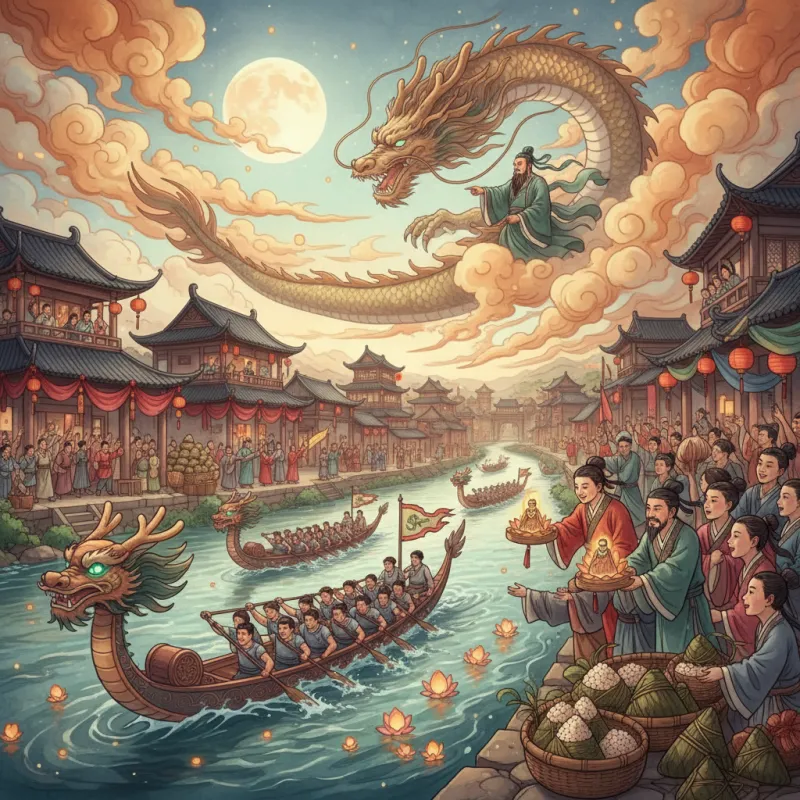
The rhythmic thunder of drums echoes across the water as dragon-headed boats slice through the waves, their crews pulling in perfect synchrony. Spectators crowd the riverbanks, cheering wildly as paddlers push themselves to exhaustion. This isn't just a race — it's a 2,300-year-old act of desperation, a ritual born from the frantic attempt to save a drowning poet whose words were too honest for his time.
The Poet Who Chose the River
屈原 (Qū Yuán, c. 340–278 BCE) wasn't just any court official. He was a nobleman of Chu, one of the most powerful states during the Warring States period, and he possessed two dangerous qualities: unwavering patriotism and the inability to keep quiet about corruption. As a minister, he advocated fiercely for alliances against the rising threat of Qin, the militaristic state that would eventually conquer all of China and establish the first unified empire.
But honesty rarely wins in palace politics. Rival ministers whispered poison into the king's ear, painting Qu Yuan as arrogant and disloyal. The king, swayed by flattery and lies, exiled his most loyal advisor. Qu Yuan wandered the countryside for years, watching from afar as Chu made disastrous diplomatic decisions, exactly as he'd warned. His exile produced some of Chinese literature's most haunting poetry, particularly 离骚 (Lí Sāo, "Encountering Sorrow"), a 373-line masterpiece that weaves personal grief with political allegory.
When Chu's capital finally fell to Qin forces in 278 BCE, Qu Yuan couldn't bear it. On the fifth day of the fifth lunar month, he waded into the Miluo River clutching a large stone, choosing death over witnessing his beloved state's destruction. He was roughly sixty years old, and his final act would birth a festival that outlasted the very kingdoms he mourned.
Racing to Save a Ghost
The dragon boat races that define 端午节 (Duānwǔ Jié, Dragon Boat Festival) today supposedly originated in the frantic search for Qu Yuan's body. Local fishermen grabbed their boats and paddled furiously down the Miluo River, beating drums and splashing their oars to scare away fish and evil spirits that might disturb the poet's corpse. They never found him.
Modern dragon boat racing has evolved into serious sport — teams train year-round, international competitions draw thousands of participants, and the boats themselves are engineering marvels. But the core ritual remains: long, narrow boats with ornately carved dragon heads and tails, crews of twenty or more paddlers, a drummer at the bow setting the rhythm, and a steersperson at the rear. The best teams move like a single organism, their paddles entering and exiting the water in perfect unison, the boat seeming to fly across the surface.
What strikes me about these races is how they've transformed grief into celebration. The original desperate search has become a festival of community strength, coordination, and competitive spirit. Yet the underlying current of remembrance persists — before races begin, many teams still perform rituals honoring Qu Yuan, and the festival date remains fixed to the anniversary of his death.
Zongzi: Food as Memorial
If dragon boats are the festival's spectacle, 粽子 (zòngzi, sticky rice dumplings) are its soul. According to legend, villagers threw rice into the Miluo River to feed Qu Yuan's spirit and prevent fish from eating his body. A spirit appeared to them in a dream, explaining that a dragon was stealing the rice offerings. The solution? Wrap the rice in leaves and tie it with colored thread — dragons fear both.
Whether or not you believe in helpful ghosts and picky dragons, zongzi have become the festival's essential food. These are not simple snacks. Making proper zongzi requires skill, patience, and strong hands. You start with glutinous rice soaked overnight, then add fillings — the possibilities are regional and endless. Northern zongzi tend toward sweet fillings like red bean paste or jujube dates. Southern versions favor savory: pork belly, salted egg yolk, mushrooms, chestnuts, dried shrimp.
The wrapping technique matters enormously. Most use bamboo leaves, though reed leaves work too. The leaves must be soaked until pliable, then folded into a cone or pyramid shape that won't leak during the hours of boiling required to cook the rice. My grandmother could wrap a perfect zongzi in under thirty seconds; I still struggle to keep mine from unraveling. The tied bundles are boiled for three to five hours, filling the house with an earthy, slightly sweet aroma that means Dragon Boat Festival has truly arrived.
Different regions have developed distinct zongzi styles. Jiaxing in Zhejiang province claims to make the definitive version — square-shaped, with pork belly and salted egg yolk. Guangdong's zongzi are enormous, sometimes weighing over a pound, packed with multiple ingredients. Beijing's are smaller, pyramid-shaped, often filled with jujubes. Eating zongzi from different regions is like tasting China's geographic diversity wrapped in leaves.
Beyond Boats and Dumplings
Dragon Boat Festival carries protective and purifying significance that predates Qu Yuan's story. The fifth month of the lunar calendar was traditionally considered 毒月 (dú yuè, "poison month"), when disease, pests, and evil influences peaked with the summer heat. The festival's original purpose may have been warding off these dangers.
Many traditional practices reflect this protective function. Families hang 艾草 (àicǎo, mugwort) and 菖蒲 (chāngpú, calamus) above their doors — both plants have strong scents believed to repel insects and evil spirits. Children wear 香囊 (xiāngnáng, fragrant sachets) filled with herbs around their necks. Some regions practice 躲午 (duǒwǔ, "hiding from noon"), where children are sent to their maternal grandparents' homes to avoid the day's peak dangerous energy.
The festival also involves 雄黄酒 (xiónghuáng jiǔ, realgar wine), a traditional liquor mixed with powdered realgar mineral. Adults drink it for protection, and parents dab it on children's foreheads, ears, and noses. Modern medicine has revealed that realgar contains arsenic compounds, making this practice questionable at best, but the tradition persists in some areas, though often with safer substitutes.
These protective rituals connect Dragon Boat Festival to broader patterns in Chinese folk belief, similar to practices during Qingming Festival and other seasonal transitions when the boundary between human and spirit worlds grows thin.
The Festival's Many Origin Stories
While Qu Yuan's suicide dominates the festival's narrative, other origin stories exist. Some scholars argue the festival predates Qu Yuan entirely, originating in ancient dragon worship or summer solstice celebrations. The Yangtze River valley's indigenous peoples held dragon deity festivals long before Qu Yuan's time, and the fifth lunar month roughly coincides with the summer solstice and rice planting season.
Another legend credits 伍子胥 (Wǔ Zǐxū), a loyal minister of the state of Wu who was forced to commit suicide by an ungrateful king. His body was supposedly thrown into a river on the fifth day of the fifth month. Yet another story honors 曹娥 (Cáo É), a filial daughter who drowned herself searching for her father's body after he fell into a river.
What's fascinating is how Qu Yuan's story eclipsed these alternatives. Perhaps because his tale combines political tragedy, literary genius, and dramatic suicide — elements that resonate across centuries. Or perhaps because his poetry survived, giving voice to his grief in ways that made him unforgettable. The 楚辞 (Chǔcí, "Songs of Chu") collection, which includes his works, influenced Chinese poetry for millennia.
I suspect the festival's persistence owes something to its flexibility. It accommodates multiple meanings: remembering a patriot, celebrating summer, protecting against disease, honoring dragons, demonstrating community strength through boat racing. This multiplicity lets each generation find relevant meaning while maintaining traditional forms.
Dragon Boat Festival Today
Modern Dragon Boat Festival has gone global. International dragon boat racing federations exist on every continent. Cities from London to Sydney host annual races. The sport has become particularly popular among breast cancer survivor groups, who find empowerment in the teamwork and physical challenge.
In China, the festival remains a major holiday. Families gather, eat zongzi, and watch races on television if they can't attend in person. The government designated it a public holiday in 2008, recognizing its cultural importance. Tourist destinations along major rivers host elaborate celebrations with traditional performances, zongzi-making competitions, and massive dragon boat races.
Yet something has shifted. Younger generations often know the festival more for the day off work and the food than for Qu Yuan's story. The protective rituals have faded as modern medicine replaced folk remedies. Dragon boat racing has become sport first, memorial second. This isn't necessarily loss — traditions evolve or die — but it does change the festival's character.
What persists is the communal aspect. Dragon boat racing requires coordination that transcends individual ability. Making zongzi is often a family affair, with multiple generations working together. Even in its modern, commercialized form, the festival creates moments of connection — to family, community, history, and the natural rhythms of the agricultural year.
The Poet's Lasting Victory
Qu Yuan lost everything during his lifetime: position, influence, his state's independence, and finally his life. But his death created something that outlasted all the kingdoms of his era. The Qin dynasty that conquered Chu collapsed after just fifteen years. The Warring States period's other powers are historical footnotes. Yet every year, millions of people commemorate a poet who refused to compromise his principles.
There's something deeply Chinese about this — the belief that moral integrity and literary achievement matter more than political success, that a righteous failure can be more admirable than a corrupt victory. This theme runs through Chinese culture, from the loyal generals who chose death over dishonor to the scholars who withdrew from public life rather than serve unworthy rulers.
Dragon Boat Festival asks us to remember that some things are worth drowning for. Not literally, perhaps, but the metaphor holds: there are principles worth sacrificing comfort, safety, and success to uphold. In an era of compromise and pragmatism, the festival's origin story feels almost radical — a reminder that integrity isn't always rewarded but remains valuable nonetheless.
As you watch dragon boats race across the water this June, or bite into a zongzi's sticky, fragrant rice, remember you're participating in an act of remembrance that spans 2,300 years. You're honoring a poet who loved his country enough to die for it, and fishermen who loved their poet enough to search for him forever. That's not a bad tradition to keep alive.
Related Reading
- Mid-Autumn Festival: Mooncakes and Moon Gazing
- Chinese Festivals the World Should Know About
- Chinese New Year: The Complete Guide to Spring Festival
- Chinese Festivals Explained: The Stories Behind the Celebrations
- Mid-Autumn Festival: Mooncakes, Legends and Lunar Beauty
- Chinese Landscape Painting: Mountains and Water
- Wuxia in the Modern World: How Martial Arts Culture Went Global
- Exploring Transformation in Chinese Folklore: Legends, Fairy Tales, and Cultural Traditions
Explore Chinese Culture
- Explore feng shui in daily life
- Explore supernatural folklore
- Explore classical Chinese literature