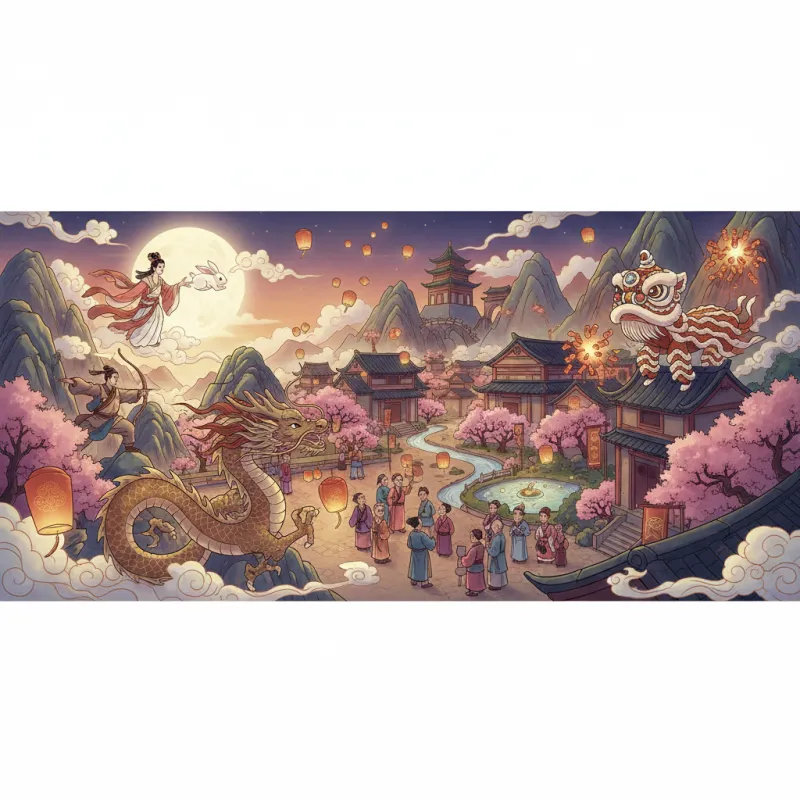
The monster Nian never existed. But every year, a billion people hang red lanterns and set off firecrackers as if it did. That's the peculiar power of Chinese festivals — they're built on stories that everyone knows aren't literally true, yet the rituals persist with religious intensity. The difference between myth and history blurs when you're eating tangyuan with your grandmother, and she's telling you the same story her grandmother told her.
The Architecture of Festival Stories
Chinese festivals follow a template: tragedy first, celebration second. Someone dies, lovers separate, a monster attacks, a poet drowns himself. Then comes the festival — not to forget the tragedy, but to ritualize it, to make it bearable through repetition. The Mid-Autumn Festival celebrates family reunion by acknowledging separation. The Dragon Boat Festival honors a suicide. Chinese New Year defeats a monster that represents the terror of winter scarcity.
This isn't unique to China, but the consistency is striking. Western holidays often celebrate victories (Christmas, Easter) or give thanks (Thanksgiving). Chinese festivals tend to commemorate losses that were survived. The underlying philosophy: suffering is inevitable, but community and ritual make it meaningful.
Spring Festival: The Monster That Taught Us Red
The Nian (年兽, niánshòu) story is probably the most famous festival origin myth, and definitely the least historical. The monster supposedly emerged every winter to devour crops, livestock, and occasionally children. Villagers discovered its three fears — red, noise, and fire — through trial and error that the stories never quite explain.
What's interesting is how the myth encodes real survival strategies. Before modern agriculture, winter was genuinely dangerous. Food scarcity, cold, and isolation killed people. The festival's timing (lunar new year, roughly February) marks the moment when the worst of winter passes and spring approaches. "Nian" literally means "year," so "driving away Nian" is driving away the old year's hardships.
The New Year's Eve dinner (年夜饭, niányè fàn) is mandatory in a way that Western holiday meals aren't. Missing it without extraordinary reason is a family crisis. The meal must include fish (鱼, yú) because it sounds like "surplus," dumplings shaped like ancient gold ingots, and long noodles for longevity. The symbolism is so heavy-handed it borders on magical thinking — but that's the point. You're not just eating; you're performing prosperity into existence.
Lantern Festival: The Emperor's Daughter and the Burning City
Two weeks after New Year comes the Lantern Festival (元宵节, Yuánxiāo Jié), which has a darker origin story that most modern celebrations ignore. One version involves the Jade Emperor planning to burn down a city on the fifteenth day of the first lunar month. His daughter, sympathetic to humans, warned them. A wise man suggested that if the entire city hung red lanterns and set off firecrackers, it would look like it was already burning, and the emperor would be satisfied.
The deception worked. The city survived. Now we eat tangyuan (汤圆, sweet rice balls) and solve riddles written on lanterns, and nobody mentions that the festival commemorates tricking heaven itself.
The tangyuan are significant beyond their taste. They're round, symbolizing family completeness, and they're eaten together, symbolizing reunion. The filling is usually black sesame or peanut paste — sweet, but hidden. You don't know what you're getting until you bite in, which feels like an accidental metaphor for family itself.
Qingming: Sweeping Graves and Flying Kites
Qingming Festival (清明节, Qīngmíng Jié), usually early April, is explicitly about death. Families visit ancestral graves, clean the tombstones, burn incense, and leave food offerings. It's somber but not morbid — more like scheduled grief, a designated time to acknowledge loss.
The festival's origins trace to the story of Jie Zitui (介子推), a loyal advisor during the Spring and Autumn Period (770-476 BCE). When his lord was in exile, Jie cut flesh from his own thigh to feed him. Years later, when the lord became Duke Wen of Jin, Jie refused rewards and retreated to the mountains. The duke set fire to the forest to force him out. Jie refused to leave and burned to death with his mother.
The duke, horrified, banned fires on the anniversary of Jie's death. This became the Cold Food Festival (寒食节, Hánshí Jié), which merged with Qingming. The modern festival dropped the no-fire rule but kept the grave-sweeping and the underlying message: loyalty matters, even when it's inconvenient, even when it kills you.
People also fly kites during Qingming, which seems incongruous with grave-sweeping until you learn the tradition: you write your troubles on the kite, then cut the string and let it fly away. The kite carries your bad luck into the sky. It's folk psychology disguised as recreation.
Dragon Boat Festival: The Poet Who Chose the River
The Dragon Boat Festival (端午节, Duānwǔ Jié), fifth day of the fifth lunar month, honors Qu Yuan (屈原, 340-278 BCE), a poet and minister from the state of Chu. When his state fell to Qin, Qu drowned himself in the Miluo River rather than live under foreign rule. Local fishermen raced out in boats, beating drums to scare fish away from his body and throwing rice dumplings into the water to feed the fish so they wouldn't eat him.
This is historical, not mythical. Qu Yuan actually existed. His poetry survives — the "Li Sao" (离骚, "Encountering Sorrow") is one of Chinese literature's masterpieces, a long, bitter meditation on political betrayal and personal integrity. The festival celebrates a documented suicide, which is unusual for a major holiday.
The zongzi (粽子, sticky rice wrapped in bamboo leaves) are the rice dumplings from the story, now eaten nationwide in dozens of regional variations. Northern zongzi tend toward sweet fillings (red bean paste, dates), southern toward savory (pork, salted egg yolk). The wrapping technique is complex enough that families have signature styles passed down generations.
Dragon boat races are the festival's spectacle — long, narrow boats with dragon-head prows, teams of paddlers synchronized to drum beats. The races are loud, competitive, and draw huge crowds. They commemorate a frantic search for a dead body, but they feel like pure celebration. That transformation — from tragedy to joy without forgetting the tragedy — is the core of Chinese festival logic.
Mid-Autumn Festival: The Moon Goddess and Eternal Separation
The Mid-Autumn Festival (中秋节, Zhōngqiū Jié), fifteenth day of the eighth lunar month, centers on Chang'e (嫦娥), who drank an elixir of immortality and floated to the moon, leaving her husband Hou Yi on earth forever. Different versions explain why she drank it — some say she was protecting it from a thief, others that she was greedy. Either way, the result is permanent separation.
The festival's main activity is moon-gazing, ideally with family, eating mooncakes (月饼, yuèbǐng) — dense, sweet pastries with elaborate designs stamped on top. The full moon symbolizes reunion, which makes the Chang'e story's emphasis on separation even sharper. You're celebrating togetherness by remembering someone who can never return.
Mooncakes have become commercialized to an almost absurd degree. Luxury brands sell mooncakes in elaborate boxes for hundreds of dollars. The cakes themselves are often secondary to the packaging. But traditional mooncakes — lotus seed paste with salted egg yolk, the yolk representing the full moon — remain popular. They're too sweet and too dense for most Western palates, but that's not really the point. You're eating the moon.
The Pattern Behind the Stories
Look at the festivals together and a pattern emerges: Chinese culture ritualizes loss. Instead of trying to overcome tragedy or transcend it, festivals incorporate it into the calendar. Qu Yuan's suicide becomes an annual boat race. Chang'e's exile becomes a moon-viewing party. The terror of winter becomes a family dinner.
This isn't pessimism — it's realism with a ritual structure. Bad things happen. People die, lovers separate, states fall, winters come. Festivals don't pretend otherwise. They create a framework where suffering becomes meaningful through repetition and community. You're not alone in your grief because your ancestors grieved the same way, and your descendants will too.
The stories themselves often feel thin or contradictory because they're not really the point. The point is the gathering, the food, the ritual actions performed together. The stories just give you something to talk about while you're doing it.
Why the Stories Persist
Modern China is urbanized, secular, and technologically advanced. Nobody literally believes in Nian or thinks Chang'e is on the moon. But the festivals remain central to Chinese identity, both in China and in diaspora communities worldwide. The stories persist because they're not really about monsters or moon goddesses — they're about family obligation, cultural continuity, and shared memory.
When you hang red decorations for New Year, you're not warding off a monster. You're participating in a tradition that connects you to your family's past and future. When you eat zongzi for Dragon Boat Festival, you're not feeding fish. You're acknowledging that integrity sometimes requires sacrifice, and that's worth remembering.
The festivals work because they're specific enough to be meaningful but flexible enough to adapt. You can be atheist, Christian, or Buddhist and still celebrate Chinese New Year. You can live in Beijing or San Francisco and still make mooncakes for Mid-Autumn Festival. The stories provide continuity without requiring belief.
That's the real story behind Chinese festivals: they're technologies for maintaining cultural identity across time and distance. The myths about monsters and moon goddesses are just the user interface. The actual function is keeping families connected and traditions alive. And judging by the billion people who still celebrate them, they work remarkably well.
Related Reading
- Chinese New Year Is Not Just a Day (It Is a Whole Season)
- Mid-Autumn Festival: Mooncakes and Moon Gazing
- Chinese New Year: The Complete Guide to Spring Festival
- Chinese Festivals: The Calendar That Runs on Stories
- Dragon Boat Festival: Racing, Remembrance and Rice Dumplings
- First Time in China? Essential Tips for Culture-Minded Travelers
- Unveiling the Celestial Tales of Chinese Folklore and Legends
- Exploring Transformation in Chinese Folklore: Legends, Fairy Tales, and Cultural Traditions
Explore Chinese Culture
- Explore feng shui in daily life
- Explore supernatural folklore
- Explore classical Chinese literature