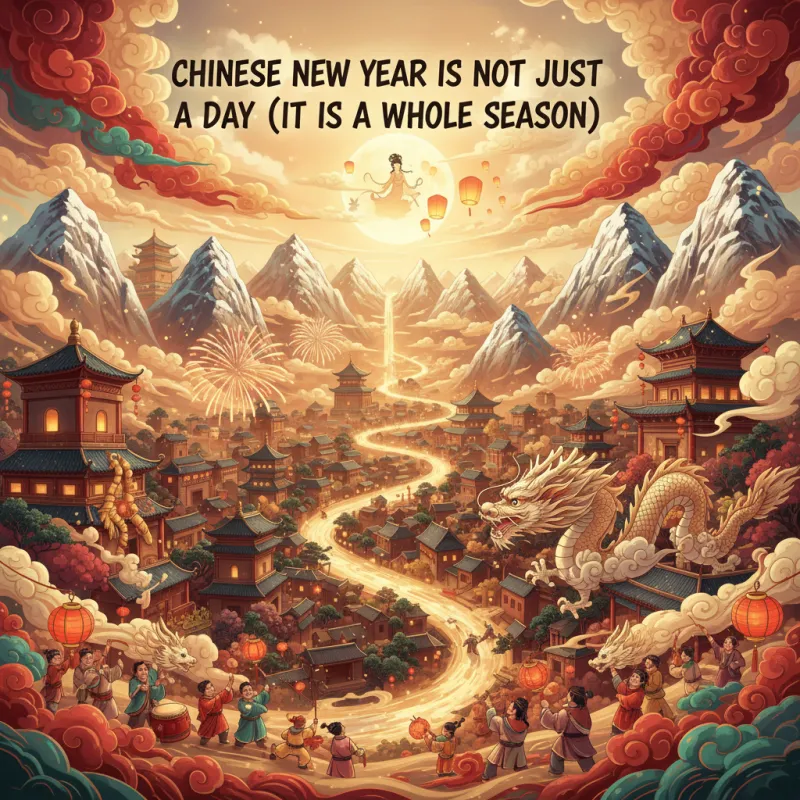
The train stations look like battlefields. Millions of people clutching red-and-white striped bags, sleeping on cardboard, camping out for days just to secure a ticket home. This is chunyun (春运, chūnyùn) — the Spring Festival travel rush — and it reveals something profound about Chinese New Year that Westerners often miss: this isn't a holiday. It's a season, a pilgrimage, a forty-day ritual that reshapes the entire nation.
Why Forty Days?
Chinese New Year itself falls on a single day — the first day of the first lunar month. But the celebration? That stretches from Laba Festival (腊八节, Làbā Jié) in the twelfth lunar month all the way through the Lantern Festival (元宵节, Yuánxiāo Jié) fifteen days after New Year's Day. Add in the travel time before and after, and you're looking at roughly forty days when China operates on a completely different rhythm.
The government officially recognizes this with the chunyun period, which typically runs from fifteen days before New Year's Eve to twenty-five days after. During this window, China's transportation system handles approximately three billion trips — yes, billion with a B. To put that in perspective, that's nearly half the world's population on the move, all trying to reach home for a single meal: the New Year's Eve reunion dinner.
This isn't just impressive logistics. It's ancient obligation made visible. The Confucian concept of xiao (孝, xiào) — filial piety — demands that children return home to honor their parents. Missing the reunion dinner isn't just disappointing; for many families, it's a betrayal of fundamental duty.
The Countdown Begins: Little New Year
The season kicks off with Xiaonian (小年, Xiǎonián), or Little New Year, which falls on the 23rd or 24th day of the twelfth lunar month (the date varies between northern and southern China). This is when the Kitchen God (灶神, Zàoshén) ascends to heaven to report on the family's behavior over the past year.
Smart families smear honey or sticky candy on the Kitchen God's lips before he leaves — either to sweeten his words or to glue his mouth shut, depending on who you ask. It's the kind of practical theology I love: if you can't be good all year, at least bribe the witness.
After Little New Year, the cleaning begins. Every surface gets scrubbed, every corner swept, every window washed. This isn't spring cleaning; it's spiritual housekeeping. You're sweeping out the old year's bad luck, making room for incoming fortune. Once New Year's Day arrives, though, you must not sweep — you might accidentally brush away your fresh new luck. The brooms stay in the closet until at least the fifth day.
New Year's Eve: The Reunion Dinner
Here's the heart of it: Chuxi (除夕, Chúxī), New Year's Eve, and the reunion dinner that makes those three billion trips worthwhile. This meal — nian ye fan (年夜饭, niányèfàn) — is non-negotiable. Families who haven't spoken all year will reconcile for this dinner. Adult children will travel for days, spending a month's salary on train tickets, just to sit at this table.
The menu varies by region, but certain dishes appear everywhere for their auspicious meanings. Fish (yu, 鱼) sounds like "surplus," so you must have fish — but you can't finish it, or you'll eat up next year's abundance. Dumplings (jiaozi, 饺子) resemble ancient gold ingots and promise wealth. In the south, niangao (年糕, niángāo) — sticky rice cake — is essential because its name sounds like "year high," suggesting rising fortunes.
After dinner, families stay up late or all night in a practice called shou sui (守岁, shǒusuì) — "guarding the year." Originally, this was meant to protect against a mythical beast called Nian (年, Nián) who supposedly terrorized villages on New Year's Eve. Now it's more about maximizing time with family and welcoming the new year together. Children receive hongbao (红包, hóngbāo) — red envelopes stuffed with money — and everyone tries to stay awake until midnight when fireworks explode across the entire country simultaneously.
The First Five Days: Gods, Visits, and Taboos
New Year's Day itself is surprisingly quiet. After the midnight fireworks, most people sleep in, then spend the day at home with immediate family. This is when you wear new clothes (preferably red), eat vegetarian food (to show respect for life), and absolutely do not wash your hair, sweep the floor, or use scissors. Each of these actions could cut or wash away your good fortune.
The second day is for married daughters to visit their parents — a relatively recent development, as traditional practice kept married women with their husband's family. The third and fourth days are for visiting extended family and friends, with complex hierarchies determining who visits whom first.
The fifth day, Po Wu (破五, Pò Wǔ), breaks the taboos. You can finally sweep (and should, to clear out the accumulated bad luck), businesses reopen, and people set off more fireworks to welcome the God of Wealth (财神, Cáishén). In northern China, families eat dumplings on this day, sometimes hiding a coin in one dumpling — whoever finds it will have exceptional luck with money that year.
The Lantern Festival: The Season's Grand Finale
Fifteen days after New Year's Day comes Yuanxiao Jie (元宵节, Yuánxiāo Jié), the Lantern Festival, which officially closes the New Year season. This is when the first full moon of the lunar year rises, and cities across China glow with elaborate lantern displays — traditional red paper lanterns, modern LED installations, massive lanterns shaped like the year's zodiac animal.
Families eat tangyuan (汤圆, tāngyuán) — glutinous rice balls in sweet soup — whose round shape symbolizes family unity and completeness. In some regions, people still solve riddles written on lanterns, a tradition dating back to the Song Dynasty (960-1279 CE). Young women once used this night to meet potential suitors, making it something like ancient China's Valentine's Day, though that romantic aspect has largely faded.
The Lantern Festival also features dragon dances, lion dances, and in some areas, the spectacular walking on stilts performances. After this night, the decorations come down, the red couplets are removed from doorways, and China returns to its regular rhythm. The season is over.
Why It Matters: Ritual in a Modern World
China is now the world's second-largest economy, home to megacities like Shanghai and Shenzhen that rival any Western metropolis in modernity and sophistication. Yet every year, this entire nation pauses for forty days to honor traditions that predate the Roman Empire. Factory production schedules bend around it. International business grinds to a halt. The government moves heaven and earth to facilitate those three billion trips.
This isn't nostalgia or tourism. It's living culture, adapted but unbroken. Yes, hongbao are now sent digitally through WeChat. Yes, the reunion dinner might include pizza alongside dumplings. But the core remains: family, return, renewal, and the belief that how you spend these forty days shapes your fortune for the entire year ahead.
Compare this to how Dragon Boat Festival has evolved, or the way Qingming Festival maintains its hold on modern Chinese life — these aren't museum pieces. They're frameworks for meaning in a rapidly changing world, and Chinese New Year is the biggest framework of all.
When you understand that Chinese New Year is a season, not a day, you begin to grasp something essential about Chinese culture: the long view, the emphasis on preparation and process, the understanding that important things cannot be rushed. The journey home is part of the ritual. The cleaning is part of the celebration. The waiting, the planning, the forty days of heightened attention — all of it matters.
So next time someone wishes you "Happy Chinese New Year" on a single day, smile and nod. But know that you're witnessing just one moment in a vast seasonal tide, a forty-day transformation that has shaped Chinese life for millennia and shows no sign of stopping.
Related Reading
- Chinese New Year: The Complete Guide to Spring Festival
- Mid-Autumn Festival: Mooncakes, Legends and Lunar Beauty
- Dragon Boat Festival: Racing for Qu Yuan
- Chinese Festivals Explained: The Stories Behind the Celebrations
- Journey to the West: A First-Timer's Guide to China's Greatest Novel
- Chinese Martial Arts in the Real World: What Actually Works
- The Chinese Language: Why It Is Both Harder and Easier Than You Think
Explore Chinese Culture
- Explore feng shui in daily life
- Explore supernatural folklore
- Explore classical Chinese literature