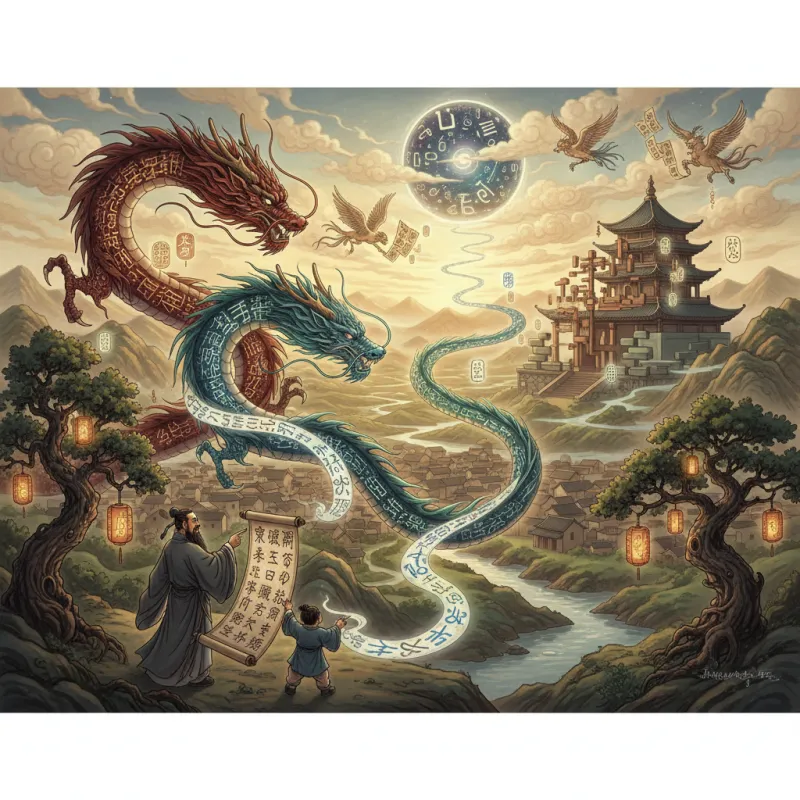
You're staring at a menu in Beijing, and you recognize every single character. 饺子 (jiǎozi) — dumplings. 面条 (miàntiáo) — noodles. 茶 (chá) — tea. Victory! Then the waiter asks you a question, and suddenly those same characters you just read are flying past your ears as incomprehensible sound. Welcome to the Chinese language paradox: a tongue that can feel absurdly simple one moment and impossibly complex the next, sometimes within the same conversation.
The Grammar Gift
Let's start with the good news, because it's genuinely shocking to anyone who's wrestled with French subjunctives or German cases. Chinese grammar is startlingly straightforward. There are no verb conjugations — 我吃 (wǒ chī, I eat), 你吃 (nǐ chī, you eat), 他吃 (tā chī, he eats). Same verb, every time. No articles cluttering up your sentences. No grammatical gender turning every noun into a memorization exercise. Want to talk about the past? Just add 了 (le) or a time word. Future? Add 会 (huì) or 要 (yào). Done.
The sentence structure follows subject-verb-object, identical to English. 我喜欢中国菜 (wǒ xǐhuān Zhōngguó cài) — I like Chinese food. Word for word, it maps perfectly. Compare this to Russian, where the same sentence requires you to conjugate the verb, decline the noun, and remember which of six cases applies. Or Japanese, where the verb goes at the end and you need to navigate multiple levels of politeness. Chinese just... doesn't bother with most of that.
This grammatical simplicity isn't laziness — it's elegance. Classical Chinese poetry achieved profound depth with minimal grammatical machinery, relying instead on context, implication, and the resonance between characters. Modern Mandarin inherits this philosophy. The language trusts you to understand meaning from context rather than spelling everything out with grammatical markers.
The Character Mountain
Now for the reckoning. Chinese writing is a different beast entirely, one that has humbled countless learners and sparked debates about literacy for over a century. There is no alphabet. Each character is a unique symbol that must be memorized individually, along with its meaning, pronunciation, and the specific order of strokes used to write it.
The numbers are daunting. Basic literacy requires roughly 3,000 characters. To read a newspaper comfortably, you need 3,500-4,000. Full literacy — the kind that lets you read classical poetry, legal documents, or specialized technical texts — demands 6,000 or more. And unlike alphabetic languages where you can sound out unfamiliar words, encountering a new character in Chinese means you're stuck unless you can guess from context or look it up.
But here's where the paradox deepens: characters aren't random squiggles. Most are composed of radicals (部首, bùshǒu) — semantic or phonetic components that offer clues. The character 妈 (mā, mother) contains the radical 女 (nǚ, woman). The character 河 (hé, river) contains 氵, the water radical. Once you learn the 214 traditional radicals (or the simplified subset), you start seeing patterns. Characters become less like individual mountains to climb and more like a landscape with recognizable features.
There's also something deeply satisfying about reading characters. Each one is a compact unit of meaning. You can scan a text faster than in alphabetic languages because your brain processes whole concepts at a glance rather than decoding letter by letter. Chinese readers often report that characters feel more "direct" — the symbol connects to meaning without the intermediate step of sound.
The Tonal Tightrope
Then there's pronunciation, which introduces yet another layer of difficulty. Mandarin Chinese has four tones plus a neutral tone, and they're not decorative — they change meaning entirely. The syllable "ma" can mean mother (妈, mā, first tone), hemp (麻, má, second tone), horse (马, mǎ, third tone), or scold (骂, mà, fourth tone), depending on how your voice moves.
For speakers of non-tonal languages, this is genuinely hard. Your brain isn't wired to treat pitch as a meaning-bearing feature. You can study the tone rules, practice until your tongue aches, and still accidentally tell someone their mother is a horse. Native speakers will usually understand from context, but the potential for confusion is real and occasionally hilarious.
Yet tones also make Chinese more efficient. Because each syllable can carry multiple meanings through tonal variation, the language packs more information into fewer sounds. Mandarin has only about 400 distinct syllables (compared to several thousand in English), but with tones, that expands to roughly 1,200 meaningful syllables. It's an elegant solution to a phonological constraint, though that elegance offers little comfort when you're struggling to hear the difference between second and third tone.
The good news? Tones become more intuitive with immersion. Your brain eventually learns to process them automatically, the same way English speakers unconsciously distinguish between "record" (noun) and "record" (verb) based on stress patterns. It just takes time and a willingness to sound ridiculous during the learning phase.
The Context Dependency
Chinese relies heavily on context in ways that can feel liberating or maddening, depending on your perspective. Because the grammar is so minimal, the language trusts you to fill in gaps. Pronouns get dropped constantly. Tense is often implied rather than stated. Measure words (量词, liàngcí) change based on what you're counting, but native speakers navigate this instinctively.
This context dependency means that Chinese conversation can feel remarkably efficient. You don't waste words on grammatical necessities. But it also means that understanding requires more active engagement. You can't just passively decode sentences — you need to track the conversational thread, remember what was said earlier, and infer what's left unstated.
For learners, this creates an interesting challenge. You might understand every individual word in a sentence but still miss the meaning because you didn't catch the contextual cues. Or you might grasp the overall meaning despite not knowing several characters, because context filled in the blanks. It's a different kind of comprehension, one that feels more holistic and less linear than reading alphabetic languages.
The Cultural Encoding
Here's something that doesn't get discussed enough: Chinese is deeply encoded with cultural knowledge in ways that go beyond vocabulary. Chinese idioms (成语, chéngyǔ) are four-character phrases that reference historical events, classical literature, or philosophical concepts. Using them correctly requires knowing the stories behind them.
Take 画蛇添足 (huà shé tiān zú) — "drawing a snake and adding feet." It means to ruin something by adding unnecessary embellishments, and it comes from a story in the Warring States period about a man who lost a wine-drinking contest because he got fancy and drew feet on his snake. You can't really understand Chinese discourse without knowing hundreds of these references.
The same goes for classical poetry, which influences modern language in subtle ways. Educated Chinese speakers pepper their conversation with poetic allusions, and written Chinese often echoes classical structures. This creates layers of meaning that are invisible to learners who haven't studied the literary tradition.
This cultural depth is part of what makes Chinese fascinating, but it also means that achieving true fluency requires more than linguistic skill — it requires cultural literacy. You're not just learning a language; you're learning a civilization's way of encoding knowledge and experience.
The Spoken-Written Divide
One final paradox: spoken and written Chinese can feel like different languages. Written Chinese, especially formal writing, uses vocabulary and structures that rarely appear in conversation. Classical Chinese (文言文, wényánwén) is even more extreme — it's essentially a different language that educated Chinese people learn in school, the way English speakers study Shakespeare or Latin.
This means you can be fluent in spoken Mandarin but struggle to read a newspaper, or vice versa. The skills don't transfer as directly as they do in alphabetic languages. It's entirely possible to chat comfortably with friends but feel lost reading a formal document, because the register shift involves not just vocabulary but different grammatical patterns and rhetorical conventions.
Regional variation adds another layer. While Mandarin is the official language, China has numerous dialects (or, more accurately, related languages) that are mutually unintelligible. A Mandarin speaker and a Cantonese speaker can't understand each other's speech, but they can communicate in writing because the characters are largely the same. This creates a unique situation where writing serves as a bridge across spoken language barriers.
The Verdict
So is Chinese hard or easy? Both, genuinely. The grammar is a gift — simple, logical, and forgiving. The characters are a mountain, but one with paths and patterns once you start climbing. The tones are genuinely difficult for most learners, but they become automatic with practice. The cultural depth is daunting but also endlessly rewarding.
What makes Chinese unique is that the easy parts and hard parts don't cancel out — they coexist. You'll have moments of surprising fluency and moments of complete bafflement, sometimes in the same conversation. The language rewards different skills than alphabetic languages do: visual memory over phonetic decoding, contextual awareness over grammatical precision, cultural knowledge over vocabulary breadth.
The real question isn't whether Chinese is hard or easy, but whether its particular challenges and rewards align with how your brain works and what you find interesting. If you love patterns, visual learning, and cultural depth, Chinese might feel easier than its reputation suggests. If you rely heavily on phonetic decoding and explicit grammar, you're in for a rougher ride. Either way, you're learning a language that has shaped one of the world's great civilizations for thousands of years — and that's worth something, regardless of the difficulty level.
Related Reading
- Chinese Idioms in Daily Life: Stories Behind Common Sayings
- Learning Chinese: An Honest Guide for Complete Beginners
- The History of Chinese Characters: From Oracle Bones to Emojis
- The Chinese Language: Why It Is Both Impossible and Beautiful
- Chinese Animation: From Ink Wash Classics to Global Hits
- Qi: The Concept That Runs Chinese Culture
- Delving into Chinese Water Legends: Tales of Spirits and Serpents
Explore Chinese Culture
- Explore feng shui in daily life
- Explore supernatural folklore
- Explore classical Chinese literature