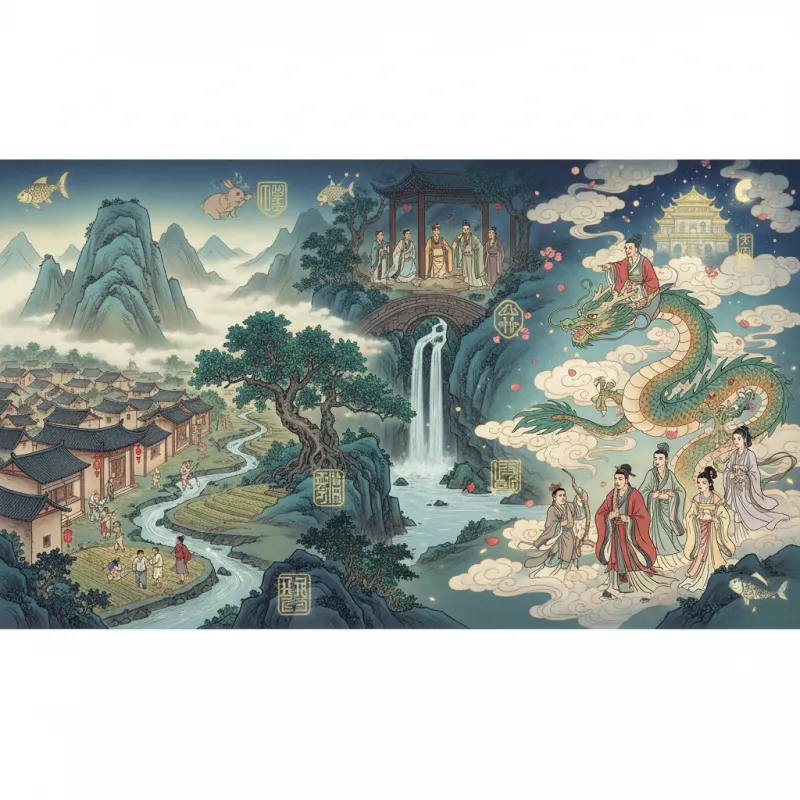
A servant in ancient Chu poured wine into a cup, looked at his four companions, and realized they had a problem: five men, one cup of wine, and no fair way to divide it. "Whoever finishes drawing a snake first gets the whole cup," someone suggested. They all crouched down and began scratching snakes into the dirt. One man finished well ahead of the others, grabbed the cup triumphantly, and then—fatally—decided to keep drawing. "Look, I even have time to add feet!" he announced. Another man snatched the cup away. "Snakes don't have feet. That's not a snake anymore. The wine is mine."
This is how 画蛇添足 (Huà Shé Tiān Zú) entered the Chinese language twenty-three centuries ago, and why your Chinese colleague will use these exact four characters when you add an unnecessary feature to a product two days before launch.
Why Four Characters Rule Everything
Chinese idioms—成语 (chéngyǔ)—follow an iron law: four characters, no more, no less. This isn't arbitrary. Classical Chinese operated on a four-character rhythm that made texts easier to memorize and recite. The structure also creates perfect symmetry: two characters balance two characters, subject mirrors object, cause reflects effect. When you hear 守株待兔 (shǒu zhū dài tù), the rhythm itself tells you this is wisdom, not just words.
But the real power of chéngyǔ isn't linguistic—it's cultural compression. Each four-character phrase encodes an entire narrative that educated speakers recognize instantly. You're not just communicating an idea; you're invoking a shared story, a common reference point, a piece of collective memory. This is why there are over 20,000 documented chéngyǔ, though only a few thousand see regular use. They're not just idioms. They're the DNA of Chinese literary culture.
Using them correctly signals education and cultural fluency. Using them incorrectly—or worse, inventing fake ones—marks you as someone pretending to sophistication they don't possess. Chinese social media regularly mocks public figures who bungle their chéngyǔ, because everyone knows the stories, and everyone knows when you don't.
The Ones You'll Actually Hear
对牛弹琴 (Duì Niú Tán Qín) — "Playing the lute to a cow"
A musician named Gongming Yi performed an elegant classical piece for a cow. The cow continued chewing grass, utterly indifferent. Gongming Yi then played sounds imitating mosquitoes and flies. The cow's ears perked up immediately. The story comes from a Buddhist text criticizing those who preach profound truths to audiences incapable of understanding them—but modern usage has shifted. Now it's what you say when explaining cloud architecture to your CEO, or discussing Chinese poetry with someone who thinks Li Bai is a type of tea.
亡羊补牢 (Wáng Yáng Bǔ Láo) — "Mending the pen after the sheep are lost"
A man's sheep escaped through a hole in the fence. His neighbor suggested repairs. "The sheep are already gone," the man said. "What's the point?" That night, wolves came through the same hole and killed more sheep. The next morning, he fixed the fence. The idiom appears in the Zhanguo Ce (Strategies of the Warring States), compiled around 33 BCE, and it means exactly what you think: better late than never, fix the problem before it gets worse, don't let pride prevent damage control. Chinese parents deploy this one when their children finally start studying two weeks before the gaokao exam.
刻舟求剑 (Kè Zhōu Qiú Jiàn) — "Carving the boat to find the sword"
A man crossing a river dropped his sword into the water. He immediately carved a mark on the side of the boat. "This is where it fell," he explained. When the boat reached shore, he jumped in at the marked spot to search for his sword. Obviously, he found nothing—the boat had moved, the sword hadn't. This story from Lüshi Chunqiu (Master Lü's Spring and Autumn Annals, circa 239 BCE) describes rigid thinking that ignores changed circumstances. It's the idiom for people who apply last year's strategy to this year's market, or who insist on solutions that worked in 2010.
叶公好龙 (Yè Gōng Hào Lóng) — "Lord Ye's love of dragons"
Lord Ye decorated his entire house with dragon imagery—dragon paintings, dragon carvings, dragon embroidery on every surface. He told everyone he loved dragons more than anything. One day, a real dragon heard about this devotion and decided to visit. It stuck its head through Lord Ye's window. Lord Ye took one look and fled in terror. The idiom, from Liu Xiang's Xin Xu (New Prefaces, 1st century BCE), describes people who claim to love something but panic when confronted with the reality. It's perfect for the manager who says he wants "innovative thinking" but rejects every unconventional idea, or the person who romanticizes rural Chinese life but can't handle three days without WiFi.
The Dark Ones Nobody Explains to Foreigners
指鹿为马 (Zhǐ Lù Wéi Mǎ) — "Pointing at a deer and calling it a horse"
In 210 BCE, the eunuch Zhao Gao brought a deer before the Second Emperor of Qin and called it a horse. The emperor laughed, thinking it was a joke. Zhao Gao asked the assembled officials: "Is this a horse or a deer?" Some officials, terrified of Zhao Gao's power, agreed it was a horse. Others insisted it was obviously a deer. Zhao Gao quietly noted who said what. Within weeks, everyone who had called it a deer was dead. This isn't an idiom about stupidity or mistakes. It's about authoritarian power—the ability to make people deny reality, to force them to participate in obvious lies, to identify who will resist and eliminate them. When Chinese speakers use this phrase, they're talking about gaslighting at a political scale.
卧薪尝胆 (Wò Xīn Cháng Dǎn) — "Sleeping on brushwood and tasting gall"
King Goujian of Yue was captured and humiliated by King Fuchai of Wu in 494 BCE. After his release, Goujian slept on firewood instead of a bed and hung a gall bladder in his room, tasting it daily to remember his bitterness and shame. He spent twenty years rebuilding his army, never forgetting his humiliation. In 473 BCE, he destroyed Wu completely and drove Fuchai to suicide. This idiom represents enduring hardship to fuel revenge—not forgiveness, not moving on, but cultivating hatred as motivation. It's the phrase for long-term grudges and patient vengeance, and it's considered admirable. The cultural message: some humiliations should never be forgotten or forgiven.
When Ancient Wisdom Meets Modern Absurdity
班门弄斧 (Bān Mén Nòng Fǔ) — "Wielding an axe at Ban's door"
Lu Ban was the legendary master carpenter of the 5th century BCE, so skilled that his name became synonymous with woodworking excellence. Showing off your carpentry skills in front of Lu Ban's house would be like explaining basketball to Michael Jordan or teaching calligraphy to Wang Xizhi. The idiom means displaying your minor talents before a true master, and it's usually deployed with false modesty: "I'm just 班门弄斧 here, but..." before proceeding to share your opinion anyway. Chinese academic conferences are 40% actual content and 60% people saying 班门弄斧 before presenting their research.
画饼充饥 (Huà Bǐng Chōng Jī) — "Drawing cakes to satisfy hunger"
A starving man drew pictures of food and pretended to eat them. This idiom from the Three Kingdoms period describes empty promises and unrealistic plans—the startup that's always six months from profitability, the government project that exists only in PowerPoint slides, the diet that starts "next Monday." It's closely related to 望梅止渴 (wàng méi zhǐ kě, "looking at plums to quench thirst"), where Cao Cao told his thirsty troops to imagine plum trees ahead, causing them to salivate and temporarily forget their thirst. Both idioms acknowledge that imagination has power—but also that it's not a substitute for actual solutions.
The Ones That Reveal How Chinese Culture Actually Works
塞翁失马 (Sài Wēng Shī Mǎ) — "The old frontier man loses his horse"
An old man's horse ran away. "What bad luck," his neighbors said. "Maybe," the old man replied. The horse returned with a wild stallion. "What good luck!" the neighbors exclaimed. "Maybe," he said again. His son tried to tame the new horse, fell, and broke his leg. "What terrible luck!" "Maybe." Then war came, and all the young men were conscripted—except his son, who was spared because of his injury. The story continues, but the point is clear: fortune and misfortune are intertwined, and immediate judgments about luck are premature. This idiom encodes a fundamentally different worldview from Western "everything happens for a reason" optimism. It's not optimistic or pessimistic—it's cyclical, patient, and suspicious of certainty.
三人成虎 (Sān Rén Chéng Hǔ) — "Three people make a tiger"
Before leaving for a distant posting, the minister Pang Cong asked the King of Wei: "If one person told you there was a tiger in the marketplace, would you believe it?" "No," said the king. "What if two people said it?" "I'd be skeptical." "What if three people said it?" "Then I suppose I'd believe it." Pang Cong warned: "There are no tigers in marketplaces, but if enough people repeat a lie, it becomes accepted as truth. While I'm gone, many people will slander me. Please remember this conversation." The king agreed. Within months of Pang Cong's departure, the king believed every rumor about him. This 2,300-year-old idiom describes what we now call "misinformation" and "echo chambers"—and it's more relevant than ever.
Why These Stories Still Matter
Every Chinese child learns these idioms in school, encounters them in books, hears them in conversation. They're not decorative—they're functional, a shared vocabulary that makes communication more efficient and culturally resonant. When someone says 守株待兔 (shǒu zhū dài tù, "guarding a tree stump waiting for rabbits"), they're not just describing passive waiting. They're invoking the complete story of a farmer who saw a rabbit run into a tree stump and die, then abandoned his fields to wait by that stump for more rabbits, and starved. Everyone knows this story. Four characters convey the entire narrative plus the judgment: this is foolish, passive, delusional thinking.
The persistence of chéngyǔ reveals something important about Chinese culture: the past is not past. These stories from the Warring States period, the Han Dynasty, the Three Kingdoms era—they're not historical curiosities. They're active, living references that shape how people think about current events, personal decisions, and social dynamics. When a Chinese speaker uses 指鹿为马, they're connecting today's political gaslighting to Zhao Gao's power play in 210 BCE. The pattern is recognized because the pattern repeats.
This is also why learning Chinese without learning chéngyǔ leaves you functionally illiterate in cultural terms. You might understand the individual words in a sentence, but you'll miss the deeper meaning, the historical resonance, the social judgment being conveyed. It's the difference between knowing what someone said and understanding what they meant—and in Chinese communication, that gap can be enormous.
The four-character structure isn't a limitation. It's a feature. It forces precision, demands cultural knowledge, and creates a shared reference system that spans centuries. When you master chéngyǔ, you're not just learning idioms. You're gaining access to the compressed wisdom, dark humor, and brutal honesty of three thousand years of Chinese civilization—four characters at a time.
Related Reading
- Learning Chinese: An Honest Guide for Complete Beginners
- The History of Chinese Characters: From Oracle Bones to Emojis
- The Chinese Language: Why It Is Both Impossible and Beautiful
- The Chinese Language: Why It Is Both Harder and Easier Than You Think
- Chinese New Year: The Complete Guide to Spring Festival
- Chinese History in 30 Minutes: From the Yellow Emperor to the Last Dynasty
- Exploring the Rich Tapestry of Chinese Folklore, Legends, and Fairy Tales
Explore Chinese Culture
- Explore feng shui in daily life
- Explore supernatural folklore
- Explore classical Chinese literature