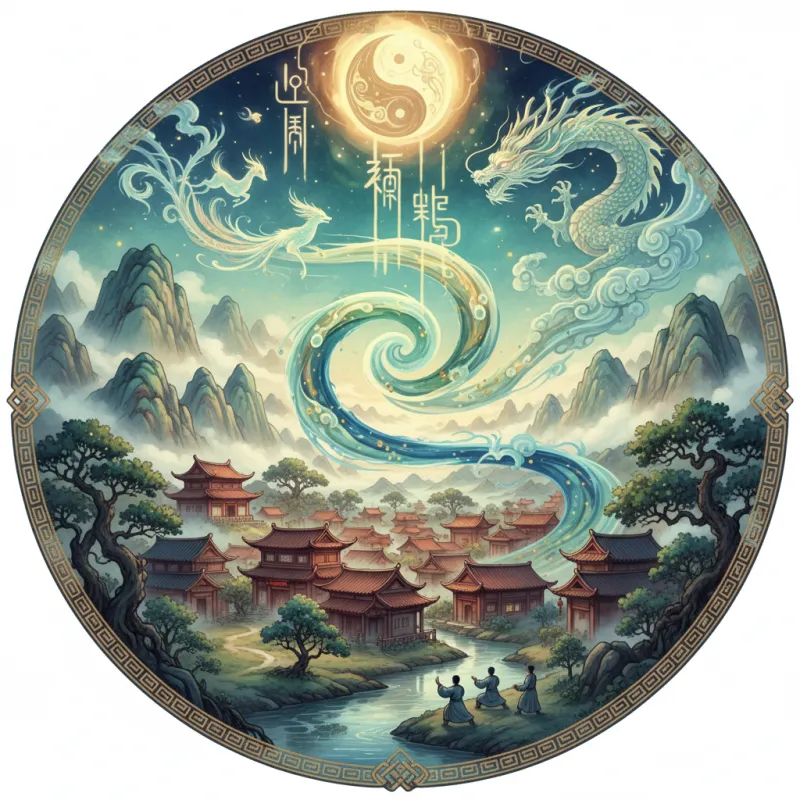
Take a deep breath. Hold it. Now let it out slowly. What you just felt moving through your body — that sensation of something flowing, circulating, animating — that's the closest a non-Chinese speaker can get to understanding qi (气, qì) without spending a decade studying classical texts. But here's the problem: you just experienced it as "breath" or maybe "air," and while qi certainly includes those things, it's also the force that makes your heart beat, the vitality in a child's laughter, the oppressive heaviness before a thunderstorm, and the reason your acupuncturist keeps poking needles into seemingly random spots on your body.
Qi isn't mystical woo-woo, despite what Western skeptics claim. It's also not some magical energy field, despite what New Age enthusiasts insist. It's something far more interesting: a conceptual framework so fundamental to Chinese thought that trying to explain Chinese culture without it is like trying to describe Western science without mentioning atoms. The word appears in thousands of compound terms, from 天气 (tiānqì, weather — literally "heaven-qi") to 生气 (shēngqì, anger — "generating qi") to 运气 (yùnqì, luck — "moving qi"). When Chinese people talk about anything from health to cooking to interpersonal relationships, qi is the invisible thread connecting it all.
The Untranslatable Problem
Every translator who's tackled classical Chinese texts has wrestled with qi and lost. "Energy" is the most common English rendering, but it's woefully inadequate. Energy in physics is a measurable quantity — joules, calories, kilowatt-hours. Qi is simultaneously more concrete and more abstract. It's the steam rising from rice, the breath of a sleeping baby, the vital force that distinguishes a living tree from a dead one, and the atmospheric quality that makes one room feel welcoming and another oppressive.
The character 气 itself offers clues. In its ancient form, it depicted vapor or steam rising — something material yet intangible, visible yet ungraspable. By the time of the Warring States period (475-221 BCE), philosophers were already using it in wildly different ways. Mencius (孟子, Mèngzǐ) wrote about 浩然之气 (hàorán zhī qì) — a "flood-like qi" of moral righteousness that fills the space between heaven and earth. Zhuangzi (庄子, Zhuāngzǐ) described the universe as nothing but qi in various states of condensation and dispersion. The medical text Huangdi Neijing (黄帝内经, Huángdì Nèijīng, circa 100 BCE) mapped out elaborate systems of qi flowing through the body in channels called meridians.
None of these thinkers were talking about the same thing exactly, yet they weren't talking about different things either. That's the genius and frustration of qi — it's a concept elastic enough to encompass breath, air, weather, emotion, vitality, and cosmic force, yet specific enough that Chinese speakers intuitively understand which meaning applies in context.
Qi in the Body: Medicine's Invisible Architecture
Walk into any traditional Chinese medicine clinic and you'll hear practitioners diagnosing problems you didn't know you had: qi deficiency (气虚, qì xū), qi stagnation (气滞, qì zhì), rebellious qi (气逆, qì nì). To Western ears, this sounds like medieval humoral theory — the kind of pre-scientific thinking we abandoned centuries ago. But here's what's interesting: Chinese medicine's qi-based diagnostic system produces consistent, reproducible results that have kept it relevant for over two millennia.
The theory goes like this: your body contains multiple types of qi, each with specific functions. 元气 (yuán qì, original qi) is your constitutional vitality, inherited from your parents and stored in the kidneys. 宗气 (zōng qì, gathering qi) accumulates in the chest and powers breathing and heartbeat. 营气 (yíng qì, nutritive qi) flows through the meridians nourishing tissues. 卫气 (wèi qì, defensive qi) circulates on the body's surface protecting against external pathogens. When these various qi flow smoothly and abundantly, you're healthy. When they're deficient, stagnant, or flowing in the wrong direction, you get sick.
The acupuncture points dotting those colorful meridian charts? They're understood as access points where practitioners can influence qi flow — removing blockages, redirecting rebellious qi, tonifying deficiencies. The herbs in those bitter decoctions? Categorized by their effects on qi: some move it, some tonify it, some descend it, some lift it. Even dietary advice revolves around qi: eat warming foods to supplement yang qi in winter, cooling foods to clear heat and regulate qi in summer.
Does qi "exist" in any way Western medicine would recognize? That's the wrong question. The better question is: does this conceptual framework produce useful clinical results? Millions of patients and thousands of years suggest it does, even if we can't measure qi with instruments or see it under microscopes.
Martial Arts: Cultivating Force Without Force
Watch a tai chi master push a much larger opponent across the room with what looks like a gentle touch, and you're seeing qi cultivation in action — or at least, that's how practitioners explain it. In Chinese martial arts, especially the internal styles (内家拳, nèijiā quán) like tai chi, bagua, and xingyi, the goal isn't building bigger muscles or learning fancier techniques. It's cultivating and directing qi.
The classic texts are full of instructions that sound mystical until you try to embody them. "Use yi (意, intention) to move qi, use qi to move the body." "Sink the qi to the dantian (丹田, dāntián)." "Let the qi flow like the Yangtze River, continuous and unbroken." What does any of this actually mean?
After years of practice, students report developing a tangible sensation of something flowing through their bodies during forms and push-hands practice. Skeptics call it proprioception, body awareness, or biomechanical efficiency. Practitioners insist it's qi. The interesting part is that regardless of what you call it, the training methods produce measurable results: improved balance, enhanced power generation, better reaction time, and that uncanny ability to sense an opponent's intention before they move.
The legendary martial artist Wang Xiangzhai (王芗斋, 1885-1963), founder of Yiquan, put it bluntly: "Qi is not mysterious. It's simply the body's natural strength and vitality properly organized and expressed." He stripped away the mystical language while keeping the training methods, proving you could cultivate "qi" without believing in anything supernatural.
Breathing Life Into Art and Architecture
Chinese landscape painting (山水画, shānshuǐ huà) isn't about accurately depicting scenery. It's about capturing the qi of a place — that ineffable quality that makes one mountain feel majestic and another merely tall, one river feel alive and another just wet. Painters talk about 气韵生动 (qìyùn shēngdòng) — "spirit resonance and life movement" — as the highest achievement in art. A painting might be technically perfect but "dead" if it lacks qi.
The same principle governs Chinese calligraphy. Master calligraphers don't just write characters; they channel qi through the brush, creating strokes that pulse with vitality. The great Tang dynasty calligrapher Zhang Xu (张旭, 675-750 CE) was famous for writing in a wild, cursive style while drunk, his qi flowing unimpeded by conscious control. His works are considered treasures not because they're legible (they're often not) but because they're alive with energy.
Feng shui, literally "wind-water," is essentially the art of managing environmental qi. The goal is arranging spaces so qi flows smoothly without stagnating or rushing too quickly. That's why feng shui practitioners obsess over door placements, furniture arrangements, and landscape features — they're all understood as influencing how qi moves through a space. A house with good feng shui has harmonious qi flow; one with bad feng shui has stagnant, chaotic, or depleted qi.
Modern architects might scoff, but there's something to it. Spaces designed with feng shui principles often do feel more comfortable and harmonious, even if you don't believe in qi. Maybe it's just good design intuition dressed in traditional language, or maybe the ancient practitioners were onto something about how environmental factors affect human wellbeing.
Qi in Daily Language: The Invisible Grammar
Here's where qi gets really interesting: it's embedded so deeply in Chinese language that native speakers use it constantly without thinking about the philosophical implications. When someone says 天气 (tiānqì, weather), they're literally saying "heaven's qi." 空气 (kōngqì, air) is "empty qi." 气氛 (qìfēn, atmosphere) is "qi division." The language itself encodes a worldview where qi is the fundamental substance of reality.
Emotional states are described as qi conditions. Anger is 生气 (shēngqì, generating qi) or 发脾气 (fā píqì, releasing spleen-qi). Discouragement is 泄气 (xièqì, leaking qi). Pride is 神气 (shénqì, spirit-qi). Being petty is 小气 (xiǎoqì, small qi). Having backbone is 骨气 (gǔqì, bone-qi). These aren't just metaphors — they reflect a genuine understanding of emotions as movements and states of qi within the body.
Even luck and fate are qi-related. 运气 (yùnqì) means luck, but literally translates as "moving qi" or "transported qi." Good fortune is having qi that flows favorably; bad luck is qi moving against you. This isn't fatalism exactly — since qi is always in motion, your luck can change. It's more like surfing: you can't control the waves, but you can learn to ride them skillfully.
The Modern Qi Paradox
Contemporary China presents a fascinating paradox. The country has embraced scientific materialism and technological modernity with enthusiasm, yet qi-based practices remain ubiquitous. Every morning, parks fill with people practicing qigong (气功, qìgōng) and tai chi. Traditional Chinese medicine hospitals operate alongside Western ones, often in the same building. Feng shui consultants advise on skyscraper construction. How does a society reconcile ancient qi theory with modern science?
The answer seems to be: pragmatically. Most educated Chinese don't literally believe qi is a measurable substance, but they don't dismiss it as superstition either. It's understood as a useful model, a way of thinking about health, environment, and human experience that complements rather than contradicts scientific understanding. You can get antibiotics for your infection and herbs to "regulate your qi" without seeing any contradiction.
Some researchers are trying to bridge the gap, investigating whether qi corresponds to anything measurable — bioelectricity, fascia networks, neurological patterns. Others argue this misses the point: qi is a phenomenological concept, describing lived experience rather than objective reality. It's a way of paying attention to subtle bodily sensations, environmental qualities, and relational dynamics that Western frameworks often overlook.
Why Qi Still Matters
In an age of MRI machines and genetic sequencing, why should anyone care about an ancient Chinese concept that can't be measured or precisely defined? Because qi addresses something modern medicine and science often miss: the qualitative, subjective dimension of human experience.
Western medicine excels at treating discrete, measurable pathologies but struggles with vague complaints like fatigue, malaise, or "just not feeling right." Chinese medicine's qi-based framework provides a vocabulary and treatment approach for these in-between states. You might not have a diagnosable disease, but your qi could be deficient or stagnant, and there are specific interventions for that.
Similarly, modern architecture can calculate load-bearing capacity and energy efficiency but often produces spaces that feel sterile or uncomfortable. Feng shui's attention to qi flow — however you interpret it — keeps human experience central to design decisions.
The real value of qi isn't as a scientific theory but as a reminder that reality has dimensions our instruments can't measure. The vitality of a living thing versus a dead one, the atmosphere of a space, the quality of a relationship — these are real phenomena that matter deeply to human life, even if they resist quantification. Qi gives us a way to think and talk about them seriously.
So the next time you walk into a room and immediately feel uncomfortable without knowing why, or notice that you're inexplicably tired despite adequate sleep, or sense tension in a conversation before anyone says anything hostile — that's your introduction to qi. Not as mystical energy or pseudoscientific nonsense, but as a framework for paying attention to the subtle, unquantifiable aspects of existence that make life rich and complex. The ancient Chinese were onto something, even if they expressed it in terms modern science doesn't recognize. Sometimes the old operating systems still run the best programs.
Related Reading
- Traditional Chinese Medicine: The Debate That Will Not End
- Traditional Chinese Medicine: What Western Science Gets Wrong About Getting It Wrong
- Acupuncture: What Science Actually Says
- Chinese Herbal Medicine: A Beginner's Guide
- Discovering Love Legends of Chinese Folklore: Tales of Passion and Destiny
- Exploring Transformation in Chinese Folklore: Legends, Fairy Tales, and Cultural Traditions
- Chinese Dynasties: A Quick Guide to 5,000 Years
Explore Chinese Culture
- Explore feng shui in daily life
- Explore supernatural folklore
- Explore classical Chinese literature