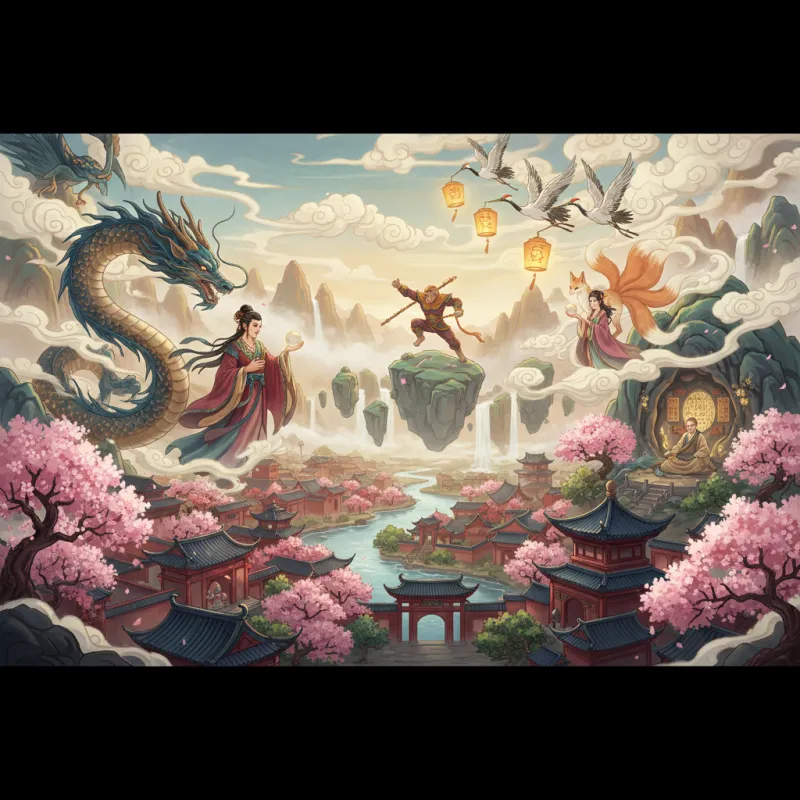
A white snake coils around a broken umbrella on West Lake's rain-slicked bridge, and in the next breath, she's a woman in flowing silk robes, her eyes holding centuries of longing. This is the moment that defines Chinese folklore—not the transformation itself, but what it reveals about the boundary between human and divine, between what we are and what we might become.
The Philosophy Behind the Shift
Chinese transformation stories operate on fundamentally different logic than their Western counterparts. Where European fairy tales often treat shapeshifting as punishment or curse—think of Beauty and the Beast's enchanted prince—Chinese narratives embrace transformation as natural law. The concept of 变化 (biànhuà, transformation) flows directly from Daoist philosophy, where the Zhuangzi asks whether the dreaming butterfly is actually a man, or the man merely a butterfly's dream. This isn't metaphor. It's cosmology.
The Shan Hai Jing (山海经, Classic of Mountains and Seas), compiled during the Warring States period (475-221 BCE), catalogs hundreds of creatures that shift between forms as casually as humans change clothes. The text describes the 鲲鹏 (kūnpéng), a fish so massive it transforms into a bird whose wings darken the sky for three thousand li. No moral lesson accompanies this metamorphosis. It simply is—a demonstration of the universe's fundamental mutability.
Fox Spirits and the Erotics of Transformation
The 狐狸精 (húlijīng, fox spirit) dominates Chinese transformation literature with an intensity that borders on obsession. Pu Songling's 18th-century masterwork Liaozhai Zhiyi (聊斋志异, Strange Tales from a Chinese Studio) contains dozens of fox spirit stories, and they're rarely simple morality plays. These vixens seduce scholars, yes—but they also save lives, expose corruption, and challenge the rigid social hierarchies of Qing dynasty China.
Take the story of Nie Xiaoqian (聂小倩), later adapted into the film A Chinese Ghost Story. She's a fox spirit forced to lure men to their deaths, but she falls genuinely in love with the scholar Ning Caichen. Her transformation isn't from fox to human—it's from tool to agent, from victim to rebel. The real metamorphosis happens in her moral awakening, not her physical form. This pattern repeats throughout Chinese folklore: transformation as a vehicle for exploring female agency in a patriarchal society. The fox spirit can do what human women cannot—choose her lovers, reject arranged marriages, move freely through the night.
The White Snake's Revolutionary Love
Bai She Zhuan (白蛇传, Legend of the White Snake) might be China's most enduring transformation tale, and it's essentially a story about interspecies marriage rights. Bai Suzhen (白素贞), a white snake who has cultivated herself for a thousand years, takes human form and marries the mortal Xu Xian. The Buddhist monk Fahai, representing religious orthodoxy, insists this union violates natural law and imprisons her beneath Leifeng Pagoda.
But here's what makes the story radical: the narrative never suggests Bai Suzhen is wrong. She's the protagonist, the moral center, the character we root for across centuries of retellings. Her husband Xu Xian is weak, easily manipulated, prone to fainting—yet she loves him anyway, bears his child, fights heaven and earth to return to him. The transformation that matters isn't snake to woman; it's the transformation of what society accepts as legitimate love. When Leifeng Pagoda finally collapses in 1924, people celebrated as if Bai Suzhen had actually been freed.
This theme of transformation challenging social boundaries connects deeply with Chinese festival traditions, where the boundaries between human and spirit worlds temporarily dissolve, allowing for encounters that would otherwise be impossible.
Monkey King and the Seventy-Two Transformations
Sun Wukong (孙悟空), the Monkey King from Journey to the West (西游记), masters seventy-two transformations—but he's terrible at them. He can become a temple, but forgets to transform his tail, which sticks up as a flagpole. He turns into a little girl, but keeps his hairy face. These failures are deliberate comedy, yes, but they also make a philosophical point: transformation without inner change is just costume.
The entire Journey to the West, written by Wu Cheng'en in the 16th century, is structured around transformation as spiritual cultivation. Sun Wukong begins as pure chaos—stealing immortality peaches, urinating on Buddha's finger, declaring himself equal to heaven. His journey accompanying the monk Xuanzang to India isn't about physical transformation; he's already mastered that. It's about transforming his nature from 妖 (yāo, demon) to 佛 (fó, Buddha). The irony is that his external transformations become less important as his internal transformation progresses.
Carp Leaping the Dragon Gate
The legend of 鲤鱼跳龙门 (lǐyú tiào lóngmén, carp leaping the dragon gate) offers transformation as meritocracy myth. Carp swimming up the Yellow River face a waterfall at Dragon Gate; those with sufficient strength and determination leap over and transform into dragons. Those who fail remain fish. This story, dating back to the Han dynasty, became the metaphor for passing the imperial examinations—the grueling tests that could transform a peasant into a government official.
But the story's darker implication is that those who don't transform deserve their fate. It's transformation as social Darwinism, justifying inequality through the language of personal effort. Not every transformation narrative in Chinese folklore is progressive or kind. Some reinforce the very hierarchies others challenge, much like how traditional Chinese food culture uses ingredients symbolically to reinforce social meanings and aspirations.
Transformation in Contemporary Chinese Culture
Walk through any Chinese city today and you'll see the transformation motif everywhere. Anime and donghua (动画, Chinese animation) series like The Legend of Hei feature cat spirits navigating modern urban life. The 2019 animated film Ne Zha reimagines the deity as a misunderstood child fighting against predetermined fate—transformation as self-determination against cosmic bureaucracy.
Video games like Black Myth: Wukong let players experience Sun Wukong's seventy-two transformations firsthand, turning ancient folklore into interactive mythology. These aren't mere adaptations; they're continuations of a living tradition that has always used transformation to ask: What makes us human? Can we change our nature? Who decides what form we should take?
The Unfinished Transformation
Chinese transformation stories rarely end with "happily ever after." Bai Suzhen gets freed from the pagoda, but in some versions, she returns to her snake form. The Monkey King achieves Buddhahood, but the novel ends with him still journeying. Fox spirits fade back into the wilderness. This ambiguity reflects a deeper truth: transformation in Chinese thought isn't a destination but a process, aligned with the Daoist principle of constant change.
The most profound transformation in these stories might be the one that happens to us as readers. We begin by seeing clear boundaries—human and animal, mortal and immortal, good and evil. By the end, those categories have blurred, shifted, transformed into something more complex and true. The snake woman loves more faithfully than most humans. The demon monkey becomes more enlightened than the gods. The fox spirit shows more integrity than the scholar.
Perhaps that's the real magic: not that creatures can take human form, but that stories can transform how we see ourselves.
Related Reading
- The Chinese Zodiac: Complete Guide to the 12 Animals
- The Eight Great Cuisines of China: A Flavorful Tour
- The Art of War: Sun Tzu's Lessons Beyond the Battlefield
Explore Chinese Culture
- Explore feng shui in daily life
- Explore supernatural folklore
- Explore classical Chinese literature