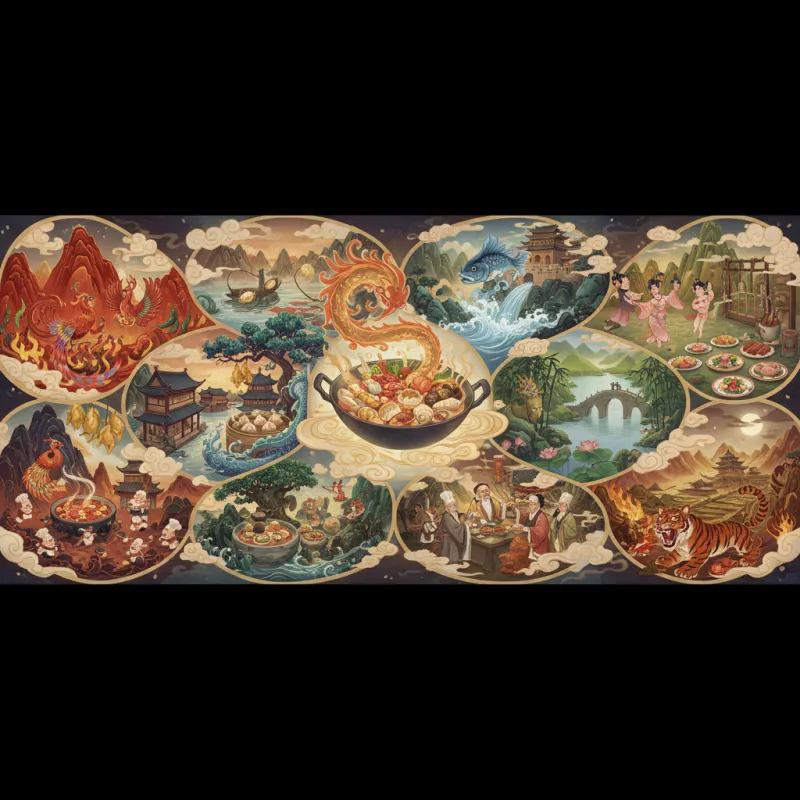
The imperial banquet hall falls silent as the chef presents eight dishes, each from a different corner of the empire. The Shandong official nods at the sea cucumber's perfect texture. The Sichuanese merchant reaches for chili oil that isn't there — and frowns. The Cantonese trader examines a braised dish with suspicion, wondering why anyone would cook something this long. This scene, repeated countless times throughout Chinese history, reveals a fundamental truth: China doesn't have one cuisine. It has eight distinct culinary philosophies, each as different from the others as French cooking is from Turkish.
The Empire's Official Cuisine: Shandong's Court Legacy
鲁菜 (Lǔcài, Shandong cuisine) holds the distinction of being China's oldest codified regional cuisine and the foundation of imperial cooking. When the Qing emperors wanted to impress foreign dignitaries, they served Shandong dishes. When wealthy families hired chefs for important occasions, they sought Shandong-trained masters. This wasn't accident or favoritism — Shandong's proximity to Beijing and its role as the birthplace of Confucius gave it unmatched political and cultural capital.
The cuisine's defining characteristic is 清 (qīng, clarity) — not in the sense of being bland, but in the precision of its flavors. Shandong chefs don't mask ingredients; they reveal them. The province's access to both the Yellow Sea and fertile agricultural land meant cooks could work with premium ingredients: sea cucumber, abalone, scallops, and the famous 章丘大葱 (Zhāngqiū dàcōng, Zhangqiu giant scallions) that can grow over a meter tall. Techniques like 爆 (bào, quick-frying at extremely high heat) and 扒 (pá, slow-braising until tender) showcase ingredients rather than transform them.
The most famous Shandong dish, 九转大肠 (jiǔzhuǎn dàcháng, nine-turn large intestine), tells you everything about the cuisine's philosophy. The intestine is cleaned meticulously, braised, fried, and braised again through multiple stages until it achieves a texture that's simultaneously tender and slightly crisp, with a sweet-sour-spicy flavor profile that never overwhelms the ingredient itself. It's technical mastery in service of the ingredient — the opposite of cuisines that use technique to create entirely new flavors.
Sichuan's Controlled Chaos: The Science of Málà
If Shandong is about clarity, 川菜 (Chuāncài, Sichuan cuisine) is about complexity bordering on chaos — but chaos with rules. The defining concept is 麻辣 (málà), the numbing-spicy combination of Sichuan peppercorns and chili peppers that foreigners either love obsessively or avoid entirely. But reducing Sichuan cuisine to "spicy food" is like reducing jazz to "loud music" — technically true but missing the entire point.
Sichuan chefs recognize 23 distinct flavor profiles, from 鱼香 (yúxiāng, fish-fragrant, which contains no fish) to 怪味 (guàiwèi, strange-flavor, which is actually perfectly balanced). The cuisine's complexity emerged from necessity: Sichuan's basin geography creates humid conditions that historically made food preservation difficult. Strong flavors — fermented bean paste, pickled vegetables, dried chilies — became preservation techniques that evolved into an aesthetic philosophy.
The dish that best demonstrates Sichuan's sophistication is 水煮鱼 (shuǐzhǔ yú, water-boiled fish), which sounds simple but isn't. The fish is poached in a broth so heavily spiced that it appears red, then covered with a layer of dried chilies and Sichuan peppercorns before hot oil is poured over the top, causing the spices to bloom and release their aromatics. Your mouth goes numb, then burns, then numbs again — but underneath, you can still taste the delicate fish. That's the point. Sichuan cuisine doesn't destroy subtlety; it creates a framework where subtlety and intensity coexist.
The historical irony: chilies only arrived in China in the 16th century from the Americas. Before that, Sichuan cuisine used 花椒 (huājiāo, Sichuan peppercorn) and ginger for heat. The cuisine adapted so thoroughly that most people now assume chilies are native to China.
Cantonese Cuisine: The Ingredient Fundamentalists
粤菜 (Yuècài, Cantonese cuisine) operates on a principle that sounds simple but requires extraordinary skill: don't mess with the ingredient. If Sichuan chefs are composers creating symphonies, Cantonese chefs are curators selecting perfect specimens and presenting them with minimal intervention. The Cantonese saying 食在广州 (shí zài Guǎngzhōu, "to eat in Guangzhou") isn't just regional pride — it's a statement of philosophy.
Guangdong's subtropical climate and access to the South China Sea provide ingredients that other regions can't match: fresh seafood, tropical fruits, and vegetables that can be harvested year-round. When you have access to fish that was swimming hours ago, why would you drown it in sauce? The signature Cantonese technique of steaming fish with just ginger, scallions, and a drizzle of soy sauce isn't laziness — it's confidence. The fish must be impeccably fresh, the timing must be precise (overcook by 30 seconds and the texture is ruined), and the seasoning must enhance rather than mask.
This philosophy extends to 早茶 (zǎochá, morning tea), the dim sum tradition that's become Cantonese cuisine's most famous export. Each dumpling, bun, and roll is a technical achievement: 虾饺 (xiājiǎo, shrimp dumplings) with translucent wrappers so thin you can see the pink shrimp inside, 叉烧包 (chāshāo bāo, BBQ pork buns) with fluffy white exteriors that crack open to reveal sweet-savory filling. The variety is staggering — a proper dim sum restaurant might offer 50+ items — but each one follows the same principle: perfect execution of a focused idea.
Cantonese cuisine also has the most adventurous ingredient list in China, leading to the saying 背脊向天,人皆可食 (bèijǐ xiàng tiān, rén jiē kě shí, "anything with its back to the sky can be eaten"). This isn't recklessness; it's the same ingredient-focused philosophy applied broadly. If something can be cooked well, why not cook it?
The Scholar's Table: Jiangsu's Refined Elegance
苏菜 (Sūcài, Jiangsu cuisine) is what happens when wealthy merchants and retired scholars have time, money, and cultural pretensions. Based in the Yangtze River Delta region around Suzhou and Nanjing, this cuisine developed in one of imperial China's most prosperous areas — a place where people had the luxury to care about aesthetics as much as flavor.
The defining characteristic is 精致 (jīngzhì, refinement). Jiangsu dishes are often slightly sweet, meticulously presented, and cooked with techniques that require patience. 松鼠桂鱼 (sōngshǔ guìyú, squirrel-shaped mandarin fish) is the cuisine's showpiece: a whole fish is scored in a crosshatch pattern, deep-fried until the flesh opens up to resemble a squirrel's tail, then covered in a sweet-and-sour sauce. It's technically impressive and visually stunning — exactly the kind of dish that would impress educated diners at a garden party.
The cuisine's other famous dish, 狮子头 (shīzi tóu, lion's head meatballs), demonstrates the Jiangsu approach to texture. The pork is hand-chopped (never ground) to create a specific consistency, mixed with water chestnuts for crunch, formed into large balls, and braised for hours until they're impossibly tender. The name comes from their appearance — large, round, with a "mane" of cabbage leaves. It's comfort food elevated to art.
Jiangsu cuisine also pioneered 红烧 (hóngshāo, red-braising), the technique of slow-cooking meat in soy sauce, sugar, and spices until it develops a deep mahogany color and melt-in-your-mouth texture. This technique spread throughout China, but Jiangsu versions tend to be sweeter and more delicate than their counterparts in other regions, much like how Chinese New Year dishes vary dramatically by region despite sharing common symbolic meanings.
Fujian's Ocean Philosophy: Soup as Art Form
闽菜 (Mǐncài, Fujian cuisine) is China's most underrated cuisine internationally, probably because its defining characteristic — extraordinary soups and broths — doesn't photograph well or travel easily. Fujian's mountainous terrain and extensive coastline created a cuisine focused on seafood and umami-rich broths that extract maximum flavor from premium ingredients.
The most famous Fujian dish is 佛跳墙 (fótiàoqiáng, Buddha Jumps Over the Wall), a soup so aromatic that legend claims even Buddhist monks would abandon their vegetarian vows to taste it. The dish contains dozens of ingredients — shark fin, abalone, sea cucumber, fish maw, chicken, ham — that are individually prepared, then combined and steamed together for hours in a clay pot. The result is a broth of almost absurd richness and complexity. It's also expensive enough that most people only eat it at banquets, which is probably why Fujian cuisine remains relatively unknown despite producing one of China's most legendary dishes.
The cuisine's other signature technique is 醉 (zuì, drunken-style cooking), where seafood is marinated in rice wine. 醉蟹 (zuìxiè, drunken crab) involves raw crabs marinated in wine, salt, and spices until they're "drunk" — the alcohol partially cures the meat while infusing it with flavor. It's an acquired taste that showcases Fujian's willingness to let ingredients shine in their most natural state.
Zhejiang's Delicate Balance: Hangzhou's Silk Road
浙菜 (Zhècài, Zhejiang cuisine) shares Jiangsu's refinement but adds a lighter touch and more emphasis on freshness. Centered around Hangzhou, one of imperial China's most beautiful cities, this cuisine developed in an environment where aesthetics mattered as much as taste. The famous West Lake provided not just scenic beauty but also ingredients — 西湖醋鱼 (Xīhú cùyú, West Lake vinegar fish) is the region's signature dish, featuring grass carp in a sweet-sour sauce that's more delicate than Sichuan's aggressive flavors.
Zhejiang cuisine is also famous for 东坡肉 (Dōngpō ròu, Dongpo pork), named after the Song Dynasty poet Su Dongpo who supposedly invented it. The dish is pork belly braised until the fat becomes translucent and the meat falls apart at the touch of chopsticks. It's rich without being heavy, sweet without being cloying — the kind of balanced dish that requires precise technique to execute properly.
The cuisine's emphasis on freshness and seasonality influenced the development of Chinese tea culture, as Hangzhou is also famous for Longjing (Dragon Well) tea, and the pairing of delicate foods with delicate teas became a refined art.
Hunan's Aggressive Heat: Mao's Favorite Fire
湘菜 (Xiāngcài, Hunan cuisine) is often confused with Sichuan cuisine by foreigners because both are spicy, but that's like confusing whiskey with rum because both contain alcohol. Hunan's heat is pure chili burn without Sichuan's numbing peppercorns — it's more aggressive, more straightforward, and often more intense.
The cuisine gained political prominence because Mao Zedong was from Hunan and loved spicy food. 毛氏红烧肉 (Máo shì hóngshāo ròu, Mao-style red-braised pork) became famous throughout China, and Hunan restaurants opened in Beijing to serve the new political elite. The dish is similar to Dongpo pork but with more chilies and a less sweet profile — comfort food with an edge.
Hunan cuisine also features 剁椒鱼头 (duòjiāo yútóu, fish head with chopped chilies), where a large fish head is covered in fermented chili paste and steamed. The result is intensely spicy but also deeply savory from the fermentation. It's the kind of dish that makes you sweat while eating but keeps you coming back for more.
Anhui's Mountain Wisdom: Wild Ingredients and Slow Time
徽菜 (Huīcài, Anhui cuisine) is the least known of the eight great cuisines, probably because Anhui province lacks the political importance of Shandong, the population of Sichuan, or the wealth of Guangdong. But this cuisine, developed in the mountainous Huangshan region, has its own distinct philosophy: use wild ingredients and cook them slowly.
The signature dish is 臭鳜鱼 (chòu guìyú, stinky mandarin fish), where the fish is preserved until it develops a strong odor, then braised. The smell is off-putting, but the taste is complex and deeply savory — it's Anhui's answer to fermented foods like cheese or kimchi. The cuisine also features extensive use of wild herbs, bamboo shoots, and mushrooms from the mountains, giving it an earthy quality that distinguishes it from coastal cuisines.
Anhui cuisine's emphasis on braising and stewing reflects the region's cooler climate and the influence of Huizhou merchant culture — these were dishes that could be prepared in advance and reheated, perfect for busy trading families.
The Unspoken Ninth: What the System Leaves Out
The eight cuisines system is useful but incomplete. It leaves out 东北菜 (Dōngběi cài, Northeastern cuisine) with its Russian influences and hearty stews, 云南菜 (Yúnnán cài, Yunnan cuisine) with its incredible ethnic diversity, and 新疆菜 (Xīnjiāng cài, Xinjiang cuisine) with its Central Asian flavors. The system was formalized in the 20th century as a way to organize and promote Chinese cuisine, but like all categorization systems, it simplifies a reality that's far more complex.
The real lesson isn't that China has eight cuisines — it's that Chinese food culture is so diverse that even eight categories barely scratch the surface. Each cuisine represents centuries of refinement, adaptation, and innovation. Understanding them doesn't just make you a more informed eater; it reveals how geography, climate, history, and culture shape what we consider delicious. The next time someone asks if you like Chinese food, you'll know the only correct answer is: "Which one?"
Related Reading
- Chinese Tea Culture: A Journey Through 5,000 Years of Brewing
- Dim Sum Culture: More Than Just Dumplings
- Why Chinese Food Tastes Different in China: A Culinary Reality Check
- The Chinese Tea Ceremony: History and Practice
- Chinese Food Culture: What the World Gets Wrong About Chinese Cuisine
- Unveiling the Mysteries of Chinese Folklore: Legends and Cultural Traditions
- Temple Etiquette: How to Visit Chinese Temples
- Chinese Calligraphy: Why Writing Is Considered the Highest Art Form
Explore Chinese Culture
- Explore feng shui in daily life
- Explore supernatural folklore
- Explore classical Chinese literature