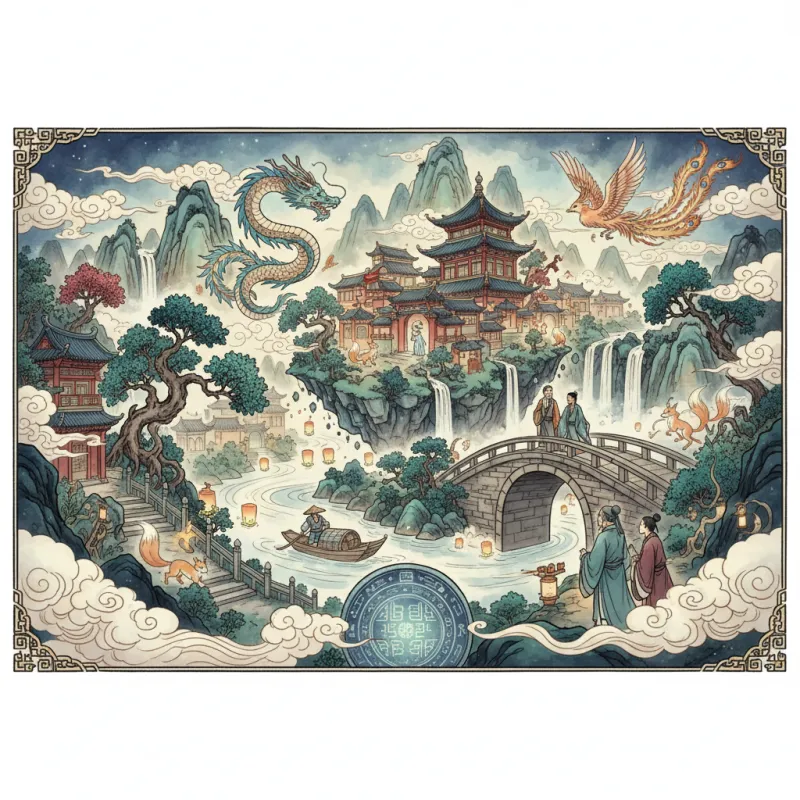
The old woman in the village square clutches a jade pendant, her weathered fingers tracing its surface as she whispers to the gathering children: "Never anger the fox spirits." Her eyes dart toward the hills where mist clings to ancient pines. This scene, repeated in countless variations across China for thousands of years, captures something essential about Chinese folklore—it's not dusty mythology locked in books, but living tradition that still shapes how people navigate the world between the seen and unseen.
The Architecture of Chinese Supernatural Belief
Chinese folklore operates on a fundamentally different logic than Western mythology. There's no clear divide between gods, ghosts, spirits, and immortals—instead, you get a fluid hierarchy where a virtuous human can become a deity, a neglected god might fade into obscurity, and even objects can cultivate consciousness. This cosmology, deeply influenced by Daoism, Buddhism, and folk religion, creates what scholars call "religious syncretism"—a beautiful mess where the Jade Emperor (玉皇大帝, Yù Huáng Dàdì) presides over a celestial bureaucracy that mirrors earthly government, complete with paperwork and petty corruption.
The concept of xian (仙, xiān)—often translated as "immortal" but more accurately meaning "transcendent being"—illustrates this fluidity perfectly. In Journey to the West (西游记, Xī Yóu Jì), written by Wu Cheng'en during the Ming Dynasty (1368-1644), Sun Wukong the Monkey King literally eats his way off the death registers, achieving immortality through a combination of Daoist alchemy, Buddhist scripture-stealing, and sheer audacity. The novel treats immortality not as a divine gift but as something that can be hacked, stolen, or earned through cultivation—a very Chinese approach to the supernatural.
Fox Spirits and Shape-Shifters: The Seductive Danger
If there's one creature that dominates Chinese supernatural fiction, it's the huli jing (狐狸精, húli jīng)—the fox spirit. These beings, typically depicted as beautiful women who seduce scholars and drain their life force, appear in everything from Tang Dynasty (618-907) classical tales to modern television dramas. But reducing them to simple villains misses their complexity. Pu Songling's 17th-century masterwork Strange Tales from a Chinese Studio (聊斋志异, Liáo Zhāi Zhì Yì) presents fox spirits as morally ambiguous figures—some malevolent, others loyal lovers more faithful than human wives.
The fox spirit phenomenon reveals deep anxieties about female sexuality, social mobility, and the dangers of desire. In traditional Chinese society, where marriages were arranged and women's movements restricted, the fox spirit represented everything forbidden: sexual agency, supernatural power, and the ability to cross social boundaries. The typical story follows a predictable arc—a young scholar encounters a beautiful woman, they fall in love, he discovers she's a fox spirit, and tragedy ensues. Yet Pu Songling often subverts this formula, creating fox characters with genuine emotions and moral depth. The story "Xiao Cui" features a fox spirit who helps a wronged woman seek justice, while "Ying Ning" presents a fox-woman whose innocent laughter and joy make her more human than the rigid society around her.
The supernatural beings of Chinese folklore rarely fit neat categories. Snake spirits, particularly white snake spirits like the famous Bai Suzhen (白素贞, Bái Sùzhēn) from The Legend of the White Snake, can be benevolent protectors. Cat spirits tend toward mischief rather than malevolence. Even ghosts operate on a spectrum—some seek revenge for injustice, others simply want proper burial rites performed.
The Bureaucracy of the Afterlife
Chinese conceptions of death and the afterlife might be the most elaborately bureaucratic in world mythology. The underworld isn't a single realm but a complex administrative system with ten courts, each presided over by a Yama King (阎罗王, Yánluó Wáng) who judges specific sins. Dead souls progress through these courts, receiving punishments tailored to their earthly transgressions before being sent to reincarnation. The entire system, documented in texts like the Jade Record (玉历宝钞, Yù Lì Bǎo Chāo), reads like a cosmic civil service manual.
This bureaucratic afterlife reflects the Confucian emphasis on social order and proper conduct. You can't bribe your way out of hell—well, actually you can, through merit accumulated by living descendants who perform rituals and burn paper money on your behalf. This creates an ongoing relationship between the living and dead that's fundamentally transactional. During Qingming Festival, families don't just honor ancestors; they're maintaining crucial supernatural connections that benefit both parties.
The concept of yuanhun (冤魂, yuānhún)—wronged ghosts who died unjustly—adds another layer. These spirits can't move on until their grievances are addressed, often appearing to the living to demand justice. Classical Chinese literature overflows with tales of murdered women returning as ghosts to expose their killers, or executed innocents haunting corrupt officials. The ghost story becomes a vehicle for social criticism, a way to discuss injustice when direct criticism might be dangerous.
Dragons, Phoenixes, and the Politics of Mythical Beasts
The Chinese dragon (龙, lóng) bears little resemblance to its Western counterpart. Rather than hoarding gold and terrorizing villages, Chinese dragons control weather, guard waterways, and symbolize imperial authority. The Dragon King (龙王, Lóng Wáng) rules the seas from crystal palaces, commanding armies of aquatic creatures. In Journey to the West, the Dragon Kings are powerful but ultimately subordinate to the Jade Emperor—even divine beings must respect hierarchy.
The phoenix (凤凰, fènghuáng) represents the empress and feminine power, but it's not the fire-bird of Western mythology. Chinese phoenixes are composite creatures with features from multiple birds, appearing only during times of peace and prosperity. The pairing of dragon and phoenix symbolizes the emperor and empress, yin and yang, the cosmic balance that maintains universal order.
Lesser-known creatures reveal even more about Chinese cosmology. The qilin (麒麟, qílín), often called a "Chinese unicorn," appears to herald the birth of great sages. The bixie (辟邪, bìxié) wards off evil spirits. The taotie (饕餮, tāotiè), a gluttonous monster face that appears on ancient bronzes, serves as both warning and protection. Each creature occupies a specific niche in the supernatural ecosystem, with defined powers and limitations.
The Cultivation of Immortality
Daoist immortality practices, called xiuxian (修仙, xiūxiān) or cultivation, form the backbone of countless Chinese supernatural tales. The basic premise: through meditation, alchemy, martial arts, and moral cultivation, humans can transcend mortality and gain supernatural powers. This isn't metaphorical—classical texts describe specific techniques for absorbing cosmic energy, refining internal elixirs, and achieving physical transformation.
The wuxia (武侠, wǔxiá) genre, exemplified by authors like Jin Yong and Gu Long, takes these concepts and runs wild with them. Martial artists cultivate internal energy (qi, 气, qì) to perform impossible feats—walking on water, flying through the air, projecting force from their palms. The line between martial arts and magic blurs completely. In Jin Yong's The Return of the Condor Heroes, the protagonist Yang Guo masters the "Overwhelming Sorrow Palm," a technique so powerful it can only be performed by someone experiencing genuine heartbreak. Emotion becomes weapon; cultivation becomes character development.
Modern xianxia (仙侠, xiānxiá) novels and web series have systematized cultivation into elaborate progression systems with defined realms and power levels, but the core concept remains ancient. The Zhuangzi, written in the 4th century BC, already describes immortals who "ride the clouds and mist, mount the sun and moon, and wander beyond the four seas." Chinese supernatural fiction has always been interested in the mechanics of transcendence—not just that it's possible, but how it works.
Festivals and the Supernatural Calendar
The Chinese calendar structures supernatural activity as much as human life. The Ghost Month (鬼月, guǐ yuè), the seventh lunar month, sees the gates of the underworld open and spirits roam freely. During this time, people avoid swimming (water ghosts might drag you down), don't whistle at night (attracts wandering spirits), and make offerings to appease hungry ghosts. The Ghost Festival (中元节, Zhōngyuán Jié) on the 15th day involves elaborate rituals to feed and comfort these displaced souls.
The Winter Solstice (冬至, Dōngzhì) marks the peak of yin energy, when the boundary between worlds grows thin. New Year celebrations involve not just family reunions but also supernatural housekeeping—cleaning to sweep out bad luck, posting door gods to ward off evil spirits, setting off firecrackers to scare away monsters. The Kitchen God (灶神, Zàoshén) ascends to heaven to report on the family's behavior, so people smear honey on his image to sweeten his words.
These aren't quaint customs but active engagement with supernatural forces. Even in modern Chinese cities, you'll find people burning incense at small shrines, consulting fortune tellers before major decisions, and carefully observing taboos around death and spirits. The supernatural isn't separate from daily life—it's woven into the fabric of existence.
The Living Tradition
What makes Chinese folklore remarkable isn't just its age or complexity, but its continued vitality. New supernatural stories emerge constantly, adapting ancient tropes to modern contexts. Urban legends about ghost encounters in subway stations coexist with thousand-year-old tales. Video games and web novels create elaborate cultivation systems that millions follow obsessively. The 2019 animated film Ne Zha reimagined a classical deity for contemporary audiences, becoming one of China's highest-grossing films ever.
This isn't preservation—it's evolution. The fox spirit who once seduced Tang Dynasty scholars now appears in romantic comedies. The Monkey King who rebelled against heaven becomes a symbol of resistance against authority. Ancient supernatural beliefs adapt to modern skepticism, finding new forms and meanings while maintaining their essential character. The old woman in the village square still warns children about fox spirits, but now those children might go home and watch a television drama where the fox spirit is the sympathetic protagonist.
Chinese folklore doesn't belong to the past. It's a living, breathing tradition that continues to shape how people understand the world, navigate uncertainty, and imagine possibilities beyond the mundane. The mysteries it unveils aren't just about ancient beliefs—they're about the enduring human need to populate the world with meaning, to see patterns in chaos, and to believe that reality contains more than what we can touch and measure.
Related Reading
- Chinese Horror Films: A Genre Guide
- Chinese Astrology: Stars, Stems, and Branches Decoded
- Chinese Fortune Telling: Ancient Methods Still Used Today
- Chinese Supernatural Fiction: From Liaozhai to Modern Web Novels
- Chinese Ghost Stories: Tales from the Supernatural Tradition
- The Sacred Mountains of China: Where Heaven Meets Earth
- Enchanting Chinese Mountain Legends: Myths, Mysteries, and Cultural Heritage
- Wu Wei: The Taoist Art of Doing Nothing (and Getting Everything Done)
Explore Chinese Culture
- Explore feng shui in daily life
- Explore supernatural folklore
- Explore classical Chinese literature