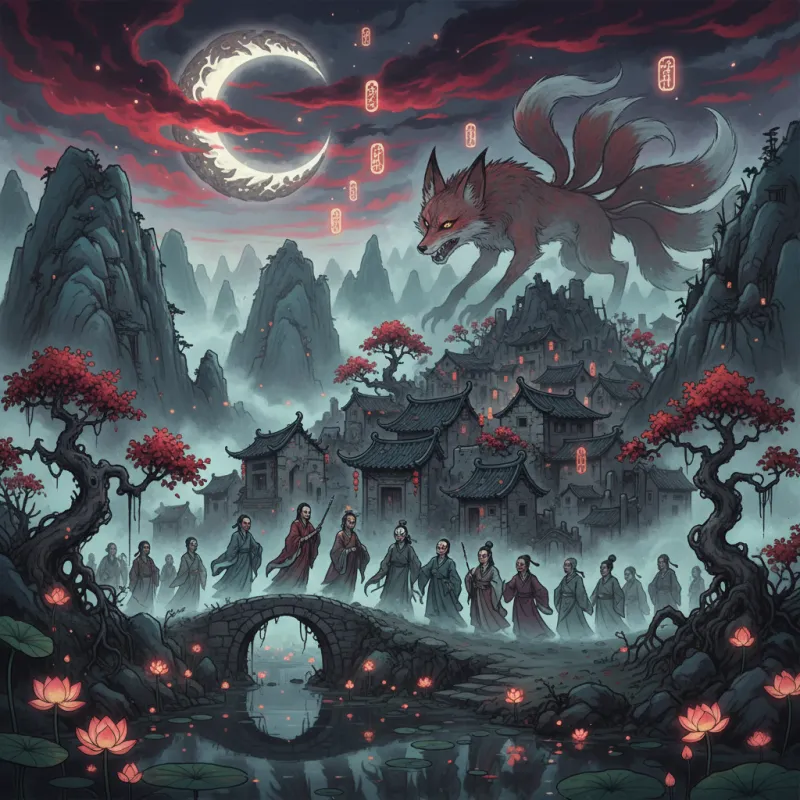
The camera lingers on a woman in a red dress standing at the edge of a well. She doesn't move. She doesn't blink. And when she finally turns toward you, her face is paper-white, her eyes black voids. If you've seen a Chinese horror film from the past two decades, you know this image. But what you might not know is that this ghost — the vengeful woman in red — can't legally exist in mainland China. Since 2008, Chinese censorship has banned ghosts from appearing in films unless they're explained away as hallucinations or dreams by the final credits. In a country with thousands of years of ghost stories, from the fox spirits of Strange Tales from a Chinese Studio (聊斋志异, Liáozhāi Zhìyì) to the hungry ghosts of Buddhist tradition, horror filmmakers face an impossible task: make horror films without the supernatural.
The Censorship Problem and the Three Chinas
Chinese horror isn't one tradition — it's three, split by politics and geography. Mainland China operates under strict censorship that bans superstition (迷信, míxìn) as ideologically harmful. Hong Kong, with its separate legal system until recently, developed a wild, anything-goes horror scene in the 1980s and 90s. Taiwan carved out its own path, blending folk religion with Japanese horror influences. Understanding Chinese horror means understanding these divisions.
The mainland's restrictions have forced filmmakers into psychological horror territory. Films like The Locker (2004) and Mysterious Island (2011) set up supernatural premises but always pull back with rational explanations. A ghost? No, just trauma-induced hallucination. A curse? Actually a serial killer with a pattern. It's horror with a safety net, and it shows. The genre has largely moved to streaming platforms where oversight is lighter, though still present.
Hong Kong, by contrast, gave us the golden age of Chinese horror. The Mr. Vampire (僵尸先生, Jiāngshī Xiānsheng) series starting in 1985 turned the hopping vampire (僵尸, jiāngshī) into a cultural icon — a Qing dynasty corpse that moves by hopping, arms outstretched, repelled by sticky rice and Taoist talismans. These films were horror-comedies that took folk beliefs seriously while having fun with them. Director Ringo Lam's Esprit D'amour (1983) and the A Chinese Ghost Story (倩女幽魂, Qiànnǚ Yōuhún) trilogy (1987-1991) showed that Chinese ghost stories could work on screen with the right mix of romance, action, and genuine scares.
The Jiangshi: China's Signature Monster
If Western horror has vampires and zombies, Chinese horror has the jiangshi. But calling it a "Chinese vampire" misses the point entirely. The jiangshi is a reanimated corpse, yes, but it's powered by qi (气, qì) — life energy — that's trapped in the body after death. It doesn't drink blood; it drains life force. It doesn't bite necks; it strangles victims. And most distinctively, it moves by hopping because rigor mortis has locked its limbs.
The jiangshi's appearance is specific: Qing dynasty official robes, a yellow talisman (符, fú) stuck to its forehead, arms extended forward, face painted corpse-white. This image comes from actual Qing dynasty funeral practices, where corpse carriers would transport bodies back to their ancestral homes for burial. The carriers used bamboo poles, and the bodies would bounce with each step — creating the hopping motion. The yellow talisman represents Taoist magic used to control the corpse during transport.
What makes the jiangshi fascinating is how it reflects Chinese attitudes toward death and the body. Unlike Western vampires, which are often sexualized and seductive, the jiangshi is purely horrific — a body that should be at rest but isn't. It represents the fear that improper burial or unresolved business will trap the soul. The Taoist priest character who appears in jiangshi films, armed with talismans and peach wood swords, isn't just a ghost hunter — he's performing actual religious functions that audiences would recognize from funerals and temple rituals.
Hong Kong's Golden Age: 1980s-1990s
The 1980s Hong Kong horror boom happened because of a perfect storm: a thriving film industry, minimal censorship, and directors willing to push boundaries. These weren't art films — they were commercial products made quickly and cheaply, often shooting multiple films simultaneously. But within that commercial framework, filmmakers created something genuinely innovative.
A Chinese Ghost Story (1987), produced by Tsui Hark and directed by Ching Siu-tung, remains the high-water mark. It adapted a story from Liáozhāi Zhìyì about a scholar who falls in love with a ghost, but added wire-fu action sequences, elaborate special effects, and a tone that shifted from romance to comedy to genuine horror within single scenes. The ghost Nie Xiaoqian (played by Joey Wong) became iconic — beautiful but trapped, forced to seduce men for a tree demon. The film spawned two sequels and countless imitators, but none captured the same magic.
The Mr. Vampire series took a different approach, playing jiangshi horror for laughs while respecting the underlying folklore. The films featured Taoist priest Lam Ching-ying as a stern master training bumbling disciples in vampire-hunting techniques. The comedy came from the disciples' incompetence and the elaborate rules for dealing with jiangshi: hold your breath so they can't sense you, use sticky rice to neutralize their poison, draw talismans with chicken blood. These weren't made-up rules — they came from actual folk beliefs, which gave the films an authenticity that Western audiences might miss.
But Hong Kong horror could also go dark. The Untold Story (1993) starring Anthony Wong as a restaurant owner who murders his family and serves them to customers pushed into Category III (adults only) territory. Dumplings (2004), part of the Three... Extremes anthology, featured a woman who stays young by eating dumplings made from aborted fetuses. These films showed that Chinese horror could be as transgressive as anything from Japan or Korea.
Taiwan's Folk Horror and the Lingchi Tradition
Taiwan developed its own horror identity, drawing heavily on local folk religion and indigenous traditions. The island's horror films often feature temples, spirit mediums, and the complex relationship between the living and dead that characterizes Taiwanese religious practice. Films like The Tag-Along (红衣小女孩, Hóngyī Xiǎonǚhái, 2015) and its sequels tap into local urban legends — in this case, the "little girl in red" who appears in hiking videos and photographs, a spirit that lures people into the mountains.
What distinguishes Taiwanese horror is its treatment of folk religion as real and functional, not superstition. Characters consult spirit mediums, perform elaborate rituals, and visit temples for protection — and these methods work within the film's logic. This reflects Taiwan's religious landscape, where temples are everywhere and folk practices coexist comfortably with modern life. The horror comes not from the supernatural existing, but from people failing to show proper respect or breaking taboos.
The Detention (返校, Fǎnxiào, 2019) film, adapted from a video game, took a different approach by setting its horror during Taiwan's White Terror period (1949-1987), when martial law suppressed political dissent. The ghosts in Detention are victims of political persecution, and the horror is as much historical as supernatural. This willingness to use horror to process historical trauma marks some of the most interesting recent Chinese-language horror.
The J-Horror Influence and the Long-Haired Ghost
Chinese horror didn't develop in isolation. The success of Japanese horror films like Ring (1998) and Ju-on: The Grudge (2002) had massive influence across Asia. The image of the female ghost with long black hair covering her face, dressed in white, became ubiquitous in Chinese horror. But this wasn't purely imitation — it connected to existing Chinese ghost traditions.
The female ghost in white (白衣女鬼, báiyī nǚguǐ) has deep roots in Chinese folklore. White is the color of mourning and death in Chinese culture, so a woman in white immediately signals ghost. The long hair relates to the belief that hair continues growing after death and that ghosts of women who died with grievances often appear with disheveled hair. The specific image of hair covering the face may have been popularized by J-horror, but it resonated because it fit existing iconography.
Films like The Eye (见鬼, Jiàn Guǐ, 2002) from Hong Kong's Pang Brothers showed how Chinese filmmakers could adapt J-horror techniques while maintaining their own cultural specificity. The film's premise — a blind woman receives an eye transplant and starts seeing ghosts — could work in any culture, but the specific ghosts she sees and the methods used to deal with them are distinctly Chinese. The film was successful enough to spawn two sequels and an American remake.
Mainland China's Workarounds and Streaming Era
Mainland filmmakers have gotten creative with censorship restrictions. One approach is the "it was all a dream" ending, where supernatural events are revealed as hallucinations or nightmares. Another is setting films in the past, particularly the Republican era (1912-1949), when "people believed in superstition" — allowing ghosts to appear as historical artifacts rather than present-day reality. A third approach is making the supernatural explicitly fake within the film's world, as in Zhong Kui: Snow Girl and the Dark Crystal (钟馗伏魔:雪妖魔灵, 2015), which frames its ghost story as mythology rather than reality.
The rise of streaming platforms has opened new possibilities. Web films (网络电影, wǎngluò diànyǐng) face lighter censorship than theatrical releases, and horror is one of the most popular genres. These films are often low-budget and formulaic, but they've created space for supernatural content that wouldn't pass theatrical censorship. The quality varies wildly, but films like The Rope Curse (粽邪, Zòng Xié, 2018) have found audiences by delivering straightforward ghost stories without the mandatory rational explanations.
Some mainland directors have simply moved production to Hong Kong or Taiwan, or partnered with studios there. This allows them to make the films they want while still accessing mainland audiences through streaming or limited theatrical releases. It's a fragmented system, but it's kept Chinese horror alive despite the restrictions.
What Makes Chinese Horror Different
Chinese horror operates on different rules than Western horror. The supernatural isn't random or chaotic — it follows specific laws based on karma, proper burial, and the relationship between the living and dead. Ghosts typically have reasons for haunting: they died unjustly, weren't buried properly, or have unfinished business. This means Chinese horror often has a moral dimension. The ghost isn't evil; it's wronged. Resolution comes not from destroying the ghost but from addressing the injustice.
This connects to Chinese religious and philosophical traditions. Buddhism teaches that actions have consequences across lifetimes. Confucianism emphasizes proper ritual and respect for ancestors. Taoism provides the magical tools — talismans, rituals, exorcisms — for dealing with supernatural problems. Chinese horror films draw on all three traditions, creating a cosmology where the supernatural is real, follows rules, and can be negotiated with.
The emphasis on family and ancestors also shapes Chinese horror. Many ghost stories involve family members returning from death, or curses that span generations. The horror comes from the breakdown of proper family relationships — a parent who failed their child, a child who didn't honor their parents, a spouse who betrayed their partner. Western horror often features strangers or random victims; Chinese horror is more likely to be about people connected by blood or obligation.
The Future: Streaming, International Co-Productions, and Genre Blending
Chinese horror is evolving rapidly. International co-productions are becoming more common, bringing Chinese ghost stories to global audiences while incorporating international production values and techniques. Films like The Bridge Curse (女鬼桥, Nǚguǐ Qiáo, 2020) from Taiwan have found international festival audiences. Streaming platforms like Netflix are investing in Chinese-language horror content, creating opportunities for filmmakers to reach beyond traditional distribution channels.
Genre blending is another trend. Horror-comedy remains popular, but we're also seeing horror mixed with action, romance, and even historical drama. Shadow (影, Yǐng, 2018), while not strictly horror, incorporated ghost story elements into a wuxia framework. The Yin-Yang Master: Dream of Eternity (侍神令, Shì Shén Lìng, 2021) blended fantasy, romance, and horror in a big-budget package aimed at mainstream audiences.
The censorship situation in mainland China remains restrictive, but filmmakers continue finding workarounds. As long as there's audience demand — and Chinese audiences have shown consistent interest in horror content — the genre will survive. Hong Kong and Taiwan will likely continue producing more traditional supernatural horror, while mainland filmmakers push the boundaries of what's permissible. The result is a horror tradition that's fragmented but vital, constrained but creative, and deeply rooted in one of the world's richest ghost story traditions.
For viewers interested in exploring Chinese horror, the path leads through multiple traditions and eras. Start with the Hong Kong classics of the 1980s and 90s to understand the genre's commercial peak. Explore Taiwan's folk horror for a different take on supernatural themes. Sample mainland streaming horror to see how filmmakers work within restrictions. And throughout, remember that Chinese horror isn't trying to be Western horror with Chinese characteristics — it's its own tradition, with its own rules, monsters, and meanings. The woman in red at the well isn't just a scary image; she's the latest iteration of ghost stories that stretch back thousands of years, adapted for cinema but still carrying the weight of that long tradition.
Related Reading
- Chinese Ghost Stories: Tales from the Supernatural Tradition
- Unveiling the Mysteries of Chinese Folklore: Legends and Cultural Traditions
- Chinese Supernatural Fiction: From Liaozhai to Modern Web Novels
- Chinese Astrology: Stars, Stems, and Branches Decoded
- Chinese Fortune Telling: Ancient Methods Still Used Today
- Chinese Internet Culture: Memes, Slang and Digital Life
- The Silk Road: How Trade Routes Shaped Chinese Culture
- Ancient Towns of China Worth Visiting
Explore Chinese Culture
- Explore feng shui in daily life
- Explore supernatural folklore
- Explore classical Chinese literature