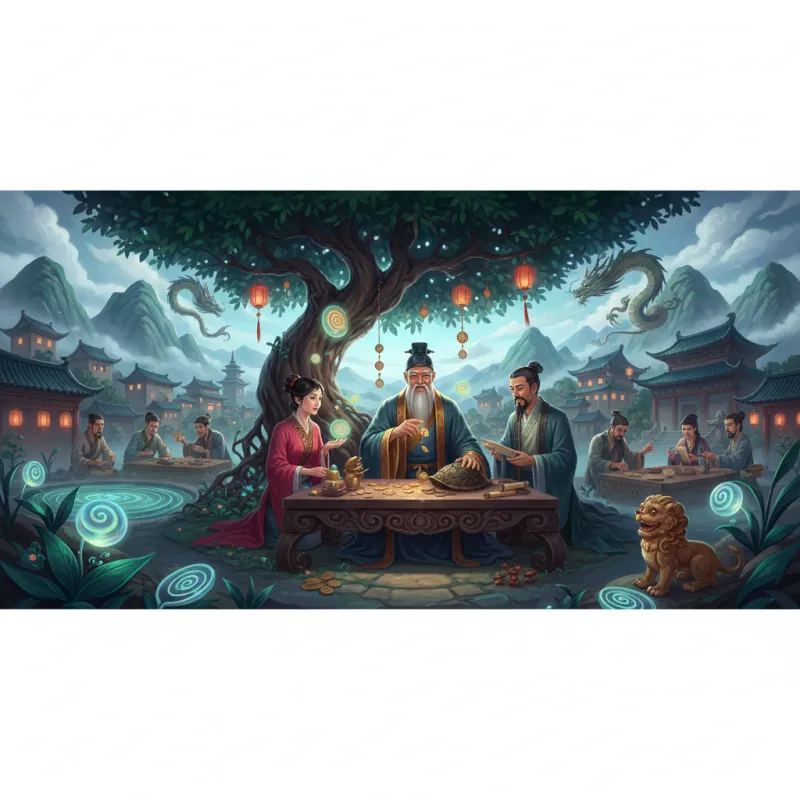
A middle-aged woman in a Shenzhen shopping mall sits across from a man who's never met her before. Within minutes, he's describing her childhood home, her relationship with her father, and the career setback she experienced three years ago. She hasn't said a word beyond her birth date and time. This isn't a magic trick or cold reading — it's 八字 (Bāzì, "Eight Characters"), one of China's most sophisticated fortune-telling systems, and it's having a renaissance in the age of smartphones and AI.
The Persistence of Ancient Calculation
Chinese fortune telling — 算命 (Suànmìng, literally "calculating fate") — operates on a premise that would make Western rationalists uncomfortable: that the moment of your birth encodes your entire life trajectory in a readable format. Unlike the vague predictions of newspaper horoscopes, traditional Chinese divination systems are deterministic, mathematical, and shockingly specific. They don't just predict "good fortune" — they'll tell you which year you'll get promoted, which direction your ideal spouse will come from, and whether you should avoid water-related businesses.
The sophistication of these systems explains their survival. 八字 analysis, for instance, converts your birth time into eight characters based on the sexagenary cycle (天干地支, Tiāngān Dìzhī), then analyzes the interactions between five elements (五行, Wǔxíng) — Wood, Fire, Earth, Metal, and Water — to map your personality, health vulnerabilities, career aptitudes, and relationship patterns. It's not mysticism; it's a complex interpretive framework that took centuries to develop and requires years to master.
What's remarkable isn't that people believed this in ancient times — it's that they still do. A 2018 survey found that over 60% of Chinese millennials had consulted fortune tellers, and the industry generates an estimated 20 billion yuan annually. Tech entrepreneurs in Beijing, doctors in Shanghai, factory owners in Guangzhou — they're all quietly visiting diviners before major life decisions. The practice has simply moved from temple courtyards to WeChat consultations.
Face Reading: The Original Profiling System
麻衣相法 (Máyī Xiāngfǎ, "Hemp-Robed Monk's Face Reading Method"), attributed to a semi-legendary Song Dynasty master, claims that facial features reveal character and destiny with the precision of a fingerprint. The forehead indicates early life and relationship with parents. The area around the eyes shows middle age and career success. The chin and jaw reveal old age and legacy. Specific features carry specific meanings: thick earlobes suggest wealth accumulation, a prominent nose bridge indicates strong willpower, and the "dragon horn bone" (龙角骨, Lóngjiǎo Gǔ) — a subtle protrusion at the temples — supposedly marks natural leaders.
Before you dismiss this as pseudoscience, consider that face reading was essentially China's first systematic attempt at personality psychology. Modern research has actually validated some correlations between facial structure and behavior — testosterone levels do affect facial width and risk-taking behavior, for instance. The ancient practitioners were observing real patterns; they just lacked the vocabulary of hormones and genetics to explain them.
Professional face readers today often work in business contexts, advising on hiring decisions or partnership compatibility. One Hong Kong practitioner I spoke with consults for a venture capital firm, providing "cultural due diligence" on potential investments. He doesn't call it fortune telling — he calls it "traditional Chinese human resource assessment." The rebranding is strategic, but the method is identical to what practitioners used 800 years ago.
Palmistry: Your Life in Your Hands
手相 (Shǒuxiàng, palm reading) operates on similar principles to face reading but focuses on the lines, mounts, and shapes of the hands. The three major lines — life, head, and heart — supposedly reveal longevity, intelligence, and emotional capacity. But traditional Chinese palmistry goes far deeper, analyzing dozens of minor lines, the flexibility of joints, the spacing between fingers, and even the texture of skin.
The system distinguishes between 先天 (Xiāntiān, "pre-heaven" or innate) characteristics shown in the left hand and 后天 (Hòutiān, "post-heaven" or acquired) characteristics in the right hand. This built-in acknowledgment that destiny can be modified through action is philosophically sophisticated — it's not pure determinism but a negotiation between fate and free will.
What makes Chinese palmistry particularly interesting is its integration with traditional medicine. The same meridian theory that underlies acupuncture informs palm reading. Certain areas of the hand correspond to specific organs, and changes in those areas supposedly indicate health issues before symptoms appear. Some modern practitioners have reframed their practice as "preventive health consultation," and there's actually some medical validity to examining hands for signs of disease — clubbed fingernails can indicate heart or lung problems, for instance.
The I Ching: Divination for Intellectuals
易经 (Yìjīng, the Book of Changes) occupies a unique position in Chinese culture — it's simultaneously a divination manual and a philosophical text so profound that Confucius supposedly studied it until his binding cords broke three times. The method involves generating hexagrams (six-line figures) through coin tosses or yarrow stalk manipulation, then interpreting the results through layers of symbolic meaning.
What distinguishes I Ching divination from other methods is its intellectual respectability. You can consult the I Ching and still consider yourself a rationalist because the text doesn't claim to predict the future — it claims to reveal the underlying dynamics of your current situation. The hexagrams are essentially sophisticated metaphors, and the interpretation process forces you to think deeply about your circumstances from multiple angles.
Carl Jung was obsessed with the I Ching, writing a famous introduction to the Wilhelm translation and developing his theory of synchronicity partly to explain how it seemed to work. Modern users range from business strategists seeking decision-making frameworks to artists looking for creative inspiration. There's even a Silicon Valley subculture of I Ching enthusiasts who treat it as an ancient algorithm for navigating complexity.
The practice connects to broader Chinese concepts of cosmic harmony and the constant flux between opposing forces. Unlike Western divination systems that try to predict specific events, the I Ching focuses on understanding processes and timing — when to advance, when to retreat, when to wait.
Feng Shui: Arranging Space, Arranging Fate
风水 (Fēngshuǐ, literally "wind-water") is probably the Chinese divination practice most familiar to Westerners, though usually in a watered-down form focused on interior decoration. Authentic 风水 is far more complex — it's a system for analyzing how the flow of 气 (Qì, vital energy) through a space affects the people who occupy it.
The two main schools — 形势派 (Xíngshì Pài, Form School) and 理气派 (Lǐqì Pài, Compass School) — use different methods but share the same goal: optimizing the relationship between humans and their environment. Form School analyzes the physical landscape, looking at mountain formations, water flow, and building orientations. Compass School uses the 罗盘 (Luópán, a specialized compass with multiple rings of information) to calculate the directional energies affecting a site based on time and space coordinates.
Hong Kong's skyline is essentially a 风水 battlefield. The HSBC building has two maintenance cranes permanently mounted on its roof, positioned like cannons aimed at the Bank of China tower, whose sharp angles were considered aggressive 风水 attacks. The Bank of China responded by angling its edges away from Government House. These aren't decorative choices — they represent millions of dollars spent on 风水 consultations by some of the world's most hard-nosed businesspeople.
The practice has evolved to address modern concerns. Contemporary 风水 masters analyze electromagnetic fields from electronics, air quality from HVAC systems, and even the psychological effects of architectural design. Some have essentially become environmental psychologists who happen to use traditional Chinese terminology.
Divination Blocks and Spirit Writing
For quick yes-or-no questions, many Chinese people turn to 筊杯 (Jiǎobēi, divination blocks) — crescent-shaped wooden or bamboo pieces thrown to receive answers from deities or ancestors. The blocks have a flat side and a rounded side; different combinations indicate different responses. Two flat sides up means "no," two rounded sides means the deity is laughing at your question, and one of each means "yes."
I've watched elderly women in Taipei temples throw these blocks dozens of times, refining their questions until they get a clear answer. The practice isn't passive fortune-telling — it's an active dialogue with the divine, and the question formulation process itself often leads to clarity.
扶乩 (Fújī, spirit writing) takes this communication further. A medium enters a trance state and writes messages from deities or deceased spirits, often in classical Chinese that the medium supposedly doesn't know when conscious. During the Qing Dynasty, spirit writing was used for everything from medical diagnoses to military strategy. The Taiping Rebellion, which killed 20-30 million people, was partly inspired by messages received through spirit writing.
Modern spirit writing has largely moved underground due to government restrictions, but it persists in temples and private religious communities. The practice connects to broader Chinese beliefs about ancestor veneration and the permeability of the boundary between living and dead.
The Fortune Teller's Dilemma
Here's the uncomfortable question that haunts all fortune-telling practices: if your fate is predetermined and readable, what's the point of knowing it? The Chinese answer is philosophically nuanced. Fate (命, Mìng) is fixed, but fortune (运, Yùn) fluctuates. You can't change your fundamental nature or major life trajectory, but you can optimize your path through timing, positioning, and behavior modification.
This explains why fortune-telling consultations typically end with recommendations: wear certain colors, avoid specific directions, choose particular career paths, marry someone with compatible elements. The divination reveals your constraints and opportunities; the recommendations help you navigate within those parameters. It's not about escaping fate but about achieving the best possible version of your predetermined life.
The modern fortune-telling industry has adapted to contemporary sensibilities. Many practitioners now frame their work as "life consulting" or "traditional wisdom counseling." They use tablets instead of ancient texts, offer video consultations, and accept payment through Alipay. But the underlying systems remain unchanged — the same 八字 calculations, the same 风水 principles, the same I Ching hexagrams that guided decisions centuries ago.
Whether these methods actually work is almost beside the point. They provide frameworks for decision-making, vocabularies for discussing personality and compatibility, and rituals for marking life transitions. In a rapidly changing society where traditional structures have collapsed and future uncertainty is high, these ancient systems offer something valuable: a sense that life follows patterns, that chaos has underlying order, and that someone, somewhere, might actually know what happens next.
Related Reading
- Chinese Astrology: Stars, Stems, and Branches Decoded
- Chinese Supernatural Fiction: From Liaozhai to Modern Web Novels
- Unveiling the Mysteries of Chinese Folklore: Legends and Cultural Traditions
- Chinese Ghost Stories: Tales from the Supernatural Tradition
- Chinese Horror Films: A Genre Guide
- Delving into Chinese Water Legends: Tales of Spirits and Serpents
- Unveiling Chinese Creation Myths: The Stories that Shaped a Civilization
- Mid-Autumn Festival: Mooncakes, Legends and Lunar Beauty
Explore Chinese Culture
- Explore feng shui in daily life
- Explore supernatural folklore
- Explore classical Chinese literature