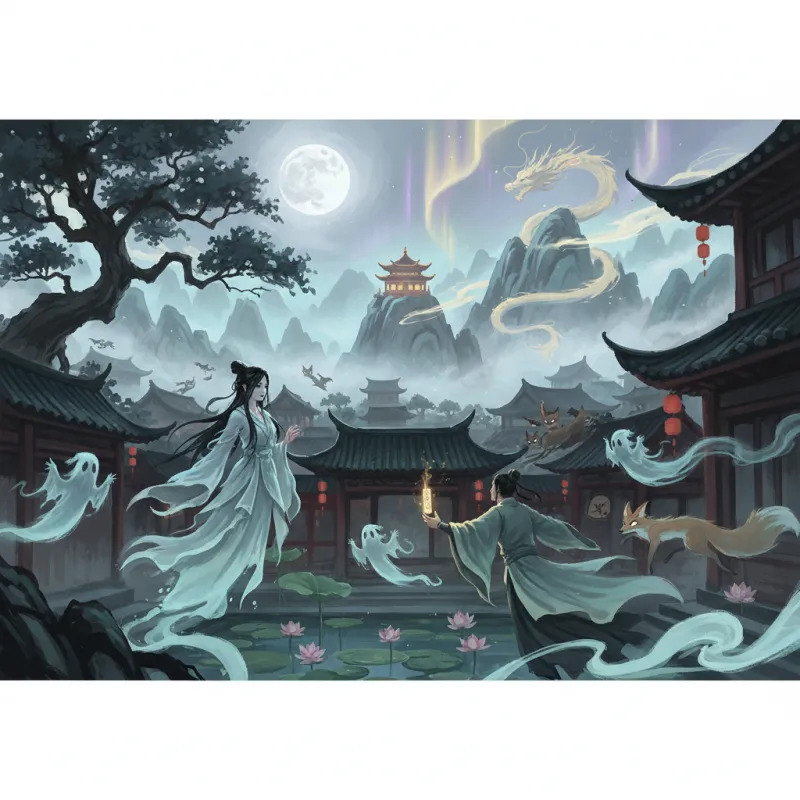
The scholar's lamp flickered as pale fingers slid through the paper window. But instead of screaming, he poured a second cup of wine. In Chinese ghost stories, this is how it begins — not with terror, but with hospitality. Because the dead, like the living, want something. And if you're clever enough to figure out what, you might survive the encounter. You might even fall in love.
The Ghost as Neighbor, Not Monster
Chinese ghost stories operate on fundamentally different metaphysics than their Western counterparts. In the Anglo-European tradition, ghosts are typically malevolent presences to be exorcised or fled. But in Chinese tradition, 鬼 (guǐ, ghosts/spirits) are complex beings with desires, grievances, personalities, and occasionally romantic inclinations. They can be terrifying — the 厉鬼 (lìguǐ, vengeful ghost) who died unjustly is genuinely dangerous. But they can also be sympathetic, seductive, funny, or wise. The Chinese supernatural world isn't primarily a horror genre; it's a parallel society with its own rules, hierarchies, and bureaucracies.
This difference stems from cosmology. In Chinese thought, death isn't an absolute boundary but a transition between states. The living world (阳间, yángjiān, the Yang realm) and the spirit world (阴间, yīnjiān, the Yin realm) exist in parallel, separated by a permeable membrane rather than an impenetrable wall. The dead maintain relationships with the living through ancestor veneration, festivals like Qingming, and sometimes through more direct encounters. A ghost isn't an aberration in the natural order — it's a person in a different state of being.
Pu Songling's Strange Tales: The Gold Standard
When people say "Chinese ghost stories," they usually mean 《聊斋志异》 (Liáozhāi Zhìyì, Strange Tales from a Chinese Studio), the 1740 collection by Pu Songling. This isn't just the most famous collection — it's the template that defined the genre for three centuries. Pu Songling was a failed scholar who spent his life writing about fox spirits, ghost brides, and supernatural examinations while never passing the imperial exams himself. The irony wasn't lost on him. His stories are populated by scholars who meet beautiful women who turn out to be ghosts or fox spirits, and the twist is that these supernatural beings are often more loyal, intelligent, and morally upright than their human counterparts.
Take "Nie Xiaoqian" (聂小倩), probably the most adapted story in Chinese cinema. A young scholar named Ning Caichen encounters a beautiful woman in a haunted temple. She's a ghost, yes, but she's being forced by a demon to lure men to their deaths. Instead of the expected horror scenario, it becomes a story about moral choice — Xiaoqian helps Ning escape and eventually finds redemption. The 1987 film "A Chinese Ghost Story" turned this into a action-romance-comedy that spawned countless imitators, but Pu Songling's original is more subtle: it's about how even the dead can choose virtue over survival.
Or consider "The Painted Skin" (画皮), which is genuinely horrifying. A demon wears the skin of a beautiful woman to seduce men, then literally eats their hearts. But the story's moral isn't "beware of beautiful women" — it's about the danger of ignoring wise counsel. The scholar's wife sees through the demon immediately, but he's too infatuated to listen. When a Taoist priest finally reveals the demon's true form — a hideous creature painting a new human skin — it's a visceral metaphor for vanity and self-deception.
The Fox Spirit: Shapeshifter and Social Critic
If ghosts are the dead with unfinished business, 狐狸精 (húlijīng, fox spirits) are something else entirely: animals who've cultivated supernatural powers through centuries of practice. They can shapeshift, usually into beautiful women, and they occupy a fascinating moral gray zone. Some fox spirits are malevolent seductresses who drain men's life force. Others are devoted lovers who help their human partners succeed. Many are simply trying to navigate a world that fears them.
The fox spirit stories are often the most subversive in Chinese literature. Because fox spirits exist outside human society, they can critique it. In Pu Songling's "Lotus Fragrance" (莲香), a fox spirit and a ghost compete for the same scholar's affection, but instead of fighting, they become friends and share him. It's a polyamorous arrangement that would be scandalous if proposed by human women, but because the characters are supernatural, Pu Songling can explore alternative relationship structures without directly challenging Confucian morality.
Fox spirits also appear in 《封神演义》 (Fēngshén Yǎnyì, Investiture of the Gods), the 16th-century novel where Daji, the fox spirit who possesses the last Shang dynasty empress, becomes the archetypal femme fatale. But even Daji is more complex than simple evil — she's following orders from the goddess Nüwa to destroy a corrupt dynasty. The misogyny is real (beautiful women as civilization-destroyers), but so is the political commentary about how rulers blame their failures on women's influence.
The Bureaucracy of the Afterlife
One of the most distinctive features of Chinese ghost stories is that the afterlife is organized like an imperial government. The 十殿阎罗 (shí diàn yánluó, Ten Courts of Hell) judge the dead, assign punishments, and determine reincarnation. There are clerks, runners, and corrupt officials who can be bribed. In "The Injustice to Dou E" (《窦娥冤》, Dòu É Yuān), a 13th-century play by Guan Hanqing, the wrongly executed Dou E becomes a ghost who petitions the celestial bureaucracy for justice. Her case goes through proper channels — ghostly channels, but channels nonetheless.
This bureaucratic afterlife reflects Chinese political reality. If the living world has corrupt officials, why wouldn't the dead world? In many stories, ghosts hire lawyers, file complaints, and navigate red tape. The 1991 film "A Chinese Ghost Story III" plays this for comedy, with ghost bureaucrats stamping forms and complaining about their workload. But the underlying idea is serious: justice is a process, not a given, and it requires persistence whether you're alive or dead.
The most famous bureaucratic ghost story is probably "The Peony Pavilion" (《牡丹亭》, Mǔdān Tíng), the 1598 opera by Tang Xianzu. Du Liniang dies of lovesickness, spends time in the underworld, and is eventually resurrected through the power of love and some creative paperwork. The King of Hell himself has to approve her return to life. It's romantic, yes, but it's also a story about how even cosmic forces can be negotiated with if you're determined enough.
Modern Ghosts: From Page to Screen
Chinese ghost stories didn't stop with the Qing dynasty. The 20th century brought new media and new anxieties. Eileen Chang's 1944 story "Aloeswood Incense: The First Brazier" features a ghost who's more psychological than supernatural — the haunting is internal, a manifestation of guilt and desire. Hong Kong cinema in the 1980s and 90s created a golden age of ghost films that blended traditional stories with modern special effects and contemporary concerns.
The 1987 "A Chinese Ghost Story" (《倩女幽魂》, Qiànnǚ Yōuhún) is the watershed moment. Director Ching Siu-tung took Pu Songling's "Nie Xiaoqian" and added wire-fu martial arts, comedy, and a Taoist swordsman sidekick. It shouldn't work — it's too many genres at once — but it does, because it understands that Chinese ghost stories were always genre-fluid. The film spawned two sequels, a TV series, an animated adaptation, and countless imitators. Leslie Cheung's performance as the hapless scholar Ning Caichen became iconic.
More recently, films like "The Eye" (2002) and "Rigor Mortis" (2013) have taken ghost stories in darker directions, influenced by Japanese horror but retaining distinctly Chinese elements. "Rigor Mortis" is particularly interesting — it's set in a Hong Kong housing estate and features elderly actors from classic jiangshi (hopping vampire) films playing versions of themselves. It's a meditation on aging, obsolescence, and how ghost stories themselves become ghosts when the culture that created them changes.
Why These Stories Endure
Chinese ghost stories persist because they address fundamental human concerns through supernatural metaphor. They're about justice (the wronged ghost seeking revenge), love (the ghost bride who's more faithful than living women), social criticism (the fox spirit who exposes hypocrisy), and the permeability of boundaries we pretend are absolute. Death, gender, human/animal, real/unreal — Chinese ghost stories suggest these categories are more fluid than we'd like to admit.
They're also deeply embedded in Chinese festival traditions and cultural practices. During Qingming and the Ghost Festival, the boundary between worlds thins, and the living make offerings to the dead. Ghost stories aren't just entertainment — they're instruction manuals for navigating a cosmos where the dead are always present, always watching, and sometimes still very much involved in family affairs.
The best Chinese ghost stories understand that the supernatural isn't separate from the natural — it's an extension of it. When the scholar pours that second cup of wine for the pale fingers sliding through his window, he's not being foolish. He's being civilized. Because in Chinese tradition, even ghosts deserve hospitality. Especially ghosts. You never know when you might need a favor from the other side.
Related Reading
- Chinese Astrology: Stars, Stems, and Branches Decoded
- Chinese Horror Films: A Genre Guide
- Chinese Fortune Telling: Ancient Methods Still Used Today
- Unveiling the Mysteries of Chinese Folklore: Legends and Cultural Traditions
- Gongfu Tea Ceremony Step by Step
- Exploring the Rich Tapestry of Chinese Folklore, Legends, and Fairy Tales
- Chinese Food Culture: What the World Gets Wrong About Chinese Cuisine
Explore Chinese Culture
- Explore feng shui in daily life
- Explore supernatural folklore
- Explore classical Chinese literature