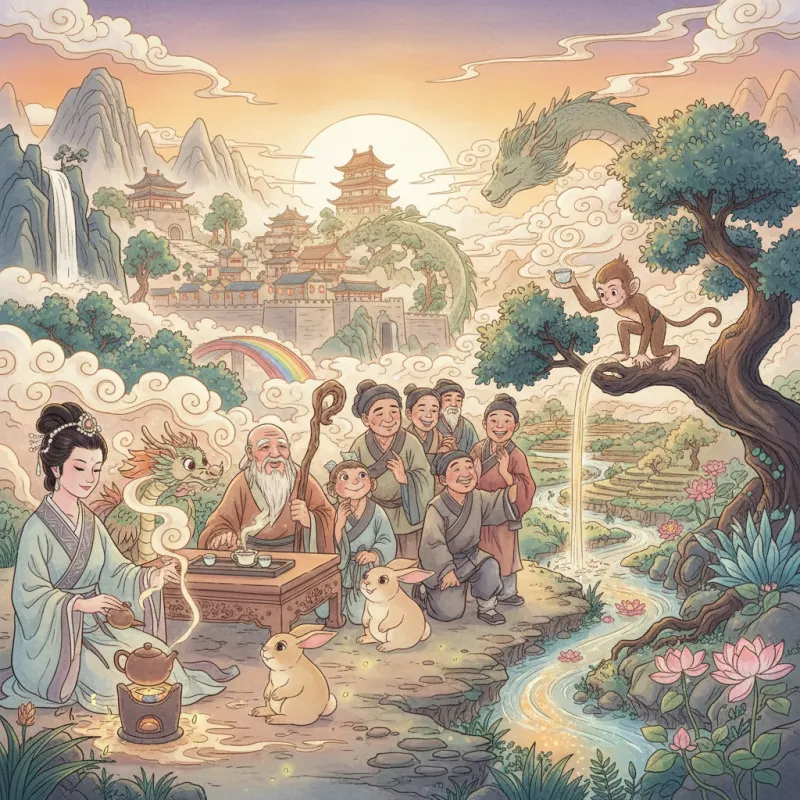
The teapot is smaller than your fist. The cups could hold maybe two sips if you're being generous. Your friend pours boiling water over everything — the pot, the cups, the tea tray itself — and you're wondering if this is some kind of elaborate prank. Welcome to gongfu tea, where less is more, waste is intentional, and that tiny pot is about to produce the best cup of tea you've ever tasted.
What Gongfu Tea Actually Is (And Isn't)
Let's clear something up immediately: gongfu tea (工夫茶, gōngfū chá) is not a ceremony. The Japanese have tea ceremony — sadō (茶道) — with its prescribed movements, seasonal flowers, and Zen philosophy. The Chinese have a brewing method. A very, very good brewing method.
The term 工夫 means "skill acquired through dedicated practice," the exact same characters used in kung fu (功夫). It's about technique, not ritual. You're not performing for the tea gods; you're extracting maximum flavor from expensive leaves using small vessels, high leaf-to-water ratios, and multiple quick infusions. The goal is simple: make the best possible tea.
This approach emerged in the Chaoshan (潮汕) region of Guangdong Province and the mountainous tea-growing areas of southern Fujian during the Ming Dynasty (1368-1644). These regions produced oolong teas so complex and aromatic that the standard "throw leaves in a big pot" method felt like using a sledgehammer to crack a walnut. Local tea merchants and connoisseurs developed gongfu brewing to showcase what their teas could actually do.
By the Qing Dynasty (1644-1912), gongfu tea had become the default brewing method for serious tea drinkers across southern China. The scholar Yuan Mei (袁枚) wrote in his 18th-century food memoir Suiyuan Shidan that tea "must be brewed in small pots to preserve its fragrance." He wasn't describing a ceremony. He was describing the only sensible way to brew good tea.
The Essential Equipment
You need surprisingly little to brew gongfu style, but what you use matters. Here's the actual setup:
Gaiwan (盖碗, gàiwǎn) or Yixing Teapot (宜兴茶壶, Yíxīng cháhú): The brewing vessel. A gaiwan is a lidded bowl, typically 100-150ml, made of porcelain. It's neutral, easy to clean, and works with any tea type. A Yixing teapot is made from purple clay (zǐshā, 紫砂) from Yixing in Jiangsu Province. The unglazed clay absorbs tea oils over time, "seasoning" the pot — which sounds romantic until you realize it means you can only use that pot for one type of tea forever. Oolong drinkers use Yixing pots. Everyone else uses gaiwans.
Fairness Pitcher (公道杯, gōngdào bēi): A small pitcher that holds the entire brew before distributing to cups. This ensures everyone gets tea of equal strength — hence "fairness." Without it, the first cup is weak and the last is bitter.
Tea Cups (品茗杯, pǐnmíng bēi): Tiny cups holding 20-40ml. Yes, really. You're not hydrating; you're tasting. The small volume lets the tea cool quickly to drinking temperature and forces you to pay attention to each sip.
Tea Tray (茶盘, chápán): A slatted tray with a water reservoir underneath. You'll be pouring water everywhere — over the pot, over the cups, onto the tray — and this catches it all. The wet-table style of gongfu tea looks wasteful until you understand it's about temperature control and cleanliness.
Kettle: Ideally electric with temperature control. Different teas need different water temperatures, and "boiling" is not a universal answer.
Tea Tools: Small tongs for handling hot cups, a tea pick for clearing the pot spout, a scoop for measuring leaves. Technically optional, but they make everything easier.
The entire setup fits on a tray the size of a laptop. This is tea brewing for small apartments and office desks, not palatial tea houses.
The Actual Steps (No Mysticism Required)
Here's how you brew gongfu tea, stripped of the performance aspects:
1. Heat Everything: Pour boiling water over your gaiwan or teapot, into the fairness pitcher, and into the cups. This preheats the vessels so they don't steal heat from your first infusion. Pour the water out. This isn't ceremonial; it's thermodynamics.
2. Add Tea Leaves: Use roughly one-third of your vessel's volume in dry leaves. This sounds insane if you're used to Western brewing (one teaspoon per cup), but gongfu brewing uses less water and shorter times. For a 100ml gaiwan, you're looking at 5-7 grams of tea. The leaves will expand dramatically, sometimes filling the entire vessel.
3. Rinse the Leaves: Pour hot water over the leaves, wait 5 seconds, and discard. This "awakens" compressed or rolled teas, washing off any dust and letting the leaves begin to unfurl. Some people skip this step for delicate teas like green tea. I always do it — the first infusion is never the best anyway.
4. First Infusion: Pour water over the leaves, cover, and wait. Time varies by tea type: 10-20 seconds for oolong, 5-10 seconds for green tea, 10-15 seconds for black tea, 20-30 seconds for aged pu-erh. You're not steeping; you're extracting. Pour everything into the fairness pitcher, then distribute to cups. The pot should be completely empty.
5. Subsequent Infusions: Repeat immediately. Don't let the leaves sit dry between infusions. Each brew should be slightly longer than the last — add 5-10 seconds each time. Good tea can handle 6-10 infusions easily. Great tea can go 15 or more, with the flavor evolving throughout.
6. Adjust as You Go: If an infusion tastes weak, increase the time. If it's bitter, decrease it. The beauty of gongfu brewing is the immediate feedback loop. You're not committing to a single large pot; you're making micro-adjustments every 30 seconds.
The whole process is fast. From heating the vessels to finishing your first cup takes maybe three minutes. Each subsequent infusion takes 30 seconds. This isn't a meditative practice that requires clearing your schedule. It's a practical brewing method that happens to produce exceptional tea.
Why This Method Works
The gongfu approach solves several problems with standard Western brewing:
Temperature Control: Small vessels cool quickly, so you can use properly hot water without scalding your mouth. Large pots stay hot forever, forcing you to either wait or burn your tongue.
Flavor Evolution: Tea leaves don't release all their compounds at once. The first infusion extracts the most volatile aromatics. The second brings out sweetness. The third develops body. By the fifth, you're getting the deep, mineral base notes. A single long steep in a big pot gives you all of this at once — a muddled average instead of a progression.
Leaf-to-Water Ratio: Using more leaves and less water means you're tasting tea, not hot leaf water. The concentration is higher, the flavors are clearer, and you can actually discern what you're drinking.
No Bitterness: Short infusions prevent over-extraction of tannins. Even robust black teas stay smooth. This is why gongfu brewing works for teas that turn astringent with Western methods.
The technique also reveals tea quality instantly. Bad tea can't hide behind milk and sugar when you're brewing it this way. This is why tea merchants in China always use gongfu brewing when selling tea — it's a demonstration of confidence. If the tea can handle this method, it's good tea.
Common Mistakes (And How to Fix Them)
Using Tea Bags: Don't. Gongfu brewing requires whole-leaf tea with room to expand. Fannings and dust in tea bags turn bitter immediately with this method. If you only have tea bags, use a different brewing method.
Wrong Water Temperature: Boiling water is not universal. Green teas need 75-80°C (167-176°F). Oolongs want 85-95°C (185-203°F). Black teas and pu-erh can handle full boiling. Using boiling water on green tea produces bitter, vegetal soup. Get a temperature-controlled kettle.
Letting Leaves Sit Dry: Between infusions, leaves should stay warm and slightly damp. If you're taking a 10-minute break, that's fine — but don't let them dry out completely. The next infusion will taste stale.
Overthinking It: Gongfu tea is not precious. You're not going to ruin anything by adding five extra seconds to an infusion. The method is forgiving because you get immediate feedback. Bad infusion? Adjust the next one. That's the entire point.
Using Terrible Tea: Gongfu brewing magnifies everything, including flaws. If your tea tastes like dust and bitterness, the problem isn't your technique. Buy better tea. This method is designed for high-quality loose-leaf tea, particularly oolongs, pu-erh, and Chinese black teas. Using it on supermarket tea is like using a sports car to drive to the mailbox — technically possible, but missing the point.
What Tea to Use
Gongfu brewing was developed for oolongs and works best with teas that can handle multiple infusions:
Oolongs: The ideal candidate. Tie Guan Yin (铁观音, Tiěguānyīn) from Fujian, Dong Ding (冻顶, Dòngdǐng) from Taiwan, and Da Hong Pao (大红袍, Dàhóngpáo) from Wuyi Mountain all shine with this method. These teas are complex, aromatic, and improve over multiple infusions. Learn more about oolong varieties.
Pu-erh: Both raw (shēng, 生) and ripe (shú, 熟) pu-erh are designed for gongfu brewing. Aged pu-erh can handle 15+ infusions, with the flavor deepening each time. The compressed cakes need the rinse step to open up.
Chinese Black Tea: Dian Hong (滇红, Diānhóng) from Yunnan and Jin Jun Mei (金骏眉, Jīn Jùn Méi) from Fujian work beautifully. They're robust enough for short, hot infusions without turning bitter.
Green Tea: Possible but tricky. Use lower temperatures (75-80°C) and very short times (5-10 seconds). Longjing (龙井, Lóngjǐng) and Bi Luo Chun (碧螺春, Bìluóchūn) can work, but they're less forgiving than oolongs.
White Tea: Silver Needle (白毫银针, Báiháo Yínzhēn) and White Peony (白牡丹, Bái Mǔdān) are gentle and sweet with gongfu brewing, though they need slightly longer infusions (15-20 seconds) and cooler water (85°C).
Avoid flavored teas, herbals, and anything with added ingredients. Gongfu brewing is about tasting the tea itself, not the bergamot oil or dried fruit pieces.
The Social Dimension
In Chaoshan culture, gongfu tea is the default hospitality. You sit down at someone's house, and within two minutes, there's a gaiwan on the table and tea being poured. Business meetings happen over tea. Family gatherings center around tea. The constant brewing and pouring creates a rhythm to conversation — natural pauses, shared focus, something to do with your hands.
The person brewing (the "tea master," though that's a pretentious term) controls the pace. They decide when to start a new infusion, when to switch teas, when the session ends. It's a subtle form of hosting that keeps everyone engaged without being overbearing.
There's also an etiquette: the tea master serves others before themselves, guests tap two fingers on the table to say thank you (a gesture supposedly dating to the Qing Dynasty emperor Qianlong traveling incognito), and you never fill your own cup. These aren't rigid rules, but they create a social structure around what could otherwise be just drinking hot leaf water.
The modern tea ceremony performances you see in tea shops — the elaborate movements, the special clothes, the incense — are recent inventions, mostly for tourists. Real gongfu tea happens at kitchen tables and office desks, with people in regular clothes having regular conversations. The tea is the ceremony.
Why Bother?
Because the tea tastes better. That's it. That's the entire reason.
Gongfu brewing extracts more flavor, more complexity, and more nuance from good tea than any other method. It's not faster than throwing a tea bag in a mug, and it's not more convenient than a coffee maker. But if you care about what tea actually tastes like — if you've ever wondered why people spend $50 on 50 grams of leaves — this is how you find out.
The method also changes how you drink tea. Instead of a mug you sip while working, you get 8-10 small cups over 15 minutes, each one slightly different. You pay attention. You notice things. The third infusion is sweeter than the second. The fifth has a mineral finish. The seventh is lighter but longer-lasting.
It's not meditation, and it's not ceremony. It's just a really good way to make tea. The fact that it also slows you down, creates space for conversation, and turns a caffeine delivery system into an actual experience — that's just a side effect of doing something well.
Start with a gaiwan, a decent oolong, and water that's the right temperature. Everything else is just practice.
Related Reading
- The Six Types of Chinese Tea
- Tea and Zen: The Spiritual Connection
- Why Chinese Tea Culture Is Not Japanese Tea Ceremony
- Chinese Tea Culture: Why Tea Is Not Just a Drink
- Unraveling China's Trickster Tales: Lore, Legends, and Cultural Impact
- Exploring the Enigmatic World of Chinese Animal Tales and Their Cultural Significance
- The Chinese Zodiac: Complete Guide to the 12 Animals
Explore Chinese Culture
- Explore feng shui in daily life
- Explore supernatural folklore
- Explore classical Chinese literature