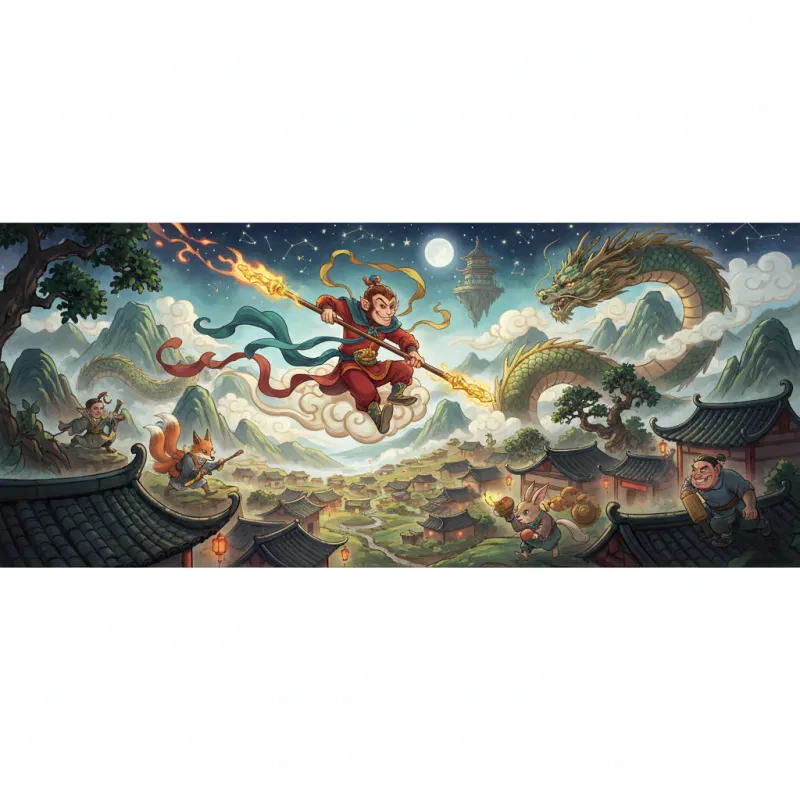
The old storyteller's voice dropped to a whisper as children pressed closer around the teahouse table. "And then," he said, eyes gleaming, "the fox spirit 狐狸精 (húlijīng) transformed herself into the merchant's beautiful daughter, walked right past the Daoist priest, and stole the jade seal from under his very nose!" The children gasped. One boy, no older than seven, tugged his grandfather's sleeve: "But Yéye, how did she trick a priest who could see demons?" The old man smiled. "Ah, that's the beauty of it—she didn't use magic. She used his own greed against him."
This scene, repeated in countless variations across China for millennia, captures the essence of Chinese trickster tales: stories where cunning trumps power, where the clever outsmart the mighty, and where moral lessons hide beneath layers of entertainment. Unlike Western trickster figures who often embody chaos for its own sake, Chinese tricksters operate within a complex moral framework shaped by Confucian ethics, Daoist philosophy, and Buddhist teachings.
The Fox Spirit: China's Most Enduring Trickster
No figure dominates Chinese trickster lore like the fox spirit. The 狐狸精 (húlijīng) or 狐仙 (húxiān) appears in texts dating back to the Warring States period (475-221 BCE), with the Shanhaijing 山海经 (Classic of Mountains and Seas) describing nine-tailed foxes as auspicious creatures. By the Tang Dynasty (618-907 CE), fox spirits had evolved into complex characters capable of both benevolence and malice.
The most famous fox tale comes from Pu Songling's 蒲松龄 (1640-1715) masterwork Liaozhai Zhiyi 聊斋志异 (Strange Tales from a Chinese Studio). In "Nie Xiaoqian" 聂小倩, a fox spirit initially lures men to their deaths but falls genuinely in love with the scholar Ning Caichen 宁采臣. The story subverts expectations—the "monster" becomes sympathetic while human society appears cruel and rigid. Pu Songling wrote 491 tales, with fox spirits appearing in over 80 of them, each exploring different facets of transformation, desire, and social critique.
What makes fox spirits quintessential tricksters isn't just their shapeshifting ability but their liminal status. They exist between human and animal, between civilization and wilderness, between yin and yang. A fox spirit might spend decades cultivating human form through meditation and absorbing moonlight—a process called 修炼 (xiūliàn). This cultivation narrative reflects Daoist concepts of self-transformation and the fluidity of identity.
Sun Wukong: The Monkey King's Revolutionary Tricks
If fox spirits represent subtle manipulation, Sun Wukong 孙悟空 embodies brazen rebellion. Created by Wu Cheng'en 吴承恩 in the 16th-century novel Journey to the West 西游记, the Monkey King remains China's most beloved trickster precisely because he challenges cosmic authority itself.
Born from a stone egg on Flower Fruit Mountain 花果山, Sun Wukong learns 72 transformations, masters cloud-somersaulting that covers 108,000 li in a single leap, and acquires the Ruyi Jingu Bang 如意金箍棒—a magical staff weighing 17,550 pounds that he can shrink to needle-size and hide behind his ear. But his greatest trick isn't magical; it's psychological. When the Jade Emperor 玉皇大帝 tries to control him by giving him the meaningless title "Keeper of the Heavenly Horses" 弼马温, Sun Wukong sees through the manipulation immediately and rebels.
His most famous trick occurs when he crashes the Peach Banquet of Immortality 蟠桃会. He eats the peaches of immortality, drinks the imperial wine, steals Laozi's 老子 pills of longevity, and defeats 100,000 celestial warriors. The Jade Emperor must call upon Buddha himself to stop him. Buddha traps Sun Wukong under Five Elements Mountain 五行山 for 500 years—but even this punishment becomes part of his transformation from chaotic trickster to enlightened protector.
What distinguishes Sun Wukong from Western tricksters like Loki or Anansi is his trajectory toward redemption. His tricks during the journey to India serve protective purposes, defending the monk Xuanzang 玄奘 from demons. The trickster energy doesn't disappear; it becomes channeled toward Buddhist enlightenment. This reflects the Chinese philosophical preference for transformation over punishment, for integration over exclusion.
Ji Gong: The Mad Monk Who Tricks for Justice
While Sun Wukong operates in mythological realms, Ji Gong 济公 (1130-1209 CE) was a real Chan Buddhist monk whose historical existence became embroidered with trickster tales. Known as the "Mad Monk of Lingyin Temple" 灵隐寺, Ji Gong violated every monastic rule—he ate meat, drank wine, consorted with prostitutes, and dressed in rags—yet possessed supernatural powers and profound wisdom.
The Jigong Quanzhuan 济公全传 (Complete Biography of Ji Gong), compiled during the Qing Dynasty, contains 240 chapters of his exploits. In one famous tale, corrupt officials hoard grain during a famine while people starve. Ji Gong gets drunk, staggers into the granary, and "accidentally" knocks over storage jars, spilling rice into the streets where the poor can gather it. When officials try to arrest him, he performs miracles that expose their corruption to higher authorities.
Ji Gong's tricks always serve the powerless against the powerful. He uses his apparent madness as camouflage, allowing him to speak truths that would get others executed. When a wealthy merchant refuses to pay workers, Ji Gong tricks him into a public confession by pretending to be a fortune teller who "sees" the merchant's past crimes. The merchant, terrified of supernatural exposure, pays the workers and reforms his behavior.
This trickster embodies the Buddhist concept of 方便 (fāngbiàn)—skillful means. Sometimes conventional morality must be violated to achieve greater compassion. Ji Gong's meat-eating and wine-drinking shock people into questioning their attachment to rules over substance. His tricks reveal that true Buddhism lies in helping others, not in following regulations.
The Cultural Function of Trickster Tales
Chinese trickster tales serve multiple social functions that explain their enduring popularity. First, they provide psychological relief from rigid hierarchical structures. In a society governed by Confucian principles emphasizing filial piety 孝 (xiào), respect for authority, and proper ritual behavior 礼 (lǐ), trickster tales offer vicarious rebellion. Peasants who couldn't challenge landlords in reality could enjoy stories of clever farmers outwitting corrupt officials.
The tale of "The Clever Daughter-in-Law" 聪明的媳妇, found in numerous regional variations, illustrates this function. A young bride uses wordplay and riddles to expose her tyrannical mother-in-law's hypocrisy without directly disobeying her. When the mother-in-law demands the impossible—"Bring me fire wrapped in paper that doesn't burn"—the daughter-in-law brings a lantern. The tale validates intelligence over authority while maintaining surface-level propriety.
Second, trickster tales encode survival strategies for the powerless. During the Ming Dynasty (1368-1644), the Sanyan Erpai 三言二拍 collections by Feng Menglong 冯梦龙 and Ling Mengchu 凌濛初 contained numerous stories of merchants, servants, and women using wit to navigate dangerous social situations. These weren't just entertainment; they were instruction manuals for negotiating power imbalances.
Third, these tales explore philosophical questions about reality and illusion. The Buddhist concept of 幻 (huàn)—illusion—permeates Chinese trickster stories. If reality itself is illusory, then the trickster who creates illusions simply makes the truth more obvious. The fox spirit who appears as a beautiful woman reveals that human perception is always already deceived by desire and attachment.
Regional Variations and Ethnic Diversity
China's vast geography and ethnic diversity produced distinct trickster traditions. In Yunnan Province, the Yi people 彝族 tell tales of Zhyge Alu 支格阿鲁, a culture hero who tricks the thunder god into teaching humans agriculture. Among the Miao people 苗族, the trickster figure Butterfly Mother 蝴蝶妈妈 uses transformation and cunning to create the world and protect her children from hostile spirits.
The Hakka people 客家人 of southern China developed a rich tradition of trickster tales featuring clever women who use linguistic ambiguity to their advantage. Since Hakka women historically had more economic independence than women in other Chinese communities, their folklore reflects this reality. One popular tale involves a woman who tricks a corrupt magistrate by exploiting the tonal nature of Chinese—using words that sound identical but have different meanings depending on tone.
In northeastern China, trickster tales often feature animals adapted to harsh climates. The clever rabbit who tricks the tiger, the fox who outwits the wolf—these stories reflect the survival strategies necessary in regions where winters could kill the unprepared. The trickster becomes a model for adaptability and quick thinking in hostile environments.
Modern Transformations and Continuing Relevance
Chinese trickster tales haven't remained frozen in the past. During the Cultural Revolution (1966-1976), traditional folklore was suppressed as "feudal superstition," but trickster tales survived in underground oral traditions and re-emerged in the 1980s with renewed vigor. Contemporary Chinese writers like Mo Yan 莫言 (Nobel Prize, 2012) incorporate trickster elements into their novels, using magical realism to critique social problems while maintaining plausible deniability.
The internet age has spawned new trickster figures. The term 网络恶搞 (wǎngluò ègǎo)—internet spoofing or pranking—describes a digital trickster culture where clever netizens use memes, wordplay, and satire to circumvent censorship and comment on social issues. The Grass Mud Horse 草泥马 (cǎo ní mǎ), a fictional alpaca-like creature whose name sounds like a vulgar phrase, became a symbol of resistance against internet censorship in 2009. This modern trickster uses the same linguistic ambiguity that traditional tricksters employed for centuries.
Chinese video games and animation have globalized trickster tales. The game Black Myth: Wukong (2024) introduced Sun Wukong to millions of international players, while animated series like The Legend of Hei 罗小黑战记 (2019) reimagine fox spirits for contemporary audiences. These adaptations maintain core trickster elements—transformation, cunning, moral ambiguity—while updating contexts and visual styles.
The enduring appeal of Chinese trickster tales lies in their sophisticated moral complexity. Unlike simple good-versus-evil narratives, these stories acknowledge that survival often requires deception, that authority isn't always legitimate, and that wisdom sometimes wears the mask of foolishness. In a rapidly changing China navigating between tradition and modernity, between collective values and individual desires, the trickster remains relevant precisely because they embody contradiction and transformation—the very essence of the human experience across all cultures and eras.
Related Reading
- Exploring Transformation in Chinese Folklore: Legends, Fairy Tales, and Cultural Traditions
- Chinese Animation: From Ink Wash Classics to Global Hits
- Modern Retellings of Chinese Folklore: Bridging Ancient Legends and Contemporary Culture
Explore Chinese Culture
- Explore feng shui in daily life
- Explore supernatural folklore
- Explore classical Chinese literature