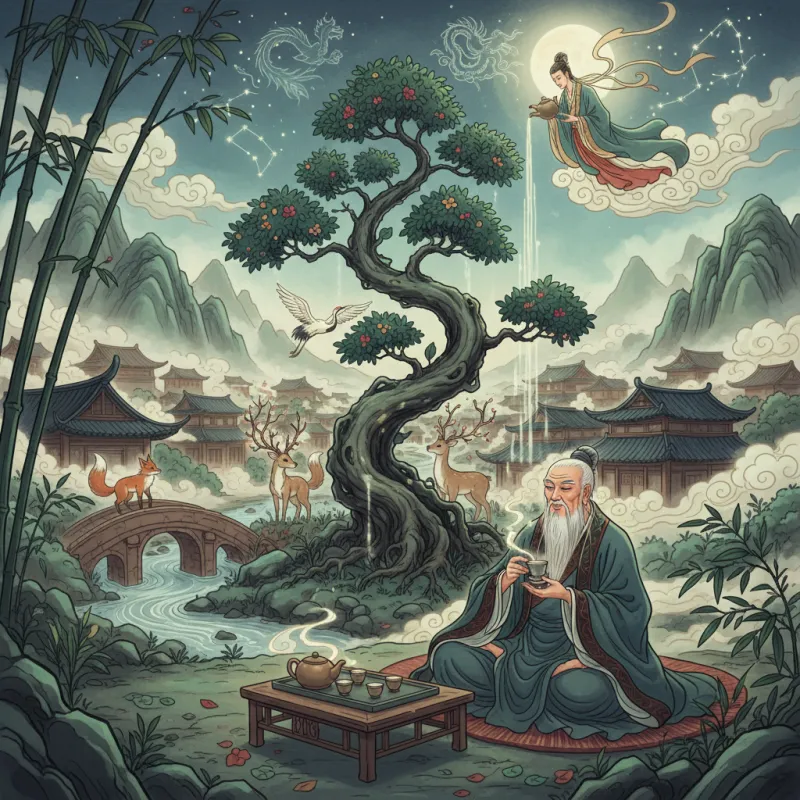
A monk walks into a monastery kitchen at dawn. The master is there, alone, heating water over charcoal. The monk expects a profound teaching, a secret transmission. Instead, the master hands him a cup of tea and says nothing. They drink in silence. Twenty minutes pass. The master stands, rinses his cup, and walks out. The monk sits there, confused, waiting for the lesson to begin. It already has.
This is 茶禅一味 (chá chán yī wèi) — "tea and Zen, one taste" — and if you're waiting for it to get more complicated than that, you've already missed it. The spiritual connection between tea and Zen Buddhism isn't hidden in ancient texts or monastery secrets. It's in the fact that both practices strip away everything except what's happening right now: water boiling, leaves steeping, liquid touching your lips. The rest is commentary.
The Historical Marriage: When Tea Met Meditation
Tea arrived in China long before Buddhism did, but it took Zen monks to turn it into a spiritual practice. By the Tang Dynasty (618–907 CE), Buddhist monasteries had become the primary cultivators and consumers of tea. Not for pleasure — for survival. Monks needed to stay awake during long meditation sessions, and tea was the perfect solution: stimulating enough to fight drowsiness, but without the agitation that comes from cruder stimulants.
The monk Eisai (栄西, Eisai, 1141–1215) wrote in his Kissa Yōjōki (Drinking Tea for Health) that "tea is the ultimate mental and medical remedy and has the ability to make one's life more full and complete." He wasn't being poetic. He was being practical. Zen monasteries ran on tea the way modern offices run on coffee, except the monks figured out how to turn a caffeine habit into enlightenment practice.
The real shift happened with masters like Zhaozhou (赵州, Zhàozhōu, 778–897 CE), who became famous for his response to nearly every question: "Go drink tea" (吃茶去, chī chá qù). A monk asks about the meaning of Bodhidharma coming from the West? "Go drink tea." Another monk asks about the nature of Buddha? "Go drink tea." It sounds like he's dodging the question, but he's actually answering it directly: stop asking abstract questions and pay attention to concrete reality. The tea in front of you is more real than any concept of enlightenment.
The Practice: What Actually Happens When You Drink Tea Like a Zen Monk
Here's what doesn't happen: you don't achieve cosmic consciousness. You don't merge with the universe. You don't transcend the mundane world. You just drink tea, but you actually drink it instead of thinking about drinking it while your mind races through tomorrow's schedule.
The Zen approach to tea is brutally simple. You heat water. You prepare leaves. You pour. You drink. Each action gets your full attention, not because it's sacred, but because it's what you're doing. The sacredness, if there is any, comes from the attention itself, not from the tea.
This is why tea ceremony traditions developed differently in Zen contexts than in other settings. There's no performance, no audience to impress. The elaborate choreography you see in formal Japanese tea ceremony (chadō, 茶道) came later, influenced by Zen but also by court aesthetics and samurai culture. The original Zen tea practice was rougher, simpler: monks in a monastery kitchen, sharing tea before dawn meditation, no ceremony required.
The key principle is 平常心是道 (píng cháng xīn shì dào) — "ordinary mind is the Way." You're not trying to achieve a special state of consciousness. You're trying to be fully present for the ordinary state you're already in. The tea helps because it gives you something concrete to focus on. The warmth of the cup. The color of the liquid. The slight bitterness on your tongue. These aren't metaphors for enlightenment. They're just what tea tastes like when you actually taste it.
The Philosophy: Why Tea Works as Meditation
Zen Buddhism is obsessed with cutting through conceptual thinking to direct experience. Words and ideas are useful, but they're also barriers between you and reality. You can read a thousand books about what water tastes like, but until you drink it, you don't know. Tea practice embodies this principle.
Consider the famous koan: "What is Buddha?" The master Yunmen (云门, Yúnmén, 864–949 CE) answered: "A dried shit-stick." Shocking, right? That's the point. He's trying to break your habit of treating "Buddha" as a sacred concept floating somewhere above ordinary life. Buddha-nature isn't separate from the mundane world. It's in the shit-stick, in the tea leaves, in the dirty bowl you need to wash.
Tea works as meditation because it's simultaneously ordinary and precise. It's not special — people have been drinking tea for thousands of years — but it requires attention. Water temperature matters. Steeping time matters. The quality of leaves matters. You can't fake it. If you're distracted, the tea tastes wrong. If you're present, the tea tastes right. Immediate feedback.
This is different from the scholarly tea culture that developed among Chinese literati, where tea became a vehicle for poetry, philosophy, and social refinement. The Zen approach is less refined, more direct. A Tang Dynasty tea master might spend hours discussing the aesthetic qualities of different water sources. A Zen monk just drinks the tea and gets back to work.
The Paradox: Trying Not to Try
Here's where it gets tricky. You can't force yourself to be present. The harder you try to focus on the tea, the more you're thinking about focusing instead of actually tasting. This is the central paradox of Zen practice: you have to make effort, but the effort is to stop making effort.
The Chinese term is 无为 (wú wéi) — "non-doing" or "effortless action." It's borrowed from Daoism, but Zen monks applied it to everything, including tea. You prepare tea with care and attention, but without strain or self-consciousness. You're not performing "mindful tea drinking." You're just drinking tea, and the mindfulness happens naturally when you stop trying to be mindful.
This is why Zen masters often seem to contradict themselves. Zhaozhou tells one monk to drink tea and another monk to wash his bowl. Yunmen hits students with his staff. Linji (临济, Línjì, died 866 CE) shouts at people. They're not following a script. They're responding to what's actually happening in the moment, which is different every time.
The same applies to tea. There's no "correct" way to drink tea mindfully. Sometimes you prepare it carefully, measuring everything precisely. Sometimes you just throw leaves in hot water and drink it while it's too hot. Both can be Zen practice if you're actually there for it. Neither is Zen practice if you're performing "being Zen" for yourself or others.
The Transmission: How Tea Practice Spread
When Eisai brought tea seeds from China to Japan in the late 12th century, he also brought Zen Buddhism. The two were already inseparable. Japanese Zen monasteries adopted the Chinese practice of serving tea during meditation sessions, but they formalized it in ways that Chinese monks hadn't.
The Japanese tea ceremony (chadō) that developed over the next few centuries is both an expression of Zen principles and a departure from them. Masters like Sen no Rikyū (千利休, 1522–1591) created elaborate rules for tea preparation: exactly how to fold the cloth, precisely where to place the scoop, the correct angle for bowing. This seems to contradict the Zen emphasis on spontaneity and naturalness.
But Rikyū understood the paradox. The rules aren't the point. The rules are training wheels. You practice the forms until they become natural, until you can perform them without thinking, and then you're free to be present within the structure. It's like learning to play music: first you practice scales until your fingers know them automatically, then you can actually make music instead of thinking about which notes to play.
Back in China, tea practice remained less formalized but more integrated into daily monastic life. Monks didn't separate "tea ceremony" from "regular tea drinking." Every cup was an opportunity for practice. The monastery tea master (茶头, chá tóu) was a respected position, responsible not just for preparing tea but for teaching younger monks how to be present during ordinary activities.
The Modern Disconnect: What We Get Wrong
Today, "Zen tea" has become a marketing category. You can buy "Zen tea sets" with little Buddha statues and incense holders. You can attend "mindful tea ceremonies" where someone guides you through "being present with your tea." This isn't necessarily bad, but it's not what the original practice was about.
The problem is that we've turned Zen tea into a special activity, something separate from ordinary life. You set aside time, create a peaceful environment, light candles, play meditation music. Then you drink your "Zen tea" and feel spiritual for twenty minutes before returning to your regular, non-Zen life.
The original practice was the opposite. The point was to bring the same quality of attention to everything: tea, yes, but also washing dishes, sweeping floors, chopping vegetables. Zhaozhou didn't say "go drink tea" because tea was special. He said it because tea was ordinary, and the monk needed to learn that enlightenment isn't separate from ordinary activities.
This is why the famous Zen saying goes: "Before enlightenment, chop wood, carry water. After enlightenment, chop wood, carry water." The activities don't change. Your relationship to them does. You're fully present for the wood-chopping and water-carrying instead of treating them as obstacles between you and some imagined spiritual achievement.
The same applies to tea. If you can only be present while drinking expensive tea from a special cup in a quiet room, you haven't learned the practice. The practice is being present while drinking cheap tea from a chipped mug in a noisy office. That's harder, which is why it's more valuable.
The Taste of Now: What Tea and Zen Actually Share
So what is 茶禅一味 (chá chán yī wèi) really about? It's about the fact that both tea and Zen point you toward direct experience instead of concepts about experience. Tea doesn't taste like the description of tea. Enlightenment doesn't feel like the idea of enlightenment. You have to actually drink the tea. You have to actually be present.
The "one taste" isn't a mystical unity. It's simpler than that. When you're fully present, everything has the same quality: immediate, vivid, complete. The tea doesn't taste like enlightenment. The tea tastes like tea, but you're actually there to taste it instead of thinking about it.
A student once asked the master Dongshan (洞山, Dòngshān, 807–869 CE): "What is Buddha?" Dongshan replied: "Three pounds of flax." Not a metaphor. Not a riddle. Just three pounds of flax, which happened to be what he was weighing at that moment. The answer is always what's actually happening right now.
Pour the water. Steep the leaves. Drink the tea. That's the whole teaching. Everything else is just commentary, and commentary is what you do when you're not actually drinking the tea.
The monk in the monastery kitchen finally understands. The master wasn't withholding the teaching. The tea was the teaching. Not the idea of tea, not the symbolism of tea, not the spiritual significance of tea. Just tea. Just this. Just now.
That's the taste they share.
Related Reading
- Why Chinese Tea Culture Is Not Japanese Tea Ceremony
- The Six Types of Chinese Tea
- Gongfu Tea Ceremony Step by Step
- Chinese Tea Culture: Why Tea Is Not Just a Drink
- The Complete Guide to Chinese Culture: Everything You Need to Know
- Enchanting Chinese Mountain Legends: Myths, Mysteries, and Cultural Heritage
- Confucianism, Daoism, Buddhism: The Three Pillars of Chinese Thought
Explore Chinese Culture
- Explore feng shui in daily life
- Explore supernatural folklore
- Explore classical Chinese literature