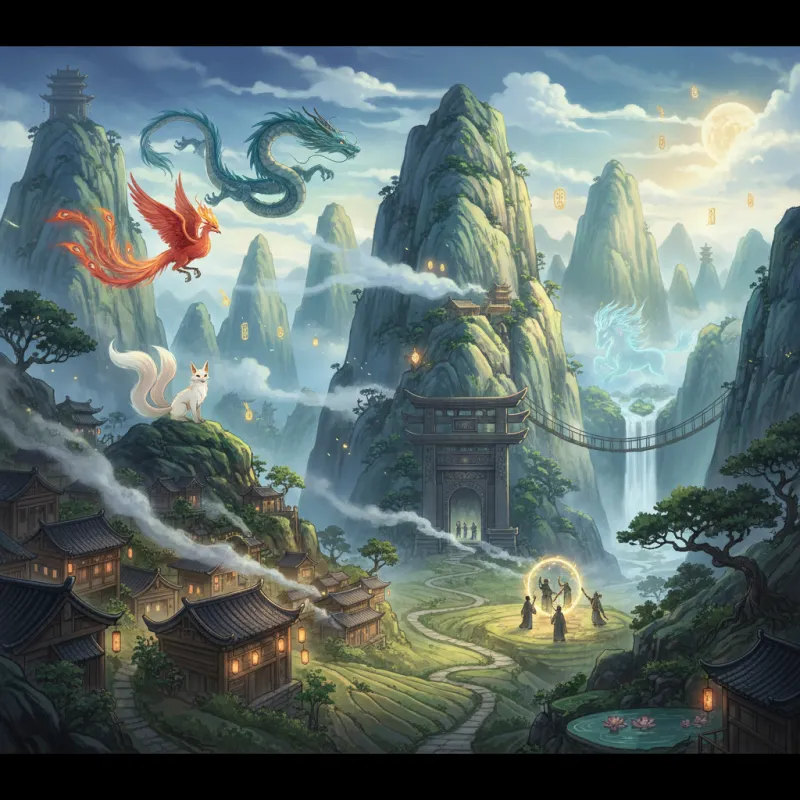
The old Daoist hermit pointed his gnarled staff toward the mist-shrouded peak and whispered a warning that still echoes through Chinese culture today: "Those mountains are not merely stone and soil—they breathe with the spirits of emperors, immortals, and dragons." For over three millennia, China's mountains have served as more than geographical landmarks; they are living mythologies, cosmic pillars connecting heaven and earth, and the stage for some of humanity's most enduring legends.
The Five Sacred Peaks: Where Emperors Met Gods
The Five Great Mountains, or Wǔyuè (五岳), weren't chosen for their height or beauty alone—they were designated as cosmic anchors by emperors who believed these peaks literally held up the sky. Mount Tai (泰山, Tài Shān) in Shandong Province stands as the most revered, where over seventy emperors performed the fengshan (封禅) sacrificial ceremonies to legitimize their rule. According to legend, the Jade Emperor himself maintains his earthly court within Tai's granite halls, dispatching celestial bureaucrats to manage human affairs.
But here's what makes these mountains truly fascinating: each peak has its own personality and guardian deity. Mount Hua (华山, Huà Shān) in Shaanxi, known for its death-defying plank walks, is protected by the goddess Xiwangmu (西王母), the Queen Mother of the West, who supposedly cultivates peaches of immortality in her mountain garden. Mount Heng in Hunan (衡山, Héng Shān—not to be confused with its northern namesake) is guarded by the fire deity Zhurong (祝融), whose temper supposedly causes the region's notorious summer heat.
The southern Mount Heng in Shanxi houses the Hanging Temple (悬空寺, Xuánkōng Sì), a gravity-defying monastery built into a sheer cliff face in 491 CE. Local legend claims the architect was guided by an immortal who revealed the secret of building on air itself—a story that seems almost plausible when you see the structure's impossibly slender wooden pillars.
The Kunlun Mountains: China's Mount Olympus
If the Five Sacred Peaks are China's earthly thrones, then the Kunlun Mountains (昆仑山, Kūnlún Shān) represent the ultimate mythological realm—a place so sacred that it exists partially in the spirit world. Ancient texts like the Shanhaijing (山海经, Classic of Mountains and Seas), compiled around the 4th century BCE, describe Kunlun as a tiered paradise where the Yellow Emperor achieved immortality and where the cosmic pillar Buzhou (不周山) once stood before the water god Gonggong smashed it in a fit of rage, tilting the earth and causing rivers to flow eastward.
The Kunlun legends reveal something profound about Chinese cosmology: mountains aren't passive scenery but active participants in cosmic drama. When Gonggong destroyed Buzhou, the goddess Nüwa (女娲) had to smelt five-colored stones to repair the broken sky—a myth that explains everything from the tilt of the earth's axis to the existence of different colored minerals. This isn't just creative storytelling; it's ancient geology wrapped in narrative form.
What strikes me most about Kunlun mythology is its influence on Chinese literature. Journey to the West's Sun Wukong was born from a stone on the Mountain of Flowers and Fruit, but he sought immortality in the Kunlun tradition. The entire xianxia (仙侠) genre of fantasy literature, which has exploded in popularity through web novels and adaptations, draws directly from these Kunlun cultivation myths where heroes ascend mountains to gain supernatural powers.
Mount Emei: Where Buddhism Climbed to Heaven
Mount Emei (峨眉山, Éméi Shān) in Sichuan Province demonstrates how Buddhist legends layered onto existing mountain mythology after Buddhism arrived in China during the Han Dynasty. This mountain became the earthly dwelling of Puxian (普贤菩萨, Samantabhadra Bodhisattva), who rides a six-tusked white elephant through the clouds. But here's the fascinating part: before Buddhism, Emei was already considered sacred in local Daoist tradition, and the two belief systems didn't clash—they merged.
The most famous Emei legend involves the "Buddha's Halo" (佛光, fóguāng), a natural optical phenomenon where your shadow is cast onto clouds surrounded by rainbow rings. Ancient pilgrims interpreted this as proof of enlightenment, believing that only the pure of heart could witness it. Modern science explains it as a combination of sunlight, mist, and viewing angle, but the spiritual interpretation persists. I'd argue both explanations are valid—one describes the mechanism, the other the meaning.
The mountain's Golden Summit (金顶, Jīndǐng) hosts a 48-meter-tall bronze statue of Puxian erected in 2006, but the real treasure is the Wannian Temple (万年寺), built in the 4th century CE, which houses a 62-ton bronze statue of Puxian cast in 980 CE without a single weld—a metallurgical miracle that locals attribute to divine intervention. For more on how Buddhist traditions shaped Chinese spiritual landscapes, explore Chinese Buddhist Festivals and Their Mountain Pilgrimages.
The Immortals of Huangshan: Granite Poets
Huangshan (黄山, Yellow Mountains) in Anhui Province might be the most painted, photographed, and poetry-inspiring mountain range in Chinese history. Its twisted granite peaks emerging from seas of clouds have been called "the loveliest mountains in China"—and nearly every peak has a legend attached. The "Monkey Watching the Sea" rock formation supposedly depicts Sun Wukong's ancestor gazing eastward. The "Flying-Over Rock" is said to be a celestial stone that fell from heaven and got stuck on the peak.
But the most compelling Huangshan legend involves the Yellow Emperor (黄帝, Huángdì) himself, from whom the mountains take their name. According to tradition, he refined elixirs of immortality in these mountains before ascending to heaven on a dragon's back around 2600 BCE. The Huangshan hot springs are supposedly the remnants of his alchemical experiments—water infused with minerals that grant longevity.
What makes Huangshan legends particularly rich is their connection to Chinese landscape painting. The Shanshui (山水, "mountain-water") painting tradition, which reached its zenith during the Song Dynasty (960-1279 CE), treated these mountains as spiritual subjects, not mere scenery. Painters like Shi Tao (石涛) spent years living on Huangshan, believing that to paint the mountain, you must first understand its qi (气), its vital energy. This isn't mysticism—it's a sophisticated philosophy of observation that predates Western phenomenology by centuries.
Dragon Kings and Mountain Storms
Nearly every significant Chinese mountain has a dragon legend, and for good reason: mountains create weather. The Dragon King (龙王, Lóngwáng) mythology represents ancient Chinese understanding of orographic precipitation—the way mountains force air upward, creating clouds and rain. But the legends are far more colorful than meteorology textbooks.
Mount Tai's Dragon Pool (龙潭) supposedly connects to the Eastern Sea Dragon King's palace through underground channels. During droughts, emperors would send officials to perform rain-summoning rituals at the pool, essentially negotiating with the dragon bureaucracy. The Tang Dynasty poet Li Bai (李白) wrote about climbing Mount Tai and encountering dragon-shaped clouds, interpreting them as auspicious omens.
The most dramatic dragon-mountain legend comes from Mount Qingcheng (青城山, Qīngchéng Shān) in Sichuan, one of Daoism's birthplaces. According to local lore, the mountain itself is a sleeping dragon that will awaken during the apocalypse to restore cosmic balance. The 2008 Wenchuan earthquake, which devastated the region, was interpreted by some as the dragon stirring in its sleep—a reminder that these legends still carry psychological weight in modern China.
Mountains as Cultivation Grounds: The Xianxia Tradition
The concept of mountain cultivation (修仙, xiūxiān) has exploded in contemporary Chinese popular culture, but its roots stretch back to the Warring States period (475-221 BCE). The idea is straightforward yet profound: mountains, being closer to heaven and farther from worldly corruption, are ideal places to cultivate immortality through meditation, alchemy, and martial arts.
Historical figures like Zhang Daoling (张道陵), who founded religious Daoism on Mount Heming (鹤鸣山) in 142 CE, weren't fictional characters—they were real people whose mountain retreats became legendary. The line between history and myth blurs intentionally in Chinese tradition; perhaps Zhang really did live to 123 years old through mountain herbs and meditation, or perhaps his disciples exaggerated to honor his memory. Does it matter? The legend inspired centuries of seekers to climb mountains in search of wisdom.
Modern xianxia novels and dramas like The Untamed and Eternal Love draw directly from this tradition, depicting mountain sects where disciples train for decades to achieve supernatural abilities. While the flying swords and energy blasts are fantasy embellishments, the core concept—that mountains facilitate spiritual transformation—remains deeply rooted in Chinese cultural consciousness. For more on how these ancient practices influence modern traditions, see Daoist Mountain Retreats and Meditation Practices.
The Living Legacy of Mountain Legends
What strikes me most about Chinese mountain legends isn't their antiquity but their vitality. These aren't dusty myths preserved in museums—they're living traditions that shape how millions of Chinese people interact with nature today. Every year, thousands climb Mount Tai to watch the sunrise, not just for the view but to participate in a ritual that connects them to emperors and immortals. The mountains haven't changed, but each generation reinterprets their meaning.
The environmental implications are significant too. Mountains protected by legendary status have often been spared from development. Mount Wudang (武当山), legendary home of Taoist martial arts and the immortal Zhenwu (真武大帝), remains largely pristine because its sacred status discouraged logging and mining. In this sense, legends function as early conservation policy—protecting ecosystems through cultural reverence rather than legal prohibition.
These mountains remind us that landscape and story are inseparable in Chinese culture. To understand China, you must understand its mountains, and to understand its mountains, you must know their legends. The mist-shrouded peaks aren't just geological formations—they're narrative archives, spiritual gateways, and cultural touchstones that continue to inspire wonder, art, and pilgrimage. The old hermit was right: these mountains do breathe, and their breath is the accumulated stories of three thousand years.
Related Reading
- Tai Chi: The Martial Art That Conquered the World's Parks
- Exploring the Rich Tapestry of Chinese Folklore, Legends, and Fairy Tales
- Modern Retellings of Chinese Folklore: Bridging Ancient Legends and Contemporary Culture
Explore Chinese Culture
- Explore feng shui in daily life
- Explore supernatural folklore
- Explore classical Chinese literature